Tyre Recycling Business Profit in 2026: How Much Can You Earn
The tyre recycling business profit opportunity in the USA is bigger than most new entrepreneurs realize. Every year, Americans throw out 290 million tyres, and each one carries real cash value. At reliablestartup.com, we help new business owners spot industries where demand stays strong and supply stays cheap.
Tyre recycling fits that profile in 2026. This guide breaks down real earnings, startup costs, profit margins, payback timelines, and the most profitable model right now. You will get hard numbers, not theory. By the end, you will know exactly what to expect before you invest a single dollar.
What Is the Tyre Recycling Business Profit Potential in 2026?
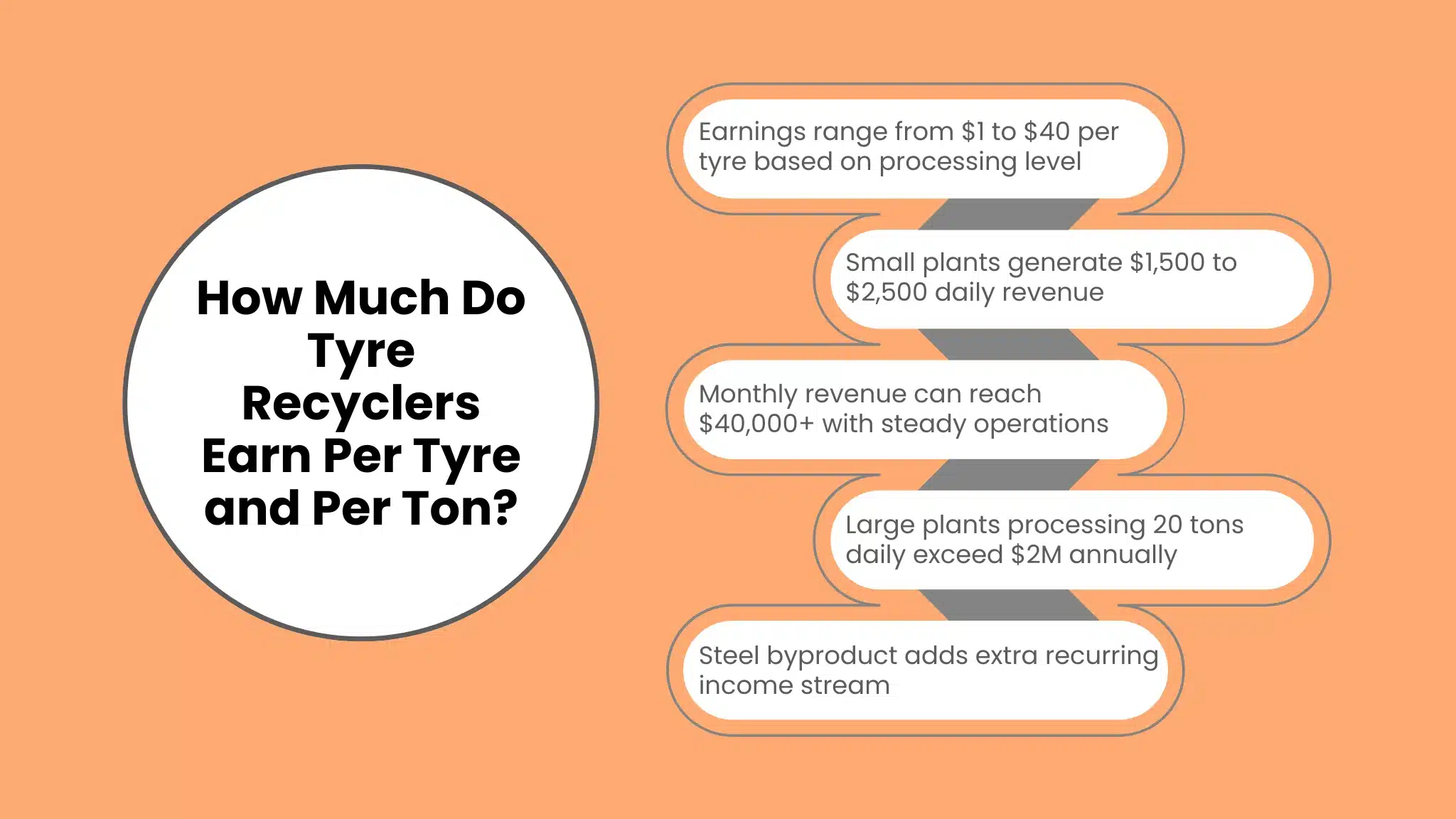
The tyre recycling business profit model is simple. You collect waste tyres, process them into reusable materials, and sell the output to industries that need rubber, fuel, or steel. Most operators earn between $1 and $5 per tyre on basic shredding. Once you move into crumb rubber, rubber powder, or tyre-derived fuel, earnings jump to $10 to $40 per tyre.
On top of that, you can charge tipping fees. Many US states now allow up to $100 per tyre as a disposal fee, which adds a second revenue stream before processing even starts. So a mid-size plant handling 5 tons of tyres a day can pull in $80,000 to $500,000 in annual profit, depending on output type and location. The US tyre recycling market is projected to cross $4 billion in 2026, which means buyers are everywhere.
Quick answer: Tyre recycling businesses in the USA earn $1 to $40 per tyre, with annual profit between $80,000 and $500,000 based on plant size and product type.
How Much Do Tyre Recyclers Earn Per Tyre and Per Ton?
So how much do tyre recyclers earn when you break it down by output? Here is the real 2026 pricing structure across the US market:
| Output Product | Price Per Ton (USD) | Primary Buyers |
|---|---|---|
| Shredded tyre chips | $80 – $120 | Landfill cover, civil engineering |
| Tyre-derived fuel (TDF) | $40 – $80 | Cement plants, paper mills |
| Crumb rubber | $300 – $500 | Asphalt, athletic fields |
| Rubber powder (fine mesh) | $500 – $1,200 | Manufacturing, sports surfaces |
| Pyrolysis oil | $400 – $600 | Industrial fuel buyers |
| Steel wire byproduct | $100 – $200 | Scrap metal recyclers |
Now let’s talk tyre recycling earnings per ton in real terms. A small plant processing 5 tons a day, focused on crumb rubber, can generate $1,500 to $2,500 in daily revenue. That works out to roughly $40,000 a month or close to $500,000 a year before costs. Bigger plants running 20 tons daily push numbers past $2 million annually. Steel wire alone covers a chunk of operating costs every month.
Tyre Recycling Business Profit Per Output Product
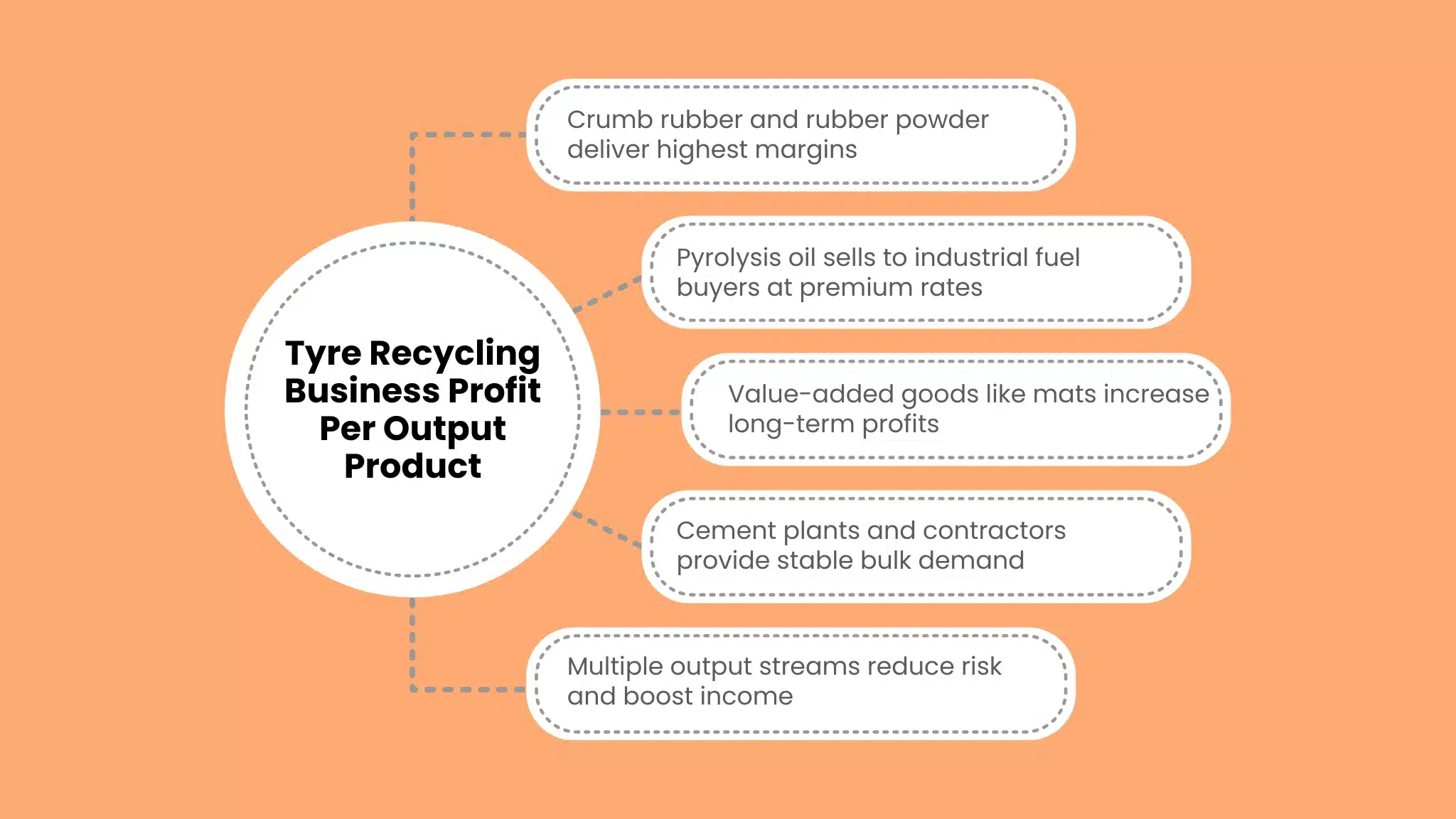
The four most profitable outputs in 2026 are crumb rubber, rubber powder, pyrolysis oil, and value-added rubber goods like mats and tiles. Among these, fine rubber powder gives the highest margin per ton. Top buyer types include:
- Cement plants buying TDF in bulk volume contracts
- Asphalt contractors using crumb rubber for road paving
- Athletic field installers needing crumb and powder grades
- Playground surfacing companies for safety tiles
- Rubber goods manufacturers producing mats and mulch
Cement plants and contractors usually sign volume contracts, which makes them the most stable buyer type for any new operator.
Tyre Recycling Profit Margin 2026: Real Numbers
The tyre recycling profit margin 2026 sits higher than most people expect. Standard shredding operations run 35% to 55% gross margin and 18% to 30% net margin once you factor in equipment, labor, utilities, and permits. Pyrolysis plants reach 40% to 60% net because oil and carbon black sell at premium prices.
Costs that eat into your margin include:
- Electricity bills, which can take 15% of revenue on full-shift runs
- Blade replacement on shredders, adding 5% to 8% over a year
- Transport costs for raw tyre pickup and finished output delivery
- Skilled labor wages, especially equipment operators
- Insurance, bonding, and ongoing permit renewals
Smart operators cut these costs by sourcing local power deals and buying spare parts in bulk.
Quick answer: The average tyre recycling profit margin 2026 ranges between 18% and 30% net, while pyrolysis operations reach 40% to 60%.
Startup Cost Breakdown for a Tyre Recycling Business in the USA
Here is the three-tier cost structure for 2026:
| Plant Size | Daily Capacity | Startup Cost (USD) | Best For |
|---|---|---|---|
| Small | 1 – 3 tons/day | $80,000 – $250,000 | Solo operators, regional pickup |
| Mid-size | 5 – 10 tons/day | $300,000 – $700,000 | Growing operators with contracts |
| Large | 20+ tons/day | $1M – $3M+ | Industrial-scale processing |
| Pyrolysis plant | 8 – 15 tons/day | $400,000 – $1.2M | Oil and carbon black focus |
Your line items include the shredder, granulator, magnetic separator, conveyors, land lease, permits, a collection vehicle, and labor for the first six months. Add insurance and bonding, which usually cost $5,000 to $15,000 a year. Permits vary by state and run between $2,000 and $20,000 depending on local environmental rules.
You can also tap federal grants. The EPA runs sustainability programs, and many states have scrap tyre cleanup funds that pay operators to handle abandoned tyres. California, Texas, Florida, and Ohio all run active programs in 2026. So your real out-of-pocket cost can drop by 10% to 25% if you apply for these incentives early.
Payback Period and Break-Even Timeline
Recovery time depends on plant size and model:
- Small plant: breaks even in 18 to 24 months
- Mid-size plant: takes 24 to 36 months
- Pyrolysis plant: recovers capital in 12 to 18 months
- Value-added line: payback inside 30 months
Your timeline depends on three things: how close your suppliers are, how often your plant runs without downtime, and how well you negotiate buyer contracts.
Which Tyre Recycling Business Model Earns the Most?
Each model serves a different operator. Here is a quick side-by-side view:
| Model | Capex Level | Margin | Payback | Best Year-1 Strategy |
|---|---|---|---|---|
| Shredding only | Low | Thin | 18–24 months | Volume contracts |
| Crumb rubber producer | Mid–High | Strong | 24–36 months | Asphalt buyer deals |
| Pyrolysis operator | High | Highest | 12–18 months | Industrial fuel contracts |
| Value-added manufacturer | Mid | Best long-term | 24–30 months | Retail rubber goods |
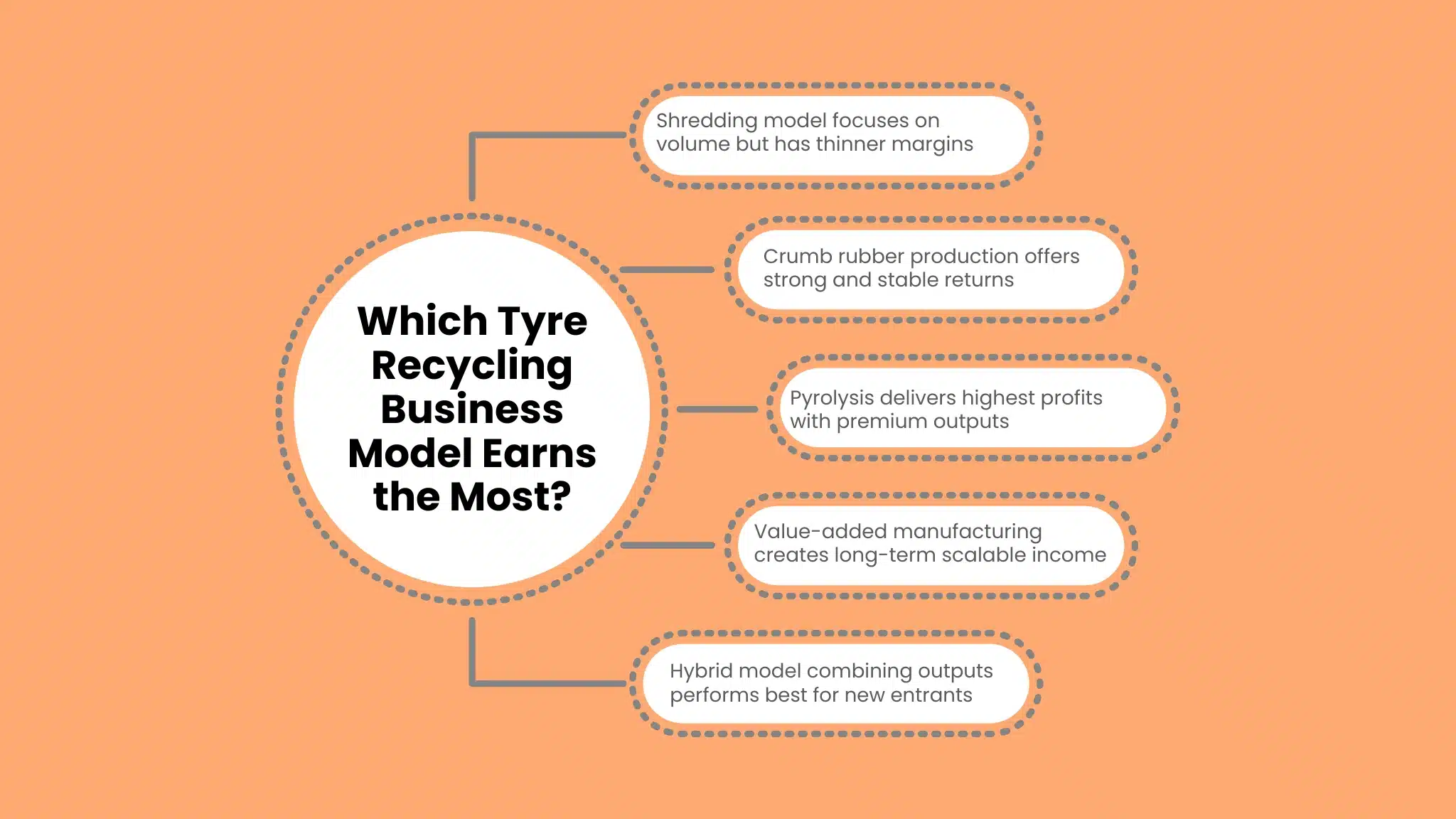
So which one wins in 2026? For most new entrants with mid-range capital, crumb rubber paired with a small value-added line beats every other setup. You control quality, sell at retail margins, and build direct buyer relationships.
Risks and Challenges That Hurt Tyre Recycling Business Profit
Plenty of things can drag your margins down. The biggest profit killers in 2026 are:
- Equipment downtime: every idle hour costs real money in lost output and labor
- Supplier distance: stay within a 150-mile radius for raw tyre pickup
- Regional oversupply: some US markets have crumb rubber price drops
- Permit delays: environmental compliance can take six months in strict states
- Labor shortage: skilled equipment operators are tough to find
Run a regional demand check before you commit to one output, and build training programs from day one to keep your crew sharp.
How to Maximize Your Tyre Recycling Business Profit in the USA
A few moves separate average operators from top earners:
- Lock long-term supply contracts with tyre dealers, fleet operators, and auto service chains
- Diversify your output across at least three product grades
- Stack tipping fees on top of processing revenue wherever your state allows it
- Add a value-added manufacturing line within your first two years
- Run preventive maintenance every week to cut downtime
- Apply for every federal and state sustainability incentive you qualify for
These six steps directly boost your tyre recycling income usa numbers and protect you from market swings.
Conclusion
The tyre recycling business profit picture in 2026 is strong for operators who plan output diversification, lock supplier contracts, and run lean operations. Earnings range from $1 to $40 per tyre, net margins sit between 18% and 30%, and pyrolysis operators push 40% to 60%. Startup costs vary from $80,000 to $3 million, and most plants break even within two to three years.
For more startup guides, profit breakdowns, and US-focused industry insights, visit reliablestartup.com. The market is wide open in 2026, and early movers will lock the best supplier deals and buyer contracts before competition tightens.
FAQs
Is tyre recycling business profit consistent year-round?
Yes, because tyre disposal happens every season. Demand from cement plants, asphalt contractors, and rubber product buyers stays steady, although construction-linked output can dip slightly in winter.
How much do tyre recyclers earn monthly in the USA?
Small operators earn $8,000 to $20,000 monthly. Mid-size plants pull $30,000 to $80,000. Large plants and pyrolysis operations cross $150,000 a month.
What is the tyre recycling profit margin 2026?
Standard plants run 18% to 30% net margin. Pyrolysis plants reach 40% to 60% based on oil and carbon black pricing.
How fast can a tyre recycling business break even?
Small plants break even in 18 to 24 months. Mid-size plants take 24 to 36 months. Pyrolysis plants recover capital in 12 to 18 months.
Which output product gives the highest tyre recycling earnings per ton?
Fine rubber powder leads at $500 to $1,200 per ton, followed by pyrolysis oil at $400 to $600 per ton.