Crumb Rubber Business: How to Make $500K+ Per Year From Old Tyres
The crumb rubber business usa market is sitting on a goldmine most people walk past every day. The EPA reports that Americans throw out 291 million scrap tires each year. That’s your raw material. And the price? In many US states, you actually get paid to take those tires off someone’s hands.
Reliable Startup put this guide together for one reason. Most articles ranking for this topic are either selling you a market report or pitching you on an Indian factory setup. Neither helps if you want to start a real operation in Texas, California, or Tennessee.
Crumb Rubber Business USA in 2026
Starting a crumb rubber business in the USA means turning scrap tires into granulated recycled rubber for sale to asphalt, sports turf, and landscape buyers.
- Startup cost: $150,000 to $1.2 million
- Average profit margin: 8–12% in year one, scaling to 18–28% by year three
- Top buyers: state DOTs, synthetic turf installers, mulch retailers, asphalt contractors
- Best states for permits and demand: California, Arizona, Tennessee, Texas, Florida
What Is the Crumb Rubber Business USA Industry in 2026?
The crumb rubber business usa sector turns end-of-life tires into granulated rubber particles ranging from 0.5mm to 6mm. These granules then get sold to manufacturers and contractors who use them in roads, sports fields, playgrounds, and molded products.
The numbers tell a strong story. The US crumb rubber market hit $5.6 billion in 2024 and is projected to reach $9.2 billion by 2033. That’s a 5.6% CAGR. Three forces are pushing this growth: federal landfill diversion goals, infrastructure spending on rubberized asphalt, and rising demand for recycled materials in construction.
By the numbers:
- 291 million scrap tires generated in the US each year (EPA)
- $5.6 billion US market size, 2024
- 22,000+ lane miles of rubberized asphalt already in service in California alone
- 4.1–5.6% CAGR forecast through 2033
Ambient vs Cryogenic Processing (Pick the Right Method)
You have got two production paths, and your choice shapes everything from equipment cost to buyer fit.
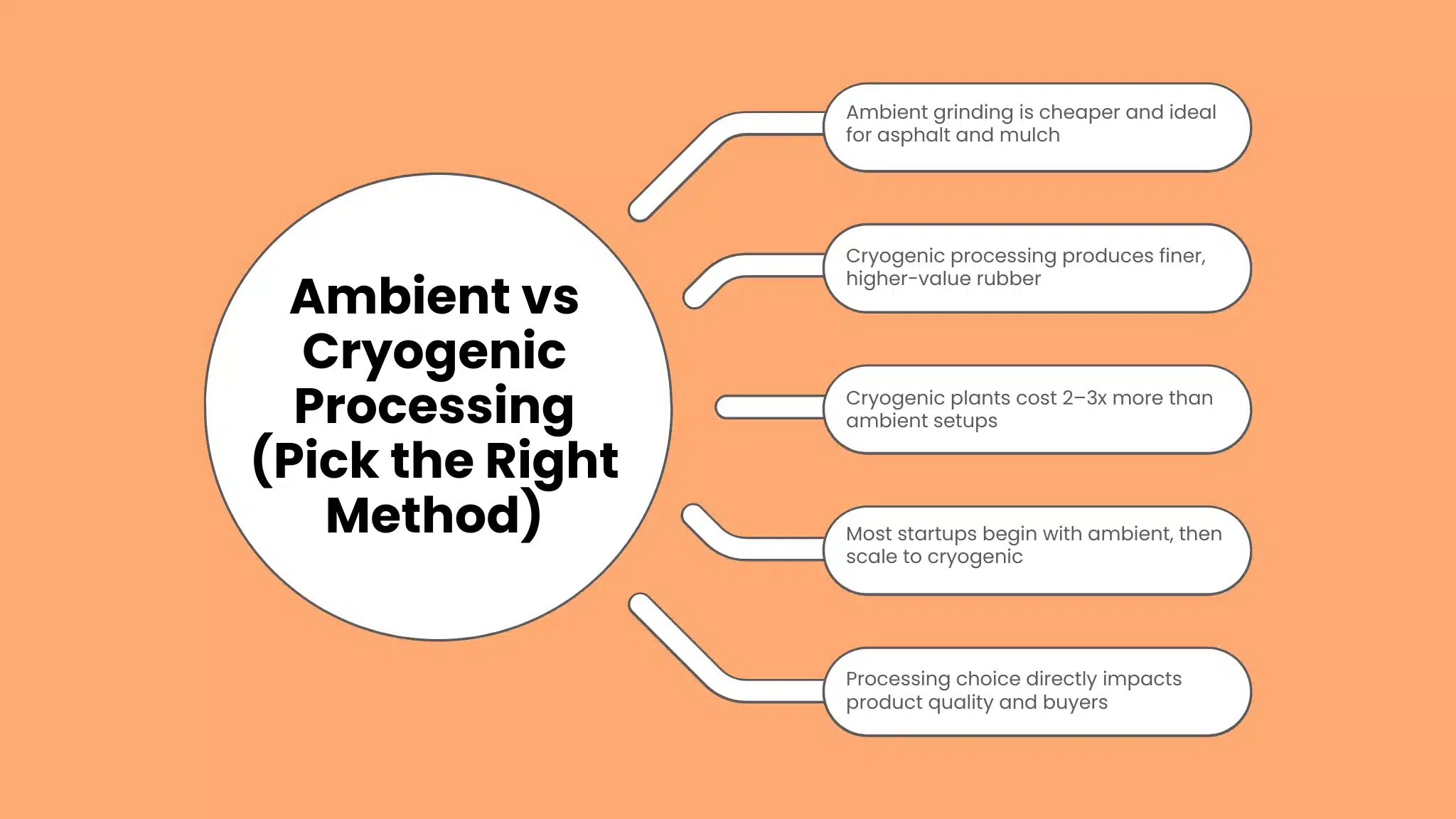
Ambient grinding runs scrap tires through a series of mills at room temperature. The output is coarser, the equipment cost is lower, and the result works great for asphalt and rubber mulch. Cryogenic processing freezes the rubber with liquid nitrogen first, then shatters it into a much finer particle.
The output is cleaner, the mesh size is finer, and it commands a higher price for synthetic turf and molded products. The tradeoff? Cryogenic plants cost roughly 2–3x more to build. Most new US operators start with ambient. Once volume and revenue stabilize, they add cryogenic capacity to capture premium buyers.
Startup Costs for a Crumb Rubber Manufacturing Business in the USA
A small ambient-grinding crumb rubber manufacturing business in the USA can launch for around $150,000. A mid-scale cryogenic operation will push past $1 million. Here’s where the money goes:
- Land and warehouse lease: $3,000–$15,000 per month
- Shredders and granulators: $80,000–$400,000
- Magnetic separators and screens: $25,000–$60,000
- Permits and EPA registration: $5,000–$25,000
- Initial tire feedstock: $0–$15,000 (and yes, many states pay you)
- Insurance and bonds: $10,000–$30,000 per year
- Labor for 4–8 staff: $40,000–$65,000 each per year
If you are working with a tighter budget, leasing equipment instead of buying can cut startup costs almost in half. Just plan to refinance into ownership once cash flow stabilizes.
US Equipment Suppliers Worth Contacting
You do not need to import equipment. The US has solid domestic suppliers who understand local regulations and offer real service contracts.
- Eco Green Equipment, based in Utah, builds modular tire shredding lines.
- Granutech-Saturn Systems out of Texas makes industrial granulators.
- CM Shredders in Florida specializes in primary shredders for whole tires.
- BCA Industries in Wisconsin offers smaller-footprint systems good for first-time operators.
Get quotes from at least three before you commit. Lead times can run 16–24 weeks, so order early.
Permits and Licensing in the USA (State-by-State Overview)
Permits are where most first-timers stumble. Plan on 4–9 months from application to approval. At the federal level, EPA compliance covers air emissions, water discharge, and waste handling. Then your state layers on its own scrap tire program. California requires a CalRecycle Tire Recycling Permit, which assigns you a TPID number.
Tennessee runs the Tire Environmental Act Program, which has handed out grants up to $1 million to operators who match the funds. Arizona, Texas, and Florida each run scrap tire programs that pay tipping fees to permitted facilities. You’ll also need an LLC or corporation, an EIN, OSHA workplace registration, and general liability insurance with environmental riders.
Crumb Rubber Price 2026: What You Can Actually Charge
Real talk on the crumb rubber price 2026: pricing depends on three things. Mesh size, cleanliness, and your buyer relationship. Here’s where the market sits right now.
- 1/4 inch coarse: $0.10–$0.18 per pound
- 10–20 mesh asphalt grade: $0.18–$0.30 per pound
- 30–40 mesh fine: $0.30–$0.55 per pound
- Cryogenic ultra-fine, 80+ mesh: $0.55–$1.20 per pound
- Colored rubber mulch: $0.40–$0.90 per pound
Cleaner product moves the price up. If your output is 99.9% steel-free with consistent mesh, you can push to the top of each range. Certifications like ASTM compliance for sports infill add another 10–15%.
Regional pricing matters too. The West Coast pays more because of CalTrans demand and tighter supply. The Southeast pays less because more recyclers compete in that zone. Plan your facility location with this in mind.
Crumb Rubber Profit Margin: Real Numbers from US Operators
Here’s the crumb rubber profit margin truth. In year one, expect a blended gross margin of 8–12%. By year three, when your product mix and buyer relationships are dialed in, you can hit 18–28%. Some operators clear 30%+ on premium product lines.
Margins vary a lot by what you sell:
- Bulk crumb rubber to asphalt contractors: 10–15%
- Synthetic turf infill: 18–25%
- Rubber mulch sold direct to consumers: 30–45%
- Tire-derived fuel: 5–10%
- Molded product blanks: 20–30%
Break-even usually lands somewhere between 12 and 24 months for a small-to-mid scale plant.
Now here’s the lever most articles skip. Tipping fees. Several US states pay licensed recyclers between $0.50 and $2.50 per tire to take feedstock. Multiply that across a few thousand tires a week and your “raw material cost” turns into a revenue line before you even start grinding.
Why Crumb Rubber Profit Margin Beats Other Recycling Niches
Compare it to metal scrap or e-waste and the picture gets clearer. Metal recycling runs on razor-thin 3–6% margins and rides commodity price swings. Plastic recycling is brutal because of contamination and oversupply.
Crumb rubber sits in a sweeter spot. You get multiple revenue streams from one feedstock: rubber, steel scrap recovered during processing, and fiber that some buyers purchase for fuel.
How to Sell Crumb Rubber: The 6 Buyer Channels
Knowing how to sell crumb rubber is half the battle. The other half is picking the right channel for your scale and product mix. Here are the six that move volume in the US.
1. Asphalt Contractors and DOT Suppliers
State DOTs like CalTrans, ADOT, and TxDOT run multi-million-dollar rubberized asphalt programs. To sell into them, you need authorized supplier status. CRM Rubber holds CalTrans approval, and that single credential puts them on every Caltrans bid sheet. Plan for 6–12 months to earn that status, but a single approved contract can move 200–2,000 tons.
2. Synthetic Turf and Sports Field Installers
Companies like FieldTurf, Shaw Sports Turf, and AstroTurf buy 50–400 tons per field. Specs are tight: 10–30 mesh, low dust, completely steel-free. Land one repeat customer here and you’ve got steady volume.
3. Playground Surfacing Manufacturers
Poured-in-place playground installers and rubber tile makers buy mid-volume crumb. Many also blend EPDM colors, which opens a higher-margin product line if you can source colored crumb.
4. Landscape and Garden Centers (Rubber Mulch)
This is the highest-margin channel. Home Depot and Lowes have regional buyer programs. Or you can skip retail and sell direct on Amazon and Walmart Marketplace. Bagged rubber mulch can clear $0.70+ per pound at retail.
5. Molded Product Manufacturers
Floor mats, parking blocks, speed bumps, and livestock mats all use crumb rubber blanks. The orders are smaller, but they repeat reliably and the margins hold up.
6. Tire-Derived Fuel (TDF) Buyers
Cement plants, paper mills, and power generation facilities burn TDF for energy. Margins are thin, but TDF moves volume fast and clears inventory when you have excess feedstock. It’s a useful pressure valve, not a primary income line.
How to Sell Crumb Rubber Online and Build Repeat Buyers
Most B2B buyers do not find you through Google. They find you through three channels.
- First, list on industry marketplaces like Recycle.net and RubberJobs.
- Second, do cold outreach directly to procurement teams at the companies above. LinkedIn works well for synthetic turf and molded product buyers.
- Third, show up at trade shows. The Synthetic Turf Council Expo and Tire Recycling Foundation events are where actual deals close.
The closer that works best for new operators? A free sample pack. Send a 5-pound bag of your best mesh to a target buyer with the spec sheet attached. About one in five samples turns into a first order.
Top 8 US Crumb Rubber Manufacturers
You’re not entering an empty market, so it helps to know who you are up against.
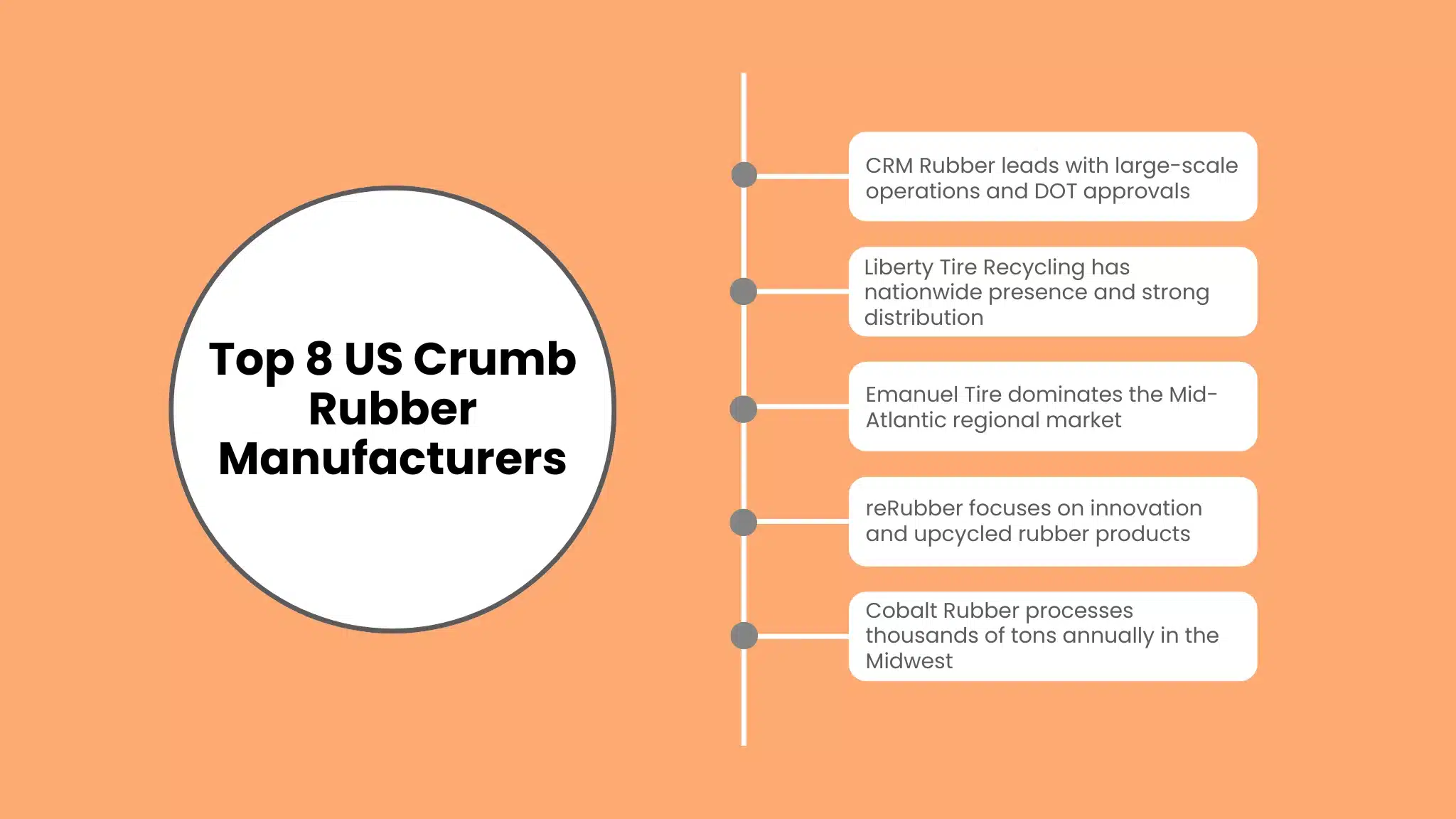
- CRM Rubber, Mesa AZ: largest in North America, holds CalTrans authorized supplier status
- Liberty Tire Recycling, Pittsburgh PA: national footprint, strong in TDF and infill
- Emanuel Tire, Baltimore MD: family-run, dominant in the Mid-Atlantic
- reRubber, Colton CA: innovation-focused, owns the upcycled coatings niche
- Lakin Tire, Connecticut: Northeast region leader
- Entech Inc.: diversified across multiple recycled product lines
- All American Tire Recycling: strong in TDF and tire-derived steel
- Cobalt Rubber, Sturgis MI: processes about 10,000 tons of scrap tires yearly
How does a new operator compete with these names? Stay regional. Pick one or two niches. Move faster than the giants on quality complaints and delivery timing. Build direct buyer relationships the big players don’t have time to maintain.
Common Mistakes That Sink a New Crumb Rubber Business USA
A lot of first-time operators in the crumb rubber manufacturing business lose money in predictable ways. Avoid these.
- Underestimating cleanliness specs is the killer. Steel or fiber contamination above 0.1% will get you rejected by every serious buyer.
- Buying oversized equipment too early eats your runway. Start with capacity for 30% above your first year forecast, not 200%.
- Ignoring tipping fee revenue is leaving money on the table. Get permitted to collect them.
- Skipping authorized supplier status with your state DOT closes a huge buyer channel.
- Selling only one product type leaves you exposed to demand swings. Diversify into at least three product lines by month 18.
Launching without a single offtake agreement is the worst mistake. Lock in at least one anchor buyer before you cut the ribbon.
Is the Crumb Rubber Business USA Worth Starting in 2026?
Honest answer: yes, but only if you fit the profile. The crumb rubber business usa rewards operators who can handle permits, deal with industrial equipment, and stay patient through an 18–24 month ramp. If you have $200,000+ in working capital and a tolerance for slow scaling, the runway is wide open.
If you’re looking for passive income or a quick exit, this isn’t the play. Something to keep in mind.
Recap of the opportunity in 2026:
- US scrap tire generation isn’t slowing
- Federal infrastructure dollars keep flowing into rubberized asphalt
- EPA pressure on landfills keeps tipping fees attractive
- Multiple revenue streams reduce single-buyer risk
Conclusion
The crumb rubber business in the USA is one of those rare opportunities where the raw material problem is enormous, the buyer demand is growing, and the regulatory environment is actually pushing customers toward you instead of away. That said, this isn’t a passive play. You’ll need real capital, real permits, and real patience to build the buyer relationships that make this profitable.
If you’re ready to dig into the numbers for your specific state, equipment match, and buyer targets, Reliable Startup can walk you through the next steps.
Frequently Asked Questions
Is the crumb rubber business profitable in the USA?
Yes. New operators typically run 8–12% gross margins in year one, then scale to 18–28% by year three. Premium product lines like rubber mulch and cryogenic infill can clear 30%+. Break-even usually arrives at 12–24 months for a small-to-mid scale operation.
How much does it cost to start a crumb rubber manufacturing business in the USA?
A small ambient-grinding plant launches for around $150,000. A mid-scale cryogenic operation runs $500,000 to $1.2 million. Costs cover equipment, permits, lease, insurance, and initial labor. Leasing equipment can cut startup capital by 40–50%.
What is the crumb rubber price 2026 per pound in the USA?
Crumb rubber prices in 2026 range from $0.10 per pound for coarse 1/4 inch material to $1.20 per pound for cryogenic ultra-fine mesh. Asphalt-grade 10–20 mesh sits around $0.18–$0.30. Rubber mulch retails at $0.40–$0.90 per pound.
Who buys crumb rubber in the USA?
The six main US buyer groups are state DOTs and asphalt contractors, synthetic turf installers, playground surfacing makers, landscape and garden centers for rubber mulch, molded product manufacturers, and tire-derived fuel buyers like cement plants.
How do I sell crumb rubber to the government or DOT?
You need authorized supplier status with your state DOT. CalTrans, ADOT, and TxDOT each have approval programs that take 6–12 months. Once approved, you can bid on rubberized asphalt contracts through state procurement portals. Register early because the testing and certification process is slow.