Best Exercises for Strength at Home: 10 Moves to Try

You can build a useful home strength routine with a small, clear set of movements and no gym membership. A home routine can start with body-weight exercises, so you can begin without buying equipment or setting aside much time.
This list gives you 10 practical moves and ways to make them easier or harder. You can choose a few for your first workout, then build a routine that fits your week. Start with a version of each movement that lets you stay in control from the first rep to the last.
Key Takeaways
- Body-weight exercises can provide resistance for strength training.
- Choose a version that lets you move with steady control.
- Start with two strength-training days each week.
- Record your reps and movement variations as you train.
- Make one change at a time as your strength improves.
Can You Build Strength at Home With Body-Weight Training?
Yes, you can build strength at home when your muscles face a progressively challenging resistance. Progressive overload means gradually increasing the challenge of an exercise over time by adding repetitions, sets, resistance or a harder variation.
Resistance training makes your muscles work against resistance. Squats and push-ups are strength training exercises because your body must work against gravity. Bodyweight training can challenge your muscles without a machine or a weight in your hands.

What resistance training does
Resistance training can help improve muscle function, muscle size and physical performance. The 2026 ACSM Position Stand includes body-weight exercises, resistance bands and home routines as forms of resistance training.
Its guidance drew on 137 systematic reviews covering more than 30,000 participants. The studies involved healthy adults aged 18 and older, with training programs lasting 6-52 weeks.
A body-weight movement still counts as resistance training when it asks the muscles to work harder than usual.
What a home routine can achieve
Strength training at home without equipment can work when your chosen body-weight exercise challenges you. The amount of challenge depends on the movement, your current strength and the variation you use.
An eight-week press-up study of 18 men found comparable muscle and strength gains with a load similar to 40% of bench-press 1RM. One-repetition maximum, or 1RM, means the heaviest load you can lift once. That result does not promise the same gains for everyone.
Home workouts can improve strength, muscle growth and physical function. Progress comes from giving your body a suitable challenge, not from the room where you train.
What Equipment Helps at Home?
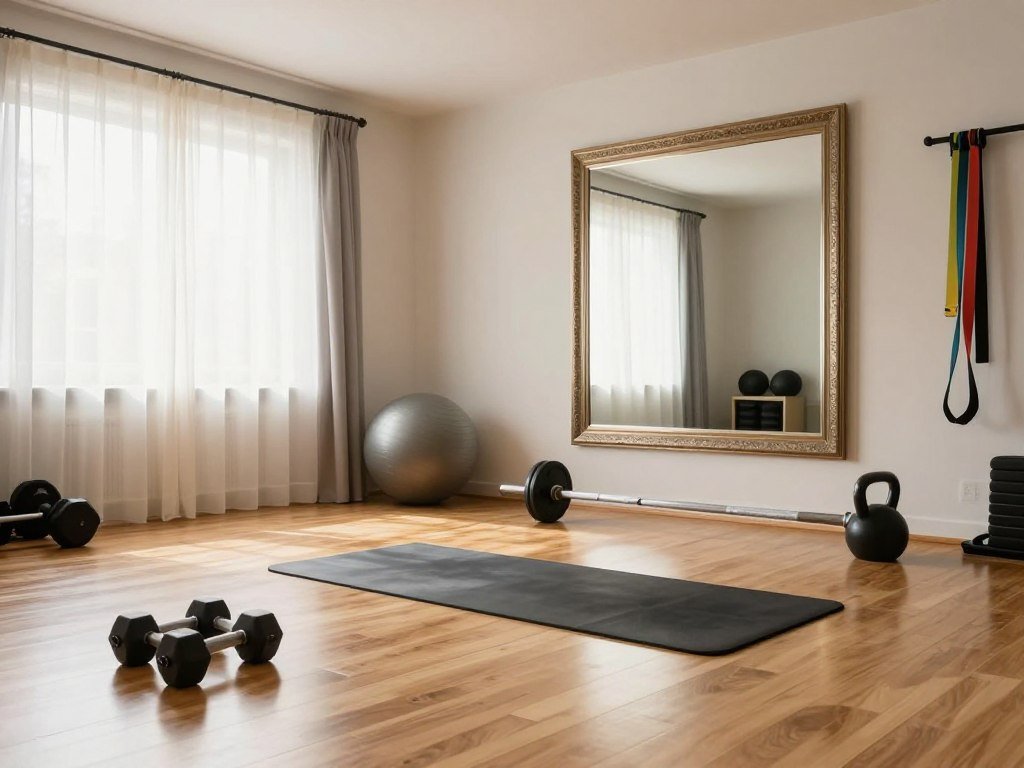
A clear space to move is the only essential starting point for a body-weight routine. Bands and weights are optional ways to add resistance, not requirements for getting started.
A stable floor area gives you room for standing and floor-based movements. A mat can make floor exercises more comfortable, but you can begin without one.
Body weight and household objects
Your body weight supplies resistance in exercises where you move or hold your body against gravity. Household objects, such as water bottles or canned goods, can add load when you can hold them securely.
Pick objects that do not slip from your hands. A pair of similar objects can make it easier to balance the load on each side, though you do not need them for a basic routine.
Bands and free weights
Resistance bands stretch as you pull, creating resistance through the movement. Dumbbells and kettlebells add a steady load, and you can choose different weights for different exercises.
Use the comparison below to decide which equipment makes sense in your space. Each option has a trade-off, so choose what you can use with control.
| Option | Examples | What provides resistance | Useful limit or benefit |
|---|---|---|---|
| Body weight | Squats, push-ups | Gravity and your body | No extra gear needed |
| Household objects | Water bottles, cans | Object weight | Needs a secure grip |
| Resistance bands | Loop or handled bands | Band tension | Easy to store |
| Dumbbells or kettlebells | Hand weights | Added load | Needs storage space |
For many people, one clear patch of floor is enough to start a home workout. Choose equipment you can grip securely and store where you will actually use it.
Best Exercises for Strength at Home Without Equipment
A squat, a push-up variation and a glute bridge are three accessible ways to start a no-equipment routine. The best exercises for strength at home without equipment can cover the main movement patterns, including lower-body, pushing, pulling and core work.
Try 8-15 reps for repetitions-based moves as a reasonable starting range. The same exercise list works for men; you do not need a different selection based on sex.
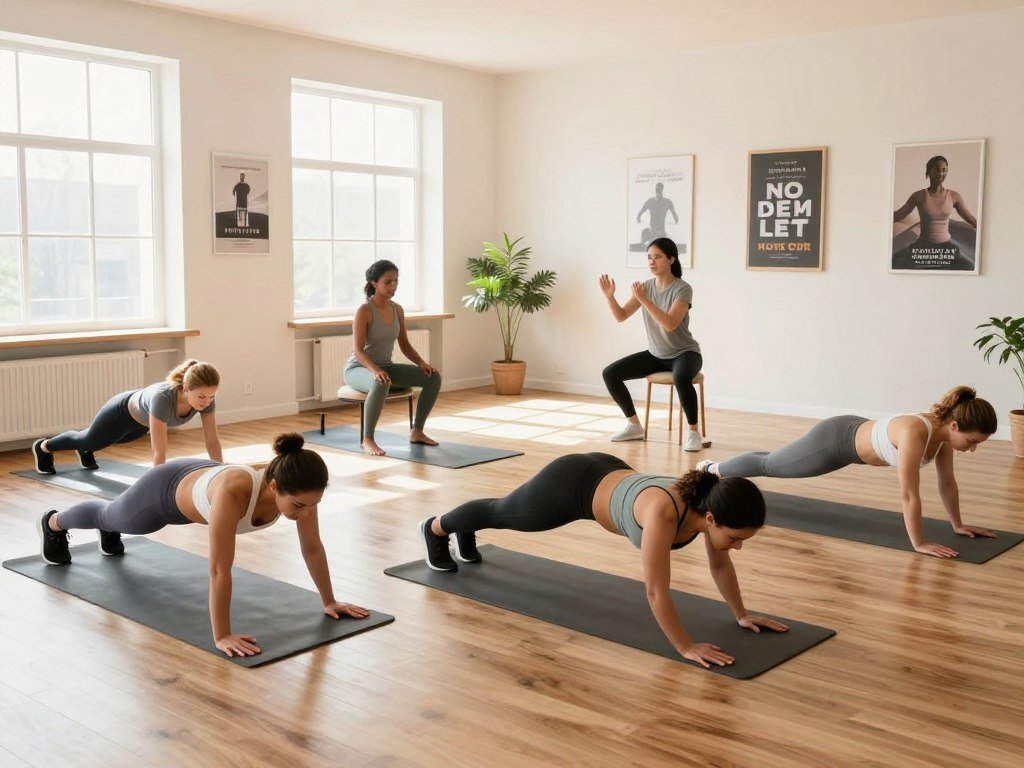
Use a pace you can control, and adjust the range if your balance or mobility calls for it. The list below names the setup, the main action and the area each move works.
- Body-weight squat: Stand with feet about shoulder-width apart. Bend your hips and knees, then stand tall; works thighs and glutes.
- Reverse lunge: Stand upright and step one foot back. Bend both knees as far as you can control, then return to standing; works legs and glutes.
- Glute bridge: Lie on your back with knees bent and feet flat. Lift your hips, then lower them; works glutes and the back of your hips.
- Calf raise: Stand with feet beneath your hips. Lift your heels, then lower them slowly; works the calf muscles.
- Wall or counter push-up: Place hands on a stable wall or counter. Bend your elbows to bring your chest closer, then press back; works chest, shoulders and arms.
- Floor push-up: Set hands on the floor and extend your legs behind you. Lower your chest with control, then push up; works chest, shoulders and arms.
- Prone back raise: Lie face down with arms by your sides. Lift your chest a small amount, then lower it; works muscles along your back.
- Bird-dog: Start on hands and knees. Reach one arm forward and the opposite leg back, then return and switch sides; works your core and back.
- Plank: Support your body on your forearms and toes, keeping a steady line. Hold for a controlled period, then lower; works your core.
- Side-lying leg raise: Lie on one side with legs straight. Lift the top leg, then lower it; works the outer hip.
For moves counted in reps, start within the 8-15 range and use the same controlled motion each time. For a plank, end the hold before your position starts to change.
Stop a set when your form changes enough that you can no longer control the movement.
How Should Beginners Scale Each Move?
If a floor push-up is too difficult to control, place your hands on a wall and move your feet back only as far as feels steady. That position reduces the challenge compared with a floor push-up.
The best exercises for strength at home for beginners are variations you can complete with control. Men can use the same easier and harder options as other beginners.

Make upper-body movements easier
A wall push-up lets you adjust the challenge by changing how far your feet stand from the wall. Move closer if the exercise feels too hard, then step back when you can keep the movement smooth.
Another option is a floor push-up with your knees down. Keep your hands and shoulders in a comfortable position, and stop the set if your body begins to sag or twist.
Adjust lower-body and core movements
A shorter lunge range can make the movement more approachable. Take a small step back and bend only as far as you can manage without losing balance.
A chair or counter can give you support during standing lower-body exercises. Hold it lightly for balance rather than pulling yourself through the movement.
Adjusting a movement does not mean you have failed at it. The basic pattern stays the same, while the amount of challenge changes to suit your current control.
Increase the range of motion only after the easier version feels repeatable and controlled.
How Do You Warm Up Before a Home Workout?
Spend the first few minutes moving easily before you ask your muscles to work harder. A warm-up of 5-10 minutes can help you shift from sitting or daily tasks into training.
Keep the warm-up low intensity and gradual. Choose movements that bring your feet, legs and shoulders into comfortable motion without tiring you out.
Pick a few options that suit your space and feel comfortable:
- March easily in place.
- Take a brisk walk around your home or outside.
- Make gentle circles with your arms.
- Practice easy hip hinges.
- Do controlled squats through a comfortable range.
When you finish the workout, spend 5-10 minutes cooling down. Walk slowly or move gently until your breathing settles, then stretch the major muscle groups without forcing a deep stretch.
Hold comfortable post-workout stretches for 15-30 seconds. A stretch should feel mild, not sharp or painful.
If you feel unwell, pause rather than using the warm-up to push through symptoms. Finish with gentle movement and stretches that feel comfortable, not forced.
How Often Should You Train Each Week?
Two strength-training days each week are a manageable starting point for many adults. The CDC recommends muscle-strengthening activity on two or more days each week.
A practical starting schedule is two or three home workouts per week. That suggestion is a way to arrange training, while the CDC recommendation is a public health minimum.
Start with two weekly sessions
Leave at least one full day of recovery between sessions that work the same muscles. This gives you a simple way to avoid packing demanding workouts together.
| Schedule | Strength-training days | Placement of recovery |
|---|---|---|
| Two full-body days | Monday and Thursday | At least one full day between |
| Three full-body days | Monday, Wednesday, Friday | One full day between sessions |
| Two split sessions | Monday upper body, Thursday lower body | Separate days for each group |
Choose a schedule you can keep
The calendar examples are options, not rules. A Tuesday and Saturday plan can work just as well if those days fit your week.
It can help to set a regular time and treat each workout like a brief appointment. If a work shift or family task interrupts your usual day, move the session rather than trying to squeeze it beside another hard workout.
Use your schedule to protect recovery for the muscles you train. Place the sessions on days you can protect consistently, with a full recovery day between them.
How Many Sets and Reps Should You Do?
Your goal changes the useful target: strength, muscle growth and power do not use identical prescriptions. The right amount also depends on the exercise and the challenge it gives you.
You do not need to test a 1RM to start training at home. ACSM figures describe structured resistance training, while a beginner can use a body-weight variation that allows controlled reps.
Train for strength
The 2026 ACSM Position Stand found greater strength gains with loads of at least 80% of 1RM, two to three sets per exercise and at least two training sessions per week. These targets describe a structured training plan, not a need to test your heaviest single lift.
With body-weight exercise, choose a variation that lets you move with control. The amount of resistance comes from the exercise and the way your body works against it.
Adjust volume for muscle growth or power
For muscle growth, at least 10 sets per muscle group per week enhanced hypertrophy in the Position Stand. That is a weekly total for each muscle group, not a starting requirement for every home trainee.
| Goal | Load or effort | Sets or weekly volume | Execution |
|---|---|---|---|
| Strength | At least 80% of 1RM | 2-3 sets per exercise | Controlled movement |
| Muscle growth | Challenging resistance | At least 10 sets per muscle weekly | Repeatable reps |
| Power | 30%-70% of 1RM | Moderate loads | Fast lifting phase |
Power training used moderate loads of 30%-70% of 1RM and a fast concentric phase, which is the lifting part of a rep. Use that guidance only when you can move safely and control the full exercise.
Start with a repeatable workload, then adjust the target as your training experience grows.
How Can You Progress Without Weights?
You can progress a body-weight move by making it harder even when you never add a dumbbell. Progressive overload can come from more reps, more sets, a harder variation or added resistance.
Change one training variable at a time so you can judge how your body responds. A notebook or phone note can help you compare sessions.
Add repetitions, sets or a harder variation
Use the table to choose one change that fits your current workout. A change should make the movement more challenging without taking away your control.
| Progression method | What changes | Home example | When to use it |
|---|---|---|---|
| Add reps | More repetitions | Do one more squat rep | When current reps feel steady |
| Add sets | More work sets | Add one set to a move | When your current workload is easy |
| Harder leverage or range | Position or movement range | Use a lower push-up surface | When you control the easier version |
| Add external resistance | Load | Hold a secure household object | When body weight is no longer enough |
Use a simple loading sequence
Track the details that show whether your training is changing:
- Record the exercise variation.
- Record the reps you complete.
- Keep the same form standard.
- Change one challenge at a time.
- Reassess after several sessions.
An eight-week study of 43 resistance-trained adults compared adding reps at a constant load with adding load at constant reps. Both methods produced muscular adaptations, with no notable between-group differences in most measured outcomes, including muscle thickness, endurance and countermovement jump performance.
The participants completed four sets of four lower-body exercises twice weekly: back squat, leg extension, straight-leg calf raise and seated calf raise. Those trained adults and loaded exercises differ from a beginner using body weight, so the results do not set a beginner’s exact plan.
A 5-4-3-2-1 sequence means five consecutive sets of 5, 4, 3, 2 and 1 reps, with the load rising as reps fall. It is a loaded progression, not a required no-equipment format.
Change one training variable at a time so you can tell what made the movement more challenging.
How Long Should You Rest Between Sets?
Rest long enough to begin the next set with controlled form rather than rushing because a timer says to move. Easy body-weight sets may need only a brief pause, while harder sets can call for more time.
For demanding sets, about 2-3 minutes is a practical rest range when needed. Use enough recovery to keep your form and performance steady.
A 2024 systematic review with Bayesian meta-analysis found a small hypertrophy benefit from resting more than 60 seconds between sets. It found no appreciable hypertrophy differences when rest exceeded 90 seconds.
Those findings do not mean every home workout needs a stopwatch. If the set felt easy, you may feel ready sooner; if your breathing or control has not settled, take longer.
Rest is part of the workout, not a sign that you lack effort. If your next set loses range or control, take more recovery before repeating it.
Which Exercises Should Come First?
Put the movement you most want to improve near the start of the session, after warming up. Your energy is often higher earlier, which can help you give that exercise focused effort.
Use a complete range of motion that you can control comfortably. Strength gains were enhanced when exercises used a complete range and appeared at the beginning of a training session.
Choose the first movement based on your goal. If building a stronger lower body matters most, start with a lower-body movement before smaller or less important work.
Complete range does not mean forcing a deep squat or reaching farther than your body allows. Adjust your movement for mobility, balance and comfort, then use a steady path through that range.
For upper-body work, consider how your shoulders and arms feel as you set up. A comfortable position can help you keep the movement smooth instead of compensating with your back.
Keep the range complete for your current ability, not deeper than you can control.
Can You Do Strength Training Every Day?
Daily movement can fit a routine, but seven hard sessions for the same muscles are not necessary. Thirty minutes of activity each day can work if you vary intensity or use different muscle groups.
Hard sessions for the same muscles need recovery. An easy walk or gentle mobility work can fill a non-lifting day without repeating a demanding strength workout.
Recovery between challenging sessions
You do not need to take every set to momentary muscle fatigue. That means pushing until you cannot complete another rep, and it is not a required test for a useful home workout.
Training to momentary fatigue, equipment type, exercise complexity, set structure, time under tension and periodization did not consistently affect resistance-training outcomes. You can keep these six programming choices simple.
Easy movement on other days
A short walk can help you stay active without placing the same demand on your muscles as a hard strength session. Mobility work is another option when you want to move but need an easier day.
Pay attention to how your body responds across the week. Normal tiredness can happen after training, but a routine that leaves you too worn out to return may need less effort or more recovery.
Keep at least one easier option in the week so normal fatigue does not become a reason to abandon the routine.
How Should Strength Training Fit With Cardio?
Strength work and aerobic activity serve different parts of an active week, so plan for both. The CDC recommends 150 minutes of moderate-intensity aerobic activity each week or 75 minutes of vigorous activity.
Those aerobic targets are in addition to muscle-strengthening activity on two or more days each week. Brisk walking is moderate intensity, while running is vigorous intensity.
For a simple plan, place cardio and lifting on separate days when your schedule allows. You can also do both on the same day, based on your time and how well you recover.
A brisk walk can fit around a home workout without adding equipment or travel time. Running may call for more recovery, especially if you are new to it or your legs feel tired after strength work.
The Cleveland Clinic’s cardio and strength training explainer also notes that both types of activity can fit into a balanced routine.
Add aerobic minutes in a way that leaves enough energy to keep your strength sessions consistent.
What Form Mistakes Make Home Moves Less Effective?
A slower repetition is often more useful than a rushed one that changes your position. A steady pace gives you more control over where your arms, knees and trunk move.
Try a two-second lifting phase and a two-second lowering phase. That makes one rep about four seconds and gives you time to notice a change in form.
Position and range errors
Watch for these common mistakes during home exercises:
- Letting your knees collapse inward instead of tracking with your feet.
- Losing a steady trunk position as your arms or legs move.
- Cutting off a range of motion you can control comfortably.
- Rushing the lifting or lowering phase.
Each mistake can shift the work away from the muscles you meant to challenge. If you lose your starting position, pause and reset before trying another rep.
Rushing or holding your breath
Move through a range that stays steady, then return to the starting position with control. Let the lowering phase take about two seconds instead of dropping quickly.
Breathe out as you make the effort, such as when standing from a squat or pressing away from a wall. Avoid holding your breath during the hard part of the movement.
A rep should feel smooth from start to finish. If a repetition becomes jerky, pause and reset before continuing.
Which At-Home Exercises Suit Older Adults?
A sturdy chair or counter can make several standing movements feel more secure. Five options to consider are sit-to-stand, heel raises, supported side-leg lifts, wall push-ups and glute bridges.
These are options to consider, not exercises every older adult should do every day. Choose movements that suit your balance, strength and comfort.
Standing moves with support
Sit-to-stand starts from a firm chair, while heel raises and supported side-leg lifts can use a chair or counter for balance. Wall push-ups let you work your upper body while standing.
A stable chair gives you a place to pause between movements. For more ideas about safe movement and daily routines, see these occupational therapy services for older adults.
The NHS also offers gentle strength exercises, including chair-supported moves and wall press-ups. Its guidance includes starting gradually and building repetitions over time.
Floor-level options
A glute bridge requires you to lie back and lift your hips. Use a firm bed as an alternative surface when appropriate, but only if the height and stability make the movement feel manageable.
Getting down and back up can take as much planning as the exercise itself. Keep a clear path and choose a stable surface you can reach safely.
Choose floor-level exercises only when getting down and back up feels safe and manageable.
How Can You Exercise More Safely at Home?
A new routine should challenge your muscles without asking you to train through pain. Muscle effort and fatigue can be expected, but pain is a reason to stop the movement.
Stop an exercise that causes pain rather than trying to push through it. An old injury, excess weight or a heart problem are reasons to discuss a new exercise plan with a clinician.
A health concern or injury may make some movements difficult to do safely. A conversation with a clinician can help you consider what changes may suit your situation.
Muscle fatigue is not the same as pain; stop a movement that causes pain.
When you return to training, pay attention to how the movement feels rather than trying to match someone else’s pace or range. Your starting point can change as your comfort and strength change.
Get individualized guidance before restarting if an injury or health concern affects how you move.
Conclusion
A strong home routine starts with movements you can repeat consistently and improve gradually. Body weight and a few well-chosen movement patterns can provide a clear starting point without a gym or a large equipment budget.
Keep your first plan small enough to fit your week. Once the sessions feel familiar, record your progress and adjust one part at a time.
Choose a few movements, schedule your first two sessions and record the variation and repetitions you plan to practice. Pick your first two training days and write down the version of each move you plan to practice.
FAQ
How do I increase my strength at home?
Train at least two days a week and gradually add reps, sets, resistance or a harder variation. Start with controlled body-weight movements that you can repeat with steady form. Write down the version you use and the reps you complete, then change one challenge at a time. Small, trackable changes make it easier to see what works.
What is 5 4 3 2 1 strength training?
It is a loading scheme with five consecutive sets of 5, 4, 3, 2 and 1 reps, increasing the load as reps decrease. The rising load makes the later sets harder despite having fewer reps. This format uses added resistance, so it is not a requirement for beginners or a standard body-weight routine.
What are 7 types of strength?
One practical framework names maximal, relative, explosive, endurance, speed, isometric and functional strength. Maximal strength means producing high force, while relative strength compares force with body weight. Explosive strength involves force produced quickly, and isometric strength holds a position. The categories overlap, so they are not one official list that every coach uses.
Can I do 30 minutes of strength training everyday?
Thirty minutes of movement every day can fit, but avoid hard sessions for the same muscles daily. Vary the effort or the muscle groups you train, and use easy walking or mobility work on lighter days. Daily activity does not mean every session needs to challenge your muscles intensely. Give worked muscles time to recover before another hard session.
What kills muscle gains the most?
Inconsistent training and inadequate recovery can undermine progress over time. A missed session now and then does not erase your work, but a routine you cannot keep makes steady progress harder. Aim for repeatable workouts, enough sleep and enough food to support your activity. You do not need to fear one supposed fatal mistake or chase perfect training days.
What 5 exercises should I do every day?
You do not need to do the same five demanding strength exercises every day. Rotate movement patterns and leave recovery between hard sessions for the same muscles. On easier days, walking or gentle mobility can keep you active without repeating your full workout. Choose movements that fit your ability, then build a weekly routine you can maintain.
What is the #1 best exercise?
For many beginners, the body-weight squat is a practical first lower-body move. It asks you to bend and straighten your hips and knees without needing equipment. Pair it with a push-up variation for upper-body pushing, and choose a version you can control. No single exercise trains every major movement pattern, so a small mix works better than relying on one move.
What is the best time of day to exercise?
The best time is one you can keep consistently and that fits your schedule and energy. Morning workouts may fit before daily demands, while evening sessions can work well after school or work. Neither time is required for strength gains. Try a few realistic time slots and keep the one that makes your routine easiest to repeat.
About The Author