What Is AGI in AI? A Beginner’s Guide for Everyone

A chatbot can draft an email and still be far from the kind of flexible intelligence people mean when they discuss AGI. That gap matters as more people use AI for writing, images, research, and work.
An image tool may recognize a dog in a photo with impressive accuracy. A text tool may explain a hard idea in clear language. Yet doing one task well does not show that a system can learn and adapt across many kinds of problems.
That difference can be easy to miss when a tool feels capable. A system may draw on vast training data and still lack the range of cognitive abilities associated with the human brain. Understanding the claim helps readers separate a useful tool from a much broader goal.
This guide explains what the term means, how it differs from AI tools today, and what evidence could support a claim. The key is to look beyond a polished answer or a high score on one test. Treat the word “AGI” as a claim about breadth, not as a synonym for advanced AI.
Key Takeaways
- AGI is a debated idea about broad capability across many tasks.
- Today’s AI tools often focus on a limited set of tasks.
- A strong test result does not prove general intelligence.
- Autonomy and general capability describe different things.
- Check the definition and evidence behind each AGI claim.
What Is AGI in AI?
AGI describes a hypothetical system able to use its intelligence across a broad range of tasks, rather than only the task it was built to perform. It is a theoretical goal, not a settled technical label.
Artificial general intelligence, or AGI, would apply knowledge and reasoning to varied problems. It would not depend only on task-specific programming for each new job. Researchers do not agree on exactly which capabilities qualify, as IBM’s overview of AGI explains.
AGI is a claim about flexible ability across different tasks, not a count of features in one product.
A system with many buttons or modes may still work within a narrow range. A general system would need to carry useful knowledge from one kind of problem to another. For example, it might use what it learned from reading instructions to plan a practical task.
OpenAI offers one proposed framing: “highly autonomous systems that outperform humans at most economically valuable work.” That definition puts weight on autonomy and economic value. It is not a universal standard shared by all researchers.
Other definitions focus on human-level ability across intellectual tasks. These different views affect what counts as evidence and where people set the bar. A system may meet one proposed threshold without meeting another.
General intelligence does not mean knowing every fact or having endless features. It means using learning and reasoning in more than one setting, including tasks the system was not built for directly. The range of tasks matters, along with the quality of its work.
AGI could work through learned patterns, stored knowledge, planning, and new learning. A practical test would ask whether it can use those abilities together when the task changes. The practical test of the idea is whether one system can adapt its knowledge to genuinely different tasks.

How Is AGI Different From Today’s AI?
Artificial intelligence is the broad field, while AGI would be a much more specific kind of system with general capabilities across tasks. Most AI in use today is built for particular tasks.
AI means machines performing work linked with intelligent human behavior, such as recognizing speech or sorting images. Narrow AI is AI designed for one task or a limited set of tasks. That includes many tools people use each day.

What AI systems do well today
Current models can generate language, recognize objects, recommend products, or turn speech into text. Some tools combine related functions, such as answering questions and drafting a reply. They can be useful without having general intelligence.
There is no single official list of seven main AI areas. One useful set includes machine learning, natural language processing, computer vision, robotics, knowledge representation, planning, and expert systems.
A general-purpose assistant can still have limits. For a closer look at AI tools for specific work tasks, the main point is to match a tool to the job. Perplexity may help with web research, Cursor with coding, and Gemini Notebook with questions about uploaded documents.
Why broad generalization is a higher bar
A broad list of features does not prove a system can cope with unfamiliar tasks. Its performance must hold up when a problem changes, when instructions are unclear, or when new information appears.
AI models may perform well in one setting and fail in another. A system that writes fluent text may still struggle to plan steps or check whether a claim is true. Capability and reliability both matter.
Artificial intelligence covers many approaches and tools. AGI would require a wider ability to transfer knowledge and solve different kinds of problems. A tool that performs several related functions can still be narrow if it cannot adapt reliably beyond its trained scope.
What Capabilities Would AGI Need?
A system would need more than fluent conversation to qualify as generally capable; it would have to combine several cognitive skills to handle different goals. Transfer to unfamiliar situations matters more than a long feature list.
There is no agreed checklist that every researcher uses. A practical way to think about the capabilities is to ask whether the system can do these five things:

- Reason and make judgments when facts are uncertain.
- Represent useful knowledge, including everyday common sense.
- Plan steps that move toward a goal.
- Learn from new tasks and use that learning later.
- Communicate and combine skills to finish different goals.
Reasoning includes comparing options and noticing when evidence is weak. A system may need to decide whether to ask for more information rather than guess. That kind of judgment is useful in changing situations.
Knowledge representation means storing facts in a form the system can use. Common sense helps connect those facts to everyday life. Knowing that a wet floor may be slippery is different from repeating the phrase “wet floors are slippery.”
Planning turns a goal into a set of steps. A system might need to compare possible routes, check what tools are available, and revise its plan after a setback. Each step depends on what it learns along the way.
Learning from a new task is not the same as memorizing a new answer. The system should be able to apply a useful lesson to a different problem. Natural-language communication can help people give instructions and understand its choices.
These abilities need to work together. A system may reason, plan, and communicate well inside a narrow setting without showing that it can generalize outside it. A restaurant booking assistant, for example, could handle many booking steps but fail at an unrelated task.
That is why the human brain often serves as a comparison, not a strict design plan. People combine memory, judgment, learning, and communication in daily life. A machine might reach broad capability through a different design.
Judge the combination of skills in unfamiliar tasks, not the number of skills advertised.
How Are AGI, Strong AI, and Superintelligence Different?
AGI asks how broadly a system can perform, while strong AI asks whether a system has a mind or consciousness. Those are separate questions about capability and inner experience.
ASI means artificial superintelligence: AI that exceeds human ability across virtually all tasks. The terms can sound alike, but they describe different ideas. AGI concerns broad capability, strong AI concerns consciousness, and ASI concerns ability beyond human levels.
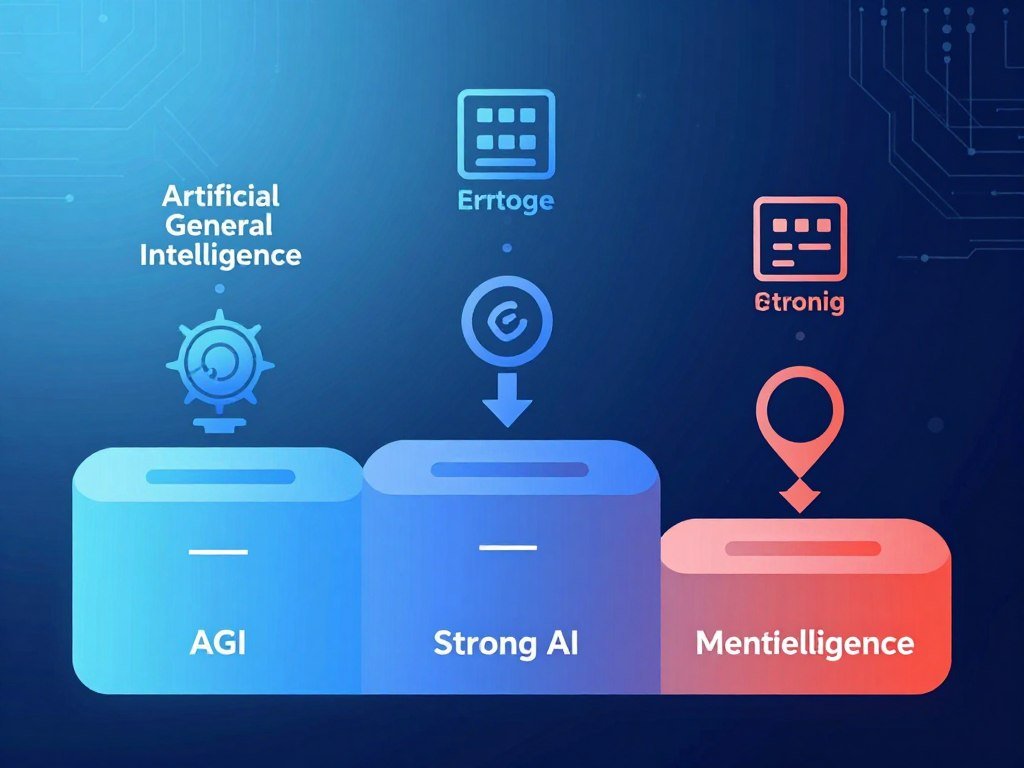
AGI and strong AI describe different questions
AGI describes general capability across intellectual tasks. Strong AI usually refers to a system with consciousness or a true mind. A machine could perform broadly without proving that it has feelings or inner experience.
Consciousness is not part of every AGI definition. A system’s ability to solve varied problems can be assessed separately from whether it experiences anything. Researchers have no simple test that settles the question of machine consciousness.
AGI and ASI set different performance levels
AGI is often linked with human-level general capability. ASI sets a higher bar: performance beyond human ability across almost every kind of task. A system could show general capability without reaching superhuman levels.
These terms describe ideas, not confirmed classes of public systems. Their status and scope differ, as the comparison shows.
| Concept | Main question | Performance scope | Status |
|---|---|---|---|
| AGI | Can it handle varied intellectual tasks? | Broad, often human-level | Theoretical goal |
| Strong AI | Does it have a mind or consciousness? | Inner experience | Debated concept |
| ASI | Does it exceed human ability? | Virtually all tasks | Hypothetical |
Why definitions change what counts as a claim
OpenAI’s Charter defined AGI as “highly autonomous systems that outperform humans at most economically valuable work.” That wording appeared in April 2018 and remained unchanged through at least March 11, 2019.
Another definition may focus on the range of intellectual tasks, the level of performance, or the degree of autonomy. A claim can sound stronger or weaker depending on which threshold it uses. This is why the same system may be called AGI under one framing and not another.
Check which definition a speaker is using before comparing an AGI claim with another one.
Do Large Language Models Count as AGI?
A model can perform impressively across several tests without demonstrating the flexible learning and reliable transfer associated with AGI. Benchmark gains do not establish general intelligence.
Large language models can write, summarize, answer questions, and work with code. They learn patterns from training data, then use those patterns to respond to prompts. That range is broad, but it does not prove autonomous general learning.
Transfer learning helps a model apply learned knowledge to related tasks. Few-shot learning lets it respond to a small number of examples. Those methods can expand what a model can do, but they do not alone establish AGI.
Recent results show both gains and uneven skills. The Stanford AI Index reports that performance on technical AI benchmarks can change quickly, while weaknesses remain on other tasks.
| Task | Reported result | What it establishes | What it does not establish |
|---|---|---|---|
| SWE-bench Verified coding tasks | Rose from 60% to near 100% in one year | Major coding-task progress | General skill across all work |
| International Mathematical Olympiad | Gemini Deep Think earned a gold medal | High-level math performance | Broad learning across domains |
| Analog-clock questions | Top model answered correctly 50.1% of the time | Performance on this task | Reliable everyday reasoning |
Other systems show how strong AI can become in a focused domain. Deep Blue defeated Garry Kasparov in chess in 1997. IBM Watson beat Ken Jennings and Brad Rutter at Jeopardy! in 2013.
AlphaFold predicts protein structures from amino-acid sequences. AlphaGo and AlphaZero are leading Go-playing systems. These are notable results, yet each centers on a particular problem or domain.
Language models may also give wrong answers with confidence or struggle when a task differs from familiar patterns. A strong result can show that a model has useful capabilities. It cannot settle whether the model can adapt broadly and reliably.
Treat a strong score as evidence about the task it measures, not as a verdict on general intelligence.
Does AGI Exist Today?
There is no settled, publicly verified answer that AGI has been achieved, in part because researchers do not agree on one definition or test. No public system has established that it meets a shared AGI standard.
OpenAI, Google, SpaceXAI, and Meta pursue AGI as a goal. That work does not prove any company has reached it. The “big four” is an informal grouping often used for OpenAI, Google DeepMind, Anthropic, and Meta, not an official ranking.
Company statements can describe internal research systems rather than products available to the public. On August 26, 2026, Sam Altman said OpenAI was “not quite yet” at AGI, while expecting an internal system he would call AGI by year’s end.
In the same August 2026 reporting, Mark Chen estimated OpenAI was “80% of the way” to AGI. That estimate reflects one person’s view of progress, not a confirmed measure with a shared definition.
OpenAI’s 2026 claim concerned an internal system, not a public product. A company’s label can reflect its own definition, which may differ from those used by researchers or other firms.
As of March 2026, Anthropic’s top model led a top U.S.-China model comparison by 2.7%. That result describes one benchmark comparison. It does not prove that Anthropic leads every area of AI or has achieved AGI.
Model rankings change with the test, the task, and the models being compared. A company may lead a specific benchmark while another system performs better elsewhere. A single ranking cannot capture every ability or limit.
Read a company’s AGI statement for its date, definition, and whether it describes a research system or a public product.
How Do Researchers Test for AGI?
Researchers can test parts of intelligence, but no single result proves that a system has general intelligence. Good evidence must cover more than conversation or one benchmark.
Tests can measure reasoning, learning, communication, and performance on varied tasks. The Turing Test is one well-known behavioral test, but it asks a narrow question about humanlike conversation.
What the Turing Test can show
Alan Turing proposed the Turing Test in 1950. A human judge chats with a person and a machine, then tries to tell which is which. The test measures whether a machine’s responses seem human in that setting.
Passing such a test would show skill at conversation. It would not prove that a system can learn new tasks, make sound plans, or perform well outside a chat.
What performance levels add
Performance levels can help separate basic competence from exceptional skill. Researchers can compare a system with people across many tasks, rather than relying on one high score. The range and difficulty of those tasks matter.
A useful evaluation can include several kinds of evidence:
- Conversation with people across different topics.
- Performance across varied cognitive tasks.
- Learning on tasks the system has not practiced.
- Reliable results in unfamiliar settings.
These checks can reveal different strengths and gaps. A high score in math does not tell researchers how well a system handles a new household task. Strong evaluations need several kinds of challenge.
Why a convincing conversation is not enough
Joseph Weizenbaum created ELIZA in 1966. The program used simple patterns to respond like a therapist. Some people treated those replies as meaningful, even though the system did not understand the conversation as a person would.
ELIZA shows why fluent language can mislead. A machine may sound warm or thoughtful without having broad cognitive abilities. Researchers need to test what happens beyond its words.
Physical tasks may also test abilities that non-physical benchmarks miss. A robot asked to sort items in an unfamiliar room must see objects, move safely, and adjust when the scene changes.
The Stanford AI Index discusses limits in common evaluations, including flawed questions and results that may reflect adaptation to a test platform. Those issues make repeated, varied testing important. A persuasive conversation is evidence of conversational skill, not proof of flexible intelligence across tasks.
How Does AGI Differ From Agentic AI?
Agentic AI describes how a system acts toward a goal; AGI describes how broadly it can think and perform. Autonomy and general intelligence are not the same thing.
Agentic AI systems take actions toward defined goals with limited human oversight. An agent might search files, fill in a form, or complete a series of steps. Its ability to act does not show that it can handle unrelated tasks.
For example, a customer-support agent may answer questions and issue refunds within set rules. Its task boundaries and human handoffs matter. A guide to business chatbot software can help distinguish a bot that answers from one that takes actions through connected tools.
| Attribute | AGI | Agentic AI | Where they overlap |
|---|---|---|---|
| Purpose | General intellectual ability | Complete a defined goal | May solve problems |
| Task scope | Broad, varied tasks | Set workflow or goal | Can handle several steps |
| Autonomy | Not required by every definition | Acts with limited oversight | May act independently |
| Example | Hypothetical broad system | Software agent booking travel | Agentic functions in AGI |
An agent can act on its own and still be narrow. A system that books a flight may not know how to plan a science experiment. AGI could include agentic functions, but the terms would still describe different features.
AI agents’ task success on OSWorld rose from 12% to about 66%. They still failed roughly one in three attempts on structured benchmarks. The progress shows better task completion, not general intelligence.
A system can be autonomous in one workflow while relying on fixed limits and instructions. General capability asks whether it can adapt beyond that workflow. Those questions should be judged separately.
Ask both what goals a system can pursue and how broadly it can handle unfamiliar tasks.
How Could AGI Affect Everyday Life and Work?
If a system could reliably transfer knowledge across domains, it could assist with tasks that now require several specialized tools. These uses are possible future applications, not proven AGI abilities.
Today’s AI use offers context, not proof of AGI. Generative AI reached 53% population adoption within three years, and organizational AI adoption reached 88%. Those figures describe current AI use, not general intelligence.
Personal assistance and health
A future general system might help someone organize appointments, compare health information, or prepare questions for a clinician. It could bring together details from several sources rather than handle only one type of request.
That help would still need limits. Health decisions depend on context, private records, and expert judgment. A system’s broad skills would not make every answer safe to follow without review.
New tools for science and creativity
In science, a capable system might help researchers compare results, suggest tests, and explain patterns across fields. It could also help an artist or writer explore ideas and revise a draft for a specific audience.
Those roles would support human work, not guarantee a discovery or a strong piece of art. People would still need to check facts, make choices, and decide what matters. The value would depend on how well the system handles the real task.
For example, a research team could ask a system to summarize papers, then test whether its summary matches the original findings. A creative team could ask for several story ideas, then choose and refine one. These are scenarios, not confirmed AGI services.
Changes to jobs and organizations
Organizations may use more capable systems to handle routine tasks, search records, or coordinate work. That could change how people spend their time and which skills employers need.
Automation may change tasks and job roles rather than make every job disappear. Some jobs may gain new duties, while other roles may shrink or change. The effects would depend on the work and how organizations use the tools.
Current AI adoption does not show that AGI exists. It shows that people and workplaces are already adjusting to tools that can support certain tasks. Treat forecasts about work as scenarios to plan for, not as a guarantee that a particular job will vanish.
What Risks and Safeguards Matter?
Greater autonomy can increase the consequences of a mistake, especially when a system can take actions with little human review. People need clear ways to limit, check, and stop those actions.
Control and alignment concerns ask whether a system will follow its intended goals and limits. Harmful misuse is another risk, especially when people use AI to support scams or other harmful acts.
Privacy and cybersecurity also matter. A system may handle private data or connect to tools that can change files and accounts. Weak access rules could let a mistake or attack affect more than one task.
Errors can have wider effects when systems act with less oversight. A wrong answer in a draft may be easy to fix. A wrong action in a payment or account workflow may be harder to reverse.
Documented AI incidents rose to 362 in 2025, up from 233 in 2024. These counts describe AI risks generally, not harm caused by AGI. They show why monitoring and clear responsibility matter as AI use grows.
Practical safeguards include:
- Require human review for consequential actions.
- Limit system access and permissions to what it needs.
- Monitor activity and report incidents.
Human review should match the possible harm. A system that drafts a low-risk note may need less oversight than one that changes medical or financial records. Permission limits can also reduce the damage from an error.
No safeguard removes every risk. Teams can make risks easier to spot by keeping records of actions and reporting problems quickly. Keep a human accountable for consequential decisions even when routine steps are automated.
What Could It Take to Develop AGI?
Developing AGI would require more than scaling a system that performs well on a fixed set of tasks. Researchers still disagree about both the goal and the route.
The field has debated artificial general intelligence for decades. The Dartmouth Summer Research Project on Artificial Intelligence took place in 1956 and is considered the origin of the term “artificial intelligence.” Ben Goertzel popularized “artificial general intelligence” in 2007 at Shane Legg’s suggestion.
Learning and transfer across tasks
A system would need to learn from limited experience and use that learning elsewhere. Today, a model may need many examples to perform well. A more general system would ideally make useful progress with fewer examples.
Transfer is difficult because similar-looking tasks can require different rules. A system might learn to sort one group of objects, then fail when the items or room change. Reliable learning means noticing which lessons still apply.
Researchers also need ways to tell learning from memorization. A model may repeat patterns it saw in training data without understanding how to apply them. Testing new tasks can show whether it has learned a method or only familiar answers.
Reasoning, knowledge, and computing
Reasoning, common sense, memory, and planning may all matter. A system needs to keep useful information available, connect it to the current problem, and revise its approach when new facts arrive.
Computing resources also shape what researchers can build and test. More processing power alone does not guarantee better reasoning or broader learning. System design and the quality of training data matter too.
The human brain may inspire some approaches, but copying it is not an agreed prerequisite. Researchers can study how people learn without building a machine that matches the brain’s structure. Other designs may also support broad capabilities.
Researchers disagree about how to define AGI and how to reach it. Some approaches may focus on new learning methods, while others may combine models, memory, and planning. No single route or timeline has broad agreement.
The central challenge is demonstrating reliable adaptation, not just adding another capability to a model.
How Can You Judge an AGI Claim?
A credible AGI claim should say what definition it uses and show reliable performance across a wide range of tasks. Look for clear tests, repeatable results, and stated limits.
One framework can make performance levels clearer without settling the definition for everyone. A 2023 Google DeepMind framework names five levels: emerging, competent, expert, virtuoso, and superhuman. It defines competent AGI as outperforming 50% of skilled adults across many non-physical tasks.
What counts as credible evidence?
Use four checks when reading a claim:
- Identify the definition of AGI being used.
- Check whether the system handles different kinds of tasks.
- Look for strong performance and reliable results.
- Check whether independent teams can repeat the result.
Performance levels help describe how well a system works, but they do not create one universal definition. The tasks, conditions, and comparison group still matter. A result on non-physical tasks may not show how a system handles the physical world.
Steve Wozniak’s coffee test offers a practical example. It asks whether a system can enter an unfamiliar home and make coffee. That task brings together vision, movement, planning, and adaptation to a new setting.
Researchers can also compare results across different settings. A system that works only in a carefully prepared room may not cope with a cluttered kitchen. The claim should make clear where it succeeds and where it fails.
Can You Download an AGI System?
No, there is no established AGI system available to download. Current AI tools can still help with writing, research, coding, and other specific jobs, but their use does not make them AGI.
For example, a text generator can draft marketing copy, but a person still needs to check its accuracy and fit. A guide to an AI content generator covers tools for that focused task, not general intelligence.
IBM identifies ANI as the only type of AI that exists today, while AGI remains theoretical. That distinction helps keep product claims separate from a goal researchers have not publicly verified.
Before trusting an AGI label, check the system’s scope, evidence, and limits.
A product page may use “AGI” as a marketing term. The useful evidence is the system’s actual performance across tasks, not the label in an advertisement.
Conclusion
AGI is best understood as a demanding goal for general capability, not a synonym for today’s advanced AI. A model may perform well and still struggle to transfer what it knows to new tasks.
When you encounter an AGI claim, check the definition, the range of tasks, and the evidence behind the result. Notice whether the system works reliably outside familiar tests. When you encounter an AGI claim, ask what tasks the system can handle reliably and what evidence supports that answer.
FAQ
What is the definition of "AI" according to Merriam-Webster?
Merriam-Webster defines artificial intelligence as a machine’s ability to imitate intelligent human behavior. AI is the broad field, covering many tools and methods. AGI is a proposed kind of AI with general capability across many tasks. A system can use AI to recognize speech or generate text without showing that it can learn and adapt broadly.
What are the 7 main areas of AI?
There is no single official list of seven AI areas. One useful set includes machine learning, natural language processing, computer vision, robotics, knowledge representation, planning, and expert systems. These areas can overlap in real systems. For example, a robot may use computer vision to recognize objects and planning to choose its next move.
Who are the big 4 of AI?
There is no official “big four” of AI. OpenAI, Google DeepMind, Anthropic, and Meta form one informal grouping of major AI developers, not a formal ranking. Other companies and research groups also shape the field. A company’s size or public profile does not prove that it has built AGI.
Which company is leading in AI right now?
As of March 2026, Anthropic’s top model led a top U.S.-China model comparison by 2.7%. That result applies to one benchmark comparison, not every AI task. Model rankings can differ across tests and abilities. The result does not establish that Anthropic is the overall leader or has achieved AGI.
Does AGI require consciousness?
No, AGI does not require consciousness under every definition. AGI usually concerns broad capability across intellectual tasks, while strong AI usually refers to a true mind or consciousness. Those ideas describe different questions. A system could show flexible performance without evidence that it has feelings or inner experience.
Can an AI system become AGI just by learning a few new tasks?
No, learning a few new tasks does not by itself make an AI system AGI. Transfer learning and few-shot learning can help a model apply knowledge to related tasks. They do not prove reliable ability across unfamiliar domains. Researchers would need broader evidence that the system can learn, adapt, and perform well across many kinds of tasks.
About The Author