What Is Machine Learning vs AI: Key Differences Explained

A recommendation, spam warning, or route estimate may involve AI, but the labels describe different levels of the technology. For a customer choosing a service or a business weighing a new tool, that difference helps clarify what the system can do.
AI is the larger category; machine learning is one way to build systems within it. Some systems follow rules written by people, while others learn patterns from data. The names can sound interchangeable, but they point to different ideas.
Here, you’ll find plain explanations and familiar examples, from inbox sorting to medical image analysis. You’ll also see how to choose an approach for a task, and what to consider before trusting a model’s result.
Key Takeaways
- AI is the broad field; machine learning is one approach within it.
- Rules-based systems can make decisions without learning from data.
- Machine learning models learn patterns from examples.
- Deep learning uses large neural networks and can be harder to interpret.
- AI tools can support human decisions, but they can make mistakes.
- Keep the umbrella relationship in mind as you compare the examples that follow.
What Is Machine Learning vs AI?
AI is the broad category of systems that make intelligent decisions, while ML is one way to build those systems by learning patterns from data. In simple terms, AI describes the field, and ML describes a data-driven approach within it.
An intelligent machine is designed to perform tasks linked to human abilities, such as reasoning or decision-making. All machine learning is AI, but not all AI uses machine learning. Some systems use programmed rules or other techniques instead.
Use the umbrella test: ask whether a term describes the whole field or one particular way of building a system.
AI and ML are terms from computer science, but they do not name equal parts. AI can include expert systems, robotics, and natural language processing, which helps computers work with human language.
The Stanford HAI glossary of AI terms defines ML as an area of AI where systems improve through experience or data. That definition focuses on how a system learns, not every task it can perform.
A common capability taxonomy divides AI into artificial narrow intelligence (ANI), artificial general intelligence (AGI), and artificial superintelligence (ASI). ANI refers to systems built for specific tasks; AGI and ASI describe broader or greater abilities. These labels form a separate taxonomy, not a breakdown of AI versus ML.
| Comparison point | AI | ML |
|---|---|---|
| Scope | Broad field | Approach within AI |
| How it can work | Rules or other techniques | Patterns learned from data |
| Goal | Systems that perform intelligent tasks | Models that make predictions or decisions for a task |
For a closer look at companies applying these ideas, see machine learning startups to watch. Their products show how the same broad field can support many kinds of work.
How Do Rules-Based Systems and Machine Learning Work?
A thermostat can follow a fixed temperature instruction, while a spam filter can learn from examples of messages labeled as spam or legitimate. The difference is how the decision is made: a person writes one rule, while an ML model learns patterns from data.
A system can be AI without learning from data. For example, a thermostat can turn on a heater below 67 degrees and turn on air conditioning above 72 degrees. The system follows explicit instructions; it does not learn from past temperatures.

Rules-Based AI Follows Explicit Instructions
A rules-based AI system uses instructions that people program in advance. It can be a good fit when a task has clear limits and the same conditions call for the same action. A set temperature threshold is easy to inspect and change.
But a rule only handles the cases its instructions cover. A spam filter with fixed rules might flag a known phrase, yet miss a new kind of scam email. It does not adjust unless someone changes its rules.
Machine Learning Learns Patterns From Data
Machine learning trains a model on data so it can find patterns and apply them to new examples. A spam filter can learn from labeled data, meaning sample emails with known outcomes. Training compares predictions with those labels and helps the model reduce errors.
Generalization means applying patterns learned from training data to new, unseen examples. It is the goal of training, not a promise that every prediction will be right.
- Provide labeled examples of spam and legitimate email.
- Train the model to learn patterns in those messages.
- Check predictions against new emails and adjust the model to reduce errors.
Algorithms guide how the model learns from the training data. The model then uses those learned patterns to predict whether a new message belongs in spam or the inbox.
For a stable threshold such as a thermostat setting, an explicit rule can be easier to inspect than a trained model.
What Are the Five Types of Machine Learning?
The five types are supervised, unsupervised, semi-supervised, self-supervised, and reinforcement learning. They differ in the feedback available: some use known outcomes, while others find structure or learn through rewards.
Three broad paradigms and a five-type grouping use different levels of categorization. Supervised, unsupervised, and reinforcement learning are broad paradigms; semi-supervised and self-supervised learning describe related ways to train models.

Supervised and Semi-Supervised Learning
Supervised learning uses labeled data, or examples with known outcomes. It trains models to predict a category or a number. Image recognition, risk assessment, predictive analytics, and fraud detection can use this approach.
Classification predicts a category, such as junk or not junk. Regression predicts a continuous value, such as temperature or salary. The type of prediction depends on the task and the outcome the model must estimate.
Semi-supervised learning combines a small labeled set with a larger unlabeled set. The labeled examples guide learning, while the additional data can help the model find useful patterns. This can help when labeling every example would take too much effort.
Unsupervised and Self-Supervised Learning
Unsupervised learning looks for patterns in unlabeled data. A model might group similar items or find unusual examples without being told the right answer for each one.
Self-supervised learning creates labels from parts of the input itself. For example, a model might learn by hiding part of a data sample and predicting what belongs there. It gains a training signal without a person labeling each example.
A research review of machine learning methods and applications describes how learning approaches differ in the data and feedback they use. The right setup depends on what information a task can provide.
Reinforcement Learning
Reinforcement learning trains an agent through actions and rewards or penalties in an environment. An agent is the part that chooses an action. It learns which choices lead to better results over time.
Video games offer a simple example: an agent may earn rewards for reaching a goal and lose points for mistakes. Robot training can use a similar process, with feedback for actions that move the robot toward a task.
Choose a learning setup by checking whether outcomes are labeled, labels can be generated from the data, or an agent can receive rewards for its actions.
How Does Deep Learning Fit Into Machine Learning?
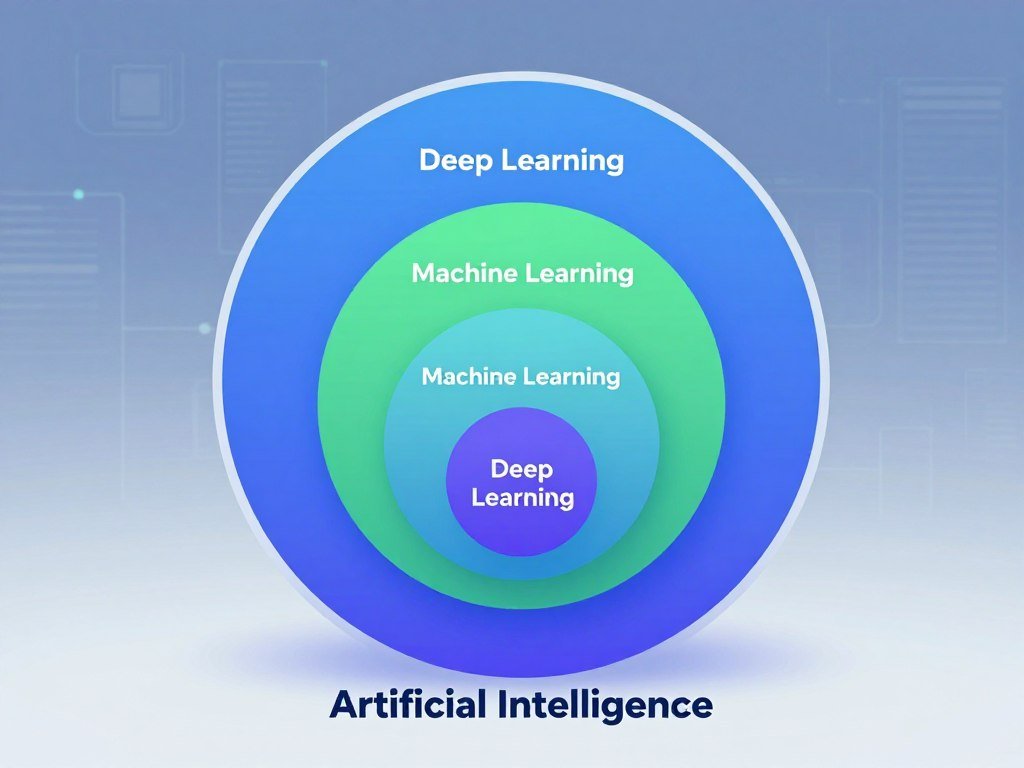
Deep learning sits inside machine learning and relies on large artificial neural networks to learn complex patterns. The hierarchy is AI, then ML, then deep learning, with neural networks as the backbone of deep learning.
Deep learning can learn features from raw data, but its decisions are often harder to explain. That trade-off matters when a team must understand why a model gave a certain result.

What Makes a Neural Network Deep?
A neural network is a set of connected layers of nodes. The input layer takes in data, hidden layers process it, and the output layer gives a result. A network is called deep when it has multiple hidden layers.
Those layers let a model learn complex patterns by working through the data in stages. The network’s structure can help with tasks involving large amounts of data, such as recognizing features in images or language.
Traditional machine learning often depends on people to choose useful features before training. A feature is a detail the model can use, such as an image’s edges or a message’s word patterns. Deep learning can learn features from raw data, which may reduce manual feature engineering.
Where Deep Learning Helps and What It Costs
Reducing feature work does not make a deep learning model automatically simple. These models can need large data sets and substantial computing power. Their many layers can also make the path from input to result difficult to follow.
That lower interpretability can matter in health care, finance, or other work where people need to explain decisions. A team may choose a simpler model if it can do the task well and its reasoning is easier to inspect.
Neural networks are not the only kind of machine learning model, and a deeper network is not always a better fit. The task, data, and need for clear explanations should shape the choice.
When people need to understand why a model made a particular decision, deep learning’s lower interpretability can be a meaningful drawback.
Where Does Machine Learning Show Up in Everyday Life?
A movie suggestion, a spam alert, and a revised arrival estimate are familiar moments when machine learning can be working in the background. These results depend on data, such as message patterns, browsing history, or current traffic.
Everyday services use ML to sort information and estimate what may happen next. The service turns those estimates into something you can act on, such as a suggested product or a route.
| Service | Information used | ML task | User-facing result |
|---|---|---|---|
| Amazon and Netflix | Taste, browsing, and shopping-cart history | Recommendations | Suggested products or viewing |
| Gmail | Message patterns | Sorting and spam detection | Organized inbox |
| Google Maps | Current traffic and location context | Route and ETA estimates | Navigation and nearby places |
| Uber and Lyft | Rider, driver, and traffic information | Matching and trip estimates | Ride coordination |
Amazon and Netflix use taste and browsing or shopping-cart history to suggest products or viewing. These services turn past activity into recommendations, though the results may not match what you want today.
Gmail uses ML to sort email into Primary, Social, and Promotions. It can also detect spam and reroute those messages, keeping many unwanted emails out of the main inbox.
Google Maps uses current traffic and location context to assess routes, nearby places, and arrival times. Uber and Lyft use ML for rider-driver matching, prices, traffic analysis, route planning, and trip estimates.
Voice assistants such as Siri and Alexa use speech recognition to identify spoken words. Natural language processing helps them interpret requests, while speech-to-text and text-to-speech support spoken exchanges.
A research paper tests combined recommendation methods using MovieLens and Amazon review data, but it does not show which methods a particular retailer uses. Its recommendation-system study offers an example of how researchers test these models.
Treat a route or recommendation as an estimate shaped by current information, not a guarantee that conditions will stay the same.
How Do Businesses and Health Care Use AI and ML?
Businesses use AI in a range of processes, and a 2025 survey found that 88 percent used it in at least one business process. That figure covers at least one process, not every task or decision at every company.
AI and ML can support analysis, but people still need to judge high-stakes results. Financial firms and health care teams use models to flag or examine data that may need closer attention.
Common uses include:
- Flagging unusual online transactions for investigation.
- Analyzing medical images to support screening.
- Classifying tumors or detecting fractures in scans.
Banks and other financial institutions use ML models to flag suspicious or atypical online transactions. The system can sort records for review, but an alert is not proof of wrongdoing.
A suspicious-transaction alert calls for investigation, not an automatic conclusion that fraud occurred. A reviewer may need to consider other details before deciding what the activity means.
In health care, image analysis can support mammogram review and early lung cancer screening. ML can also classify tumors or spot fractures that may be difficult to see with the human eye.
These systems can help people review large amounts of information, but they do not make every consequential decision alone. Models can miss patterns or flag ordinary cases, so human judgment remains important.
For a broader view of companies and sectors using these tools, see machine-learning companies and applications. Businesses exploring services for other firms can also consider AI and software startup ideas.
In medical imaging, describe the model as supporting screening or analysis rather than replacing a clinician’s judgment.
Is ChatGPT AI, Machine Learning, or Both?
ChatGPT is both an AI application and a system built with machine learning, specifically large language models called generative pre-trained transformers. It is generative AI, which creates content in response to a prompt.
Generative AI and machine learning are not competing categories. ML also supports tasks such as classification and prediction, while generative AI focuses on producing new content.
Generative AI Creates New Content
ChatGPT is a generative AI chatbot developed by OpenAI. It uses large language models, or LLMs, called generative pre-trained transformers to produce responses. The name describes a kind of model, not a separate alternative to AI.
ChatGPT was originally released on November 30, 2022. Its language models draw on patterns learned during training to generate text that fits a prompt. They do not simply retrieve a fixed answer for every request.
Natural language processing helps AI systems work with human language. Large language models can use those language patterns to respond to questions, follow instructions, or create new text.
For a wider comparison of assistants and other software, see these AI tools for work, writing, and design. The right tool depends on what you need it to do.
ChatGPT’s Inputs, Outputs, and Limits
Users can provide text, audio, and image prompts, then receive text, audio, and image outputs. The available formats let people interact in more than one way, though the details of a response still depend on the prompt and model.
ChatGPT can produce incorrect or nonsensical answers that sound plausible. This problem is called a hallucination. Fluent wording does not prove that the information is accurate.
Generative AI may be useful for drafting or explaining, but its response is not a substitute for careful review. A model can combine familiar patterns in a way that sounds sure while getting a fact wrong.
Check important claims independently, especially when a plausible-sounding answer could affect a consequential decision.
What Do You Need to Learn Machine Learning?
A focused learner can build ML foundations and complete a small guided project in three months, but that is not the same as mastering the field. Regular study matters, and the time needed depends on your starting skills and the project.
Python is a common tool for machine learning, not a feature that separates AI from ML. You can start with existing libraries before mastering every math idea behind them.
Python, Math, and a First ML Project
Python is widely used to work with data, train models, and test algorithms. Useful math foundations include probability, statistics, linear algebra, and calculus. The amount of theory you need depends on the work you plan to do.
Hands-on practice can begin while you are still learning the math. A small project with labeled data helps connect the ideas to a real task, such as sorting examples into known categories.
- Learn basic Python.
- Study core math and ML concepts.
- Train a small model on a labeled dataset.
- Evaluate it on examples it has not seen.
Keep the project modest. A small dataset and a clear goal make it easier to see how training choices affect a model’s predictions.
Learning Timelines and Machine Learning Careers
With consistent study, three months can cover fundamentals and support a small guided project. That period does not master every ML specialty or guarantee job readiness. A larger project and deeper skills take more time.
AI and machine learning engineers may build, train, evaluate, and deploy models. Their work can also involve preparing data and checking whether a model performs as expected for its task.
Pay depends on role, experience, location, and employer. An engineer’s salary can vary widely across job types and workplaces, so one figure cannot describe every career.
Start with one small Python project and test its predictions on examples that were kept out of training.
How Do You Choose the Right AI Approach?
If a task can be described with stable, explicit instructions, rules may be enough; choose ML when useful patterns must be learned from data. Start with the task, then match the approach to its data and decision needs.
A more complex model is not automatically the better choice for a clearly defined task. A simple system may be easier to inspect and maintain when the rules stay stable.
Choose complexity only when the task needs it. A larger model can add data, testing, and explanation needs without improving the result.
| Approach | Suitable task conditions | How decisions are produced | What to check |
|---|---|---|---|
| Rules-based AI | Clear, stable instructions | Explicitly programmed rules | Rules cover expected cases |
| Supervised ML | Labeled examples and known outcomes | Patterns learned from data | Predictions on unseen examples |
| Deep learning | Complex patterns in raw data | Features learned through multilayer neural networks | Interpretability and data needs |
Model development often uses separate training, validation, and test datasets. Training data teaches the model, validation data helps compare choices, and test data gives a final check on examples kept aside.
Teams can use grid search or random search to tune hyperparameters, which are settings that shape how a model learns. After deployment, they monitor performance because data patterns or task requirements may change.
Good performance on past data does not ensure the same results later. A change in customer behavior or business rules can make a model less useful, so teams need to watch how it performs.
Before deployment, define the task’s success measure and check the final model on a separate test set.
Conclusion
The clearest distinction is that AI names the broader field, while machine learning names one way to build systems within it. That difference helps you match a tool to a task without treating every AI system as a model trained on data.
Some tasks call for explicit instructions. Others benefit from patterns learned from examples. The useful choice is the one that fits the task’s data, goals, and need for clear decisions.
Pick one repetitive task, define what a successful result looks like, and decide whether explicit rules or learned patterns fit it better.
FAQ
Can I learn ML in 3 months?
Yes, three months of steady study can cover ML fundamentals and support a small guided project. That timeline does not master every specialty or guarantee job readiness. Your progress depends on your starting knowledge, study time, and project scope. A focused project can still teach you how data, training, and evaluation fit together.
What are 7 types of AI?
There is no single standard list of seven AI types. A common capability taxonomy names ANI, AGI, and ASI, while other lists group AI by techniques or applications. Those systems describe different ways to sort the field, so a seven-item list may reflect one author’s chosen categories rather than a shared standard.
What is the definition of machine learning?
Machine learning trains a model on data so it can learn patterns and make predictions on new examples. It does not rely only on instructions written for each case. For instance, a model can use past labeled examples to estimate an outcome for data it has not seen before. Its predictions can still be wrong.
Is ChatGPT AI or ML?
ChatGPT is an AI chatbot that uses machine learning, including large language models called generative pre-trained transformers. AI is the broader category, and ML is one approach used to build systems within it. ChatGPT generates responses from learned patterns, but a fluent answer can still contain mistakes or made-up details.
What is a simple example of machine learning?
A spam filter is a simple example: it learns from labeled examples of spam and legitimate messages, then applies those patterns to new email. The examples show the model which messages belong in each category. The filter can make mistakes, so users may still need to move a message or mark it as spam.
What are examples of machine learning in everyday life?
Recommendations from Amazon or Netflix, Gmail spam filtering, Google Maps route estimates, and ride matching from Uber or Lyft are everyday examples. These services use information such as browsing activity, message patterns, or traffic conditions. Their results are estimates, so a suggestion or arrival time may change when new information comes in.
What math is used in machine learning?
Probability, statistics, and linear algebra are useful foundations for machine learning. Calculus helps with some methods and deeper study. The amount of math you need depends on the models and work you pursue. You can begin hands-on practice with existing Python libraries before you understand every formula behind them.
Is machine learning hard to learn?
Machine learning can feel harder if you are new to both programming and math. Using an existing Python library is often an easier starting point than building algorithms from scratch. A small project lets you practice with real data while learning the terms. More advanced work calls for stronger math and coding skills.
About The Author