Franchise vs Independent Business: Which Suits a First-Time Owner?
Choosing between a franchise vs independent business is one of the defining decisions a first-time entrepreneur will make. For most newcomers, a franchise is the safer, more predictable choice if you have higher upfront capital and value structured guidance, whereas an independent business is better suited for founders with lower budgets who prioritize creative control and long-term profit retention.
Both pathways lead to business ownership, yet they offer entirely different day-to-day realities. Buying into an established system trades autonomy for a proven operational playbook.
Launching from scratch trades that safety net for complete ownership over your brand, pricing, and strategic direction. Understanding how these two models compare across cost, risk, support, and lifestyle will help you commit to the right venture with confidence.
Understanding the Core Differences
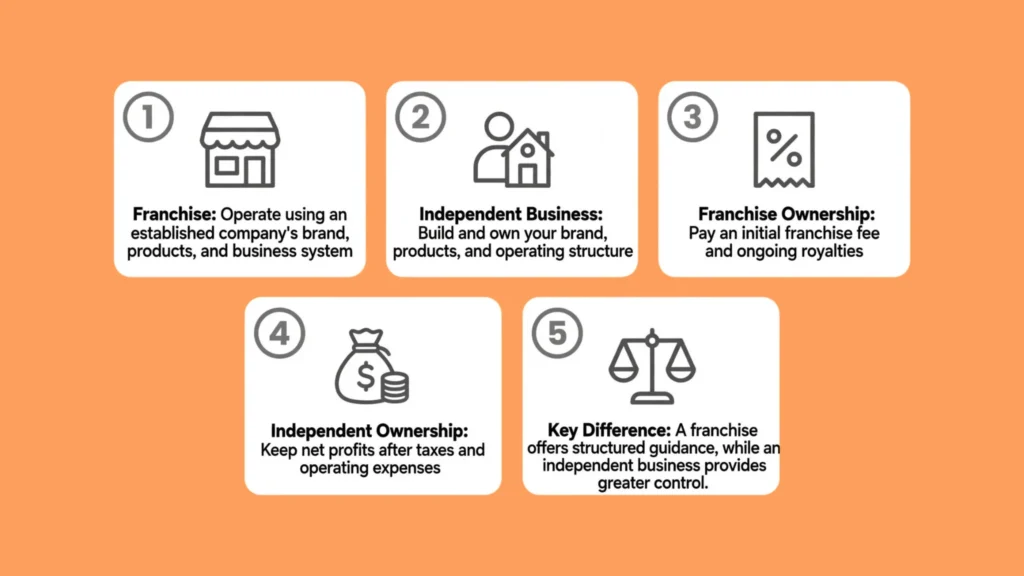
Before weighing financial projections or operational demands, it helps to define what separates buying a franchise vs starting your own company from the ground up.
What Is a Franchise Business?
A franchise is a legal and commercial relationship in which an established company (the franchisor) grants an individual (the franchisee) the right to operate a business using its trademark, products, and operating system.
In exchange, the franchisee pays an initial franchise fee and ongoing royalties, typically calculated as a percentage of gross revenue. Examples span fast-casual restaurants, fitness studios, home repair services, and senior care agencies.
What Is an Independent Business?
An independent business is a company conceived, built, and owned entirely by its founder. You develop the brand name, source your own suppliers, design your customer experience, and keep all net profits after taxes and expenses.
Whether you open a neighborhood coffee shop, launch a boutique consulting firm, or build an e-commerce store, every structural and creative decision rests with you.
Franchise Pros and Cons for First-Time Entrepreneurs
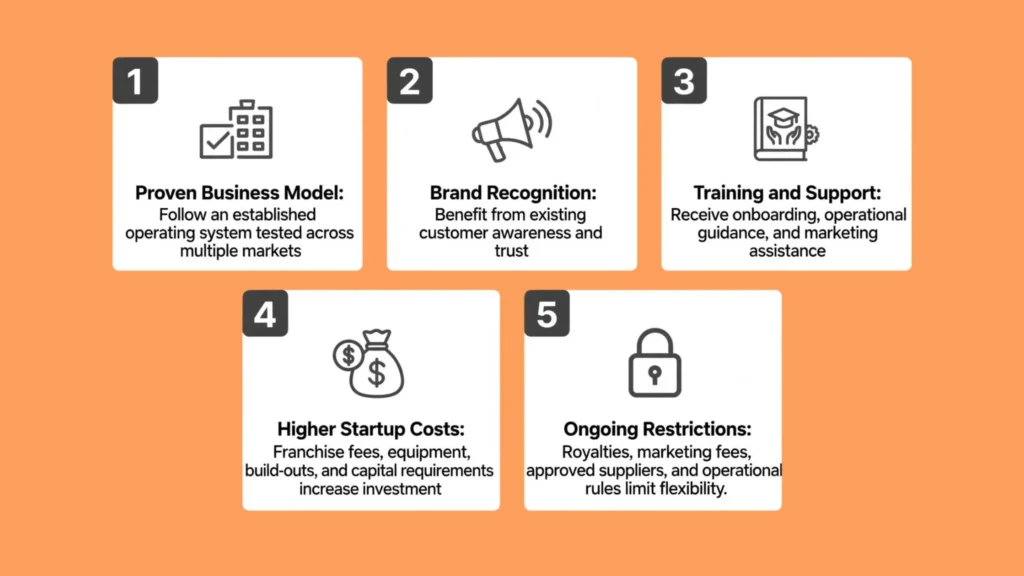
Evaluating franchise pros and cons requires looking beyond brand recognition to see how contractual rules affect your daily routine and bottom line.
Advantages of Buying a Franchise
Proven Business Model: You do not have to guess whether customers want the product or how to price it. The franchisor has already tested the concept across multiple markets and refined the workflow.
Built-In Brand Recognition: Customers often trust an established name immediately, reducing the time and marketing spend required to attract your first wave of buyers.
Comprehensive Training and Support: Most franchisors provide structured onboarding covering hiring, inventory management, point-of-sale software, and local marketing, which is invaluable when you have never run a company before.
Easier Access to Financing: Banks and commercial lenders generally view established franchises as lower-risk investments than brand-new concepts, making small business loans easier to secure.
Collective Buying Power: Franchisors negotiate bulk pricing on equipment, supplies, and software across their entire network, lowering your per-unit operating costs.
Disadvantages of Buying a Franchise
High Upfront Capital Requirements: Between the initial franchise fee, build-out specifications, required equipment, and liquid capital minimums, entry costs can be substantial.
Ongoing Royalty and Marketing Fees: You must pay recurring royalties often 4% to 12% of gross sales regardless of whether your location turns a profit that month, alongside mandatory contributions to a national advertising fund.
Strict Operational Restrictions: Franchisors dictate everything from store layout and uniforms to approved vendors and menu items. Deviating from the operations manual can put you in breach of contract.
Shared Reputation Risk: If the parent company faces a public relations crisis or other franchisees deliver poor service, your local business can suffer from association.
The Appeal and Reality of Independent Business Freedom
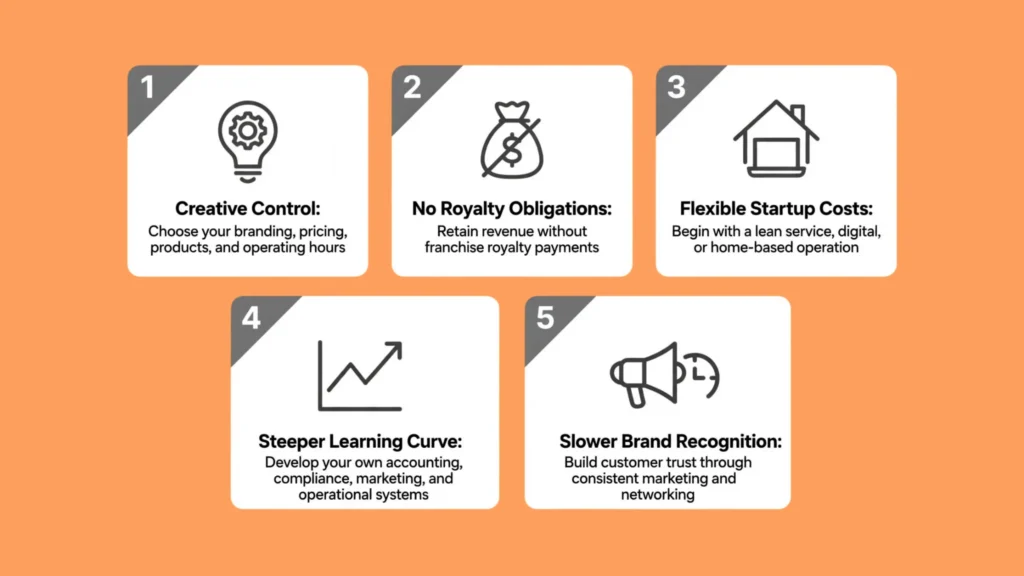
For many aspiring owners, the primary draw of entrepreneurship is independent business freedom the ability to build something uniquely yours without answering to a corporate headquarters.
Advantages of Starting an Independent Business
Total Creative and Strategic Control: You choose your branding, product lineup, operating hours, technology stack, and company culture. If a service isn’t selling, you can pivot tomorrow without corporate approval.
Lower Barrier to Entry: Many independent businesses especially service-based, digital, or home-based ventures can launch lean with minimal equipment and scale gradually using cash flow.
No Royalty Obligations: Every dollar of revenue stays inside your business to cover expenses, reinvest in growth, or pay yourself.
Unlimited Exit Flexibility: You can sell your business, merge with a competitor, bring on investors, or even franchise your own concept later without needing permission from a third party.
Disadvantages of Starting an Independent Business
Steeper Learning Curve: Without an operations manual, you have to figure out accounting, compliance, vendor contracts, customer acquisition, and staffing through trial and error.
Longer Path to Customer Trust: Building brand awareness from zero takes sustained marketing effort, networking, and patience before steady word-of-mouth kicks in.
Higher Early-Stage Uncertainty: Without historical unit economics from comparable locations, forecasting revenue and cash flow during your first year involves more guesswork.
Side-by-Side Comparison: Franchise vs Independent Business
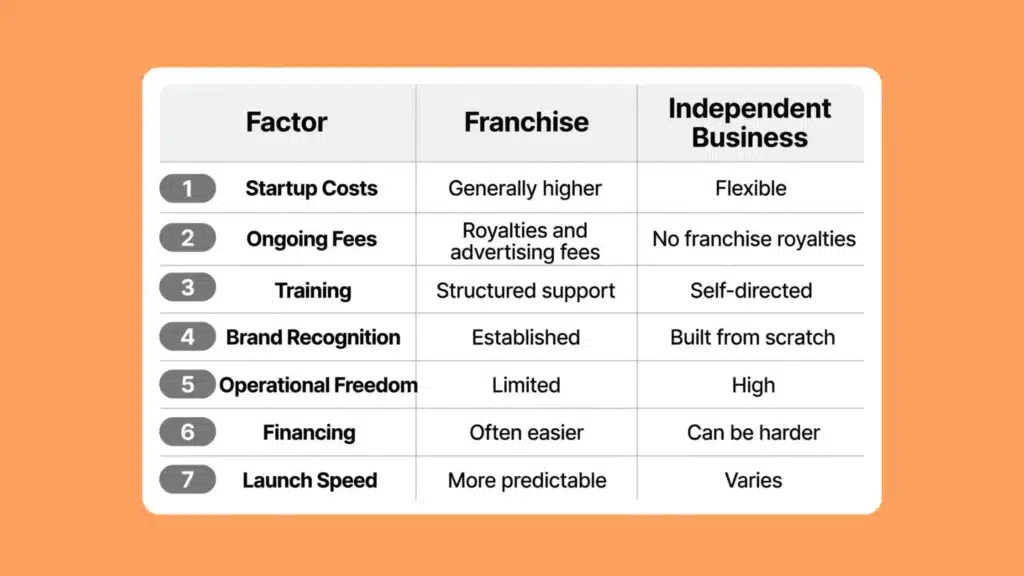
The table below highlights how key operational and financial factors compare when deciding between a franchise vs independent business.
| Factor | Franchise Business | Independent Business |
| Startup Costs | Generally higher due to franchise fees and strict build-out standards | Flexible; can range from very low (service/online) to high (brick-and-mortar) |
| Ongoing Fees | Ongoing royalties and national ad fund fees based on gross revenue | None; you retain 100% of net profits |
| Training & Support | Structured onboarding, manuals, and dedicated field support | Self-directed; relies on mentors, advisors, and independent research |
| Brand Recognition | Immediate recognition in established markets | Built from scratch over time |
| Operational Freedom | Low; must follow standardized systems and approved suppliers | High; complete autonomy over branding, pricing, and operations |
| Financing Approval | Often easier due to proven track record and lender familiarity | Harder without strong collateral, personal credit, or industry experience |
| Speed to Launch | Predictable timeline guided by a corporate launch checklist | Varies widely depending on planning, permitting, and setup efficiency |
Financial Realities: Startup Costs and Ongoing Expenses
Money often settles the debate before personal preference even enters the picture. When comparing buying a franchise vs starting your own venture, look closely at both initial capital and recurring cash flow demands.
In a franchise, your initial investment is clearly outlined in Item 7 of the Franchise Disclosure Document (FDD) a mandatory legal disclosure file that franchisors must provide to prospective buyers at least 14 days before signing a contract.
This estimate includes the one-time franchise fee, real estate leasehold improvements, initial inventory, signage, and working capital reserves. Because royalties are typically taken off the top of gross revenue rather than net profit, thin-margin industries require high sales volume to generate healthy owner take-home pay.
In an independent business, startup costs are far more adaptable. A solo consultant or digital agency might launch for a few thousand dollars, while an independent restaurant or retail boutique might match or exceed franchise build-out expenses.
However, because you avoid ongoing royalty fees, a successful independent business often achieves stronger profit margins once it reaches steady customer volume.
How to Decide Which Path Fits Your Personality and Goals
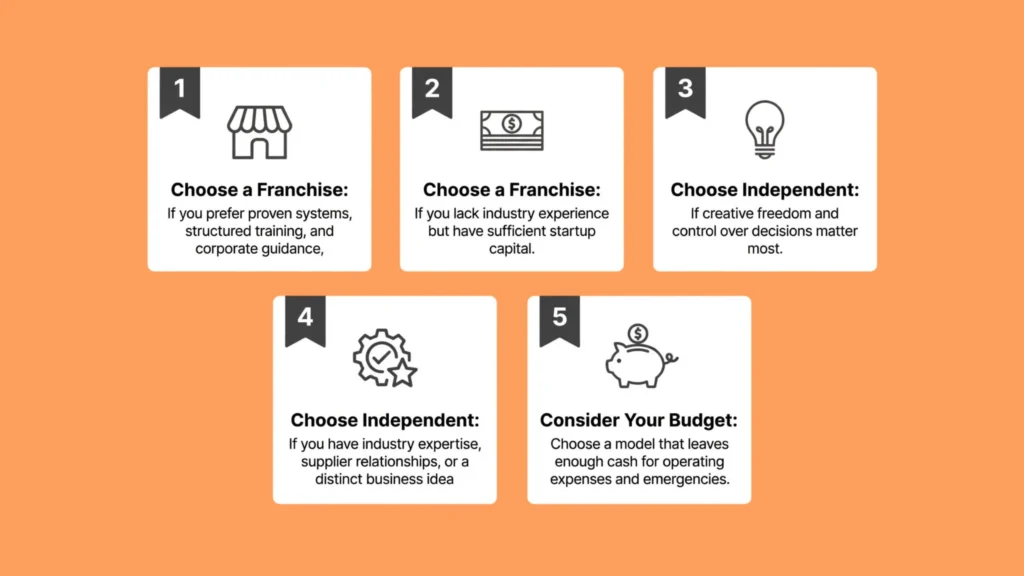
Beyond spreadsheets, your temperament and work style play a decisive role in which model will keep you energized over the long haul.
Choose a Franchise If:
You are an executor rather than an inventor: You thrive when given a clear checklist, measurable benchmarks, and a proven system to optimize.
You lack industry-specific experience: You want to enter a sector like home services, fitness, or food service, and need training to bridge your knowledge gap.
You prefer structured guardrails: Having corporate support teams to call when equipment breaks or marketing stalls gives you peace of mind.
You have access to sufficient capital: You meet the franchisor’s net worth and liquidity thresholds without exhausting your personal emergency savings.
Choose an Independent Business If:
You value autonomy above all else: Following someone else’s rules on branding, pricing, or vendor selection would quickly make you feel restricted.
You have a distinct vision or niche: Your idea relies on local flavor, bespoke craftsmanship, or a specialized service that standardized chains cannot replicate.
You bring deep domain expertise: You already understand the industry, know how to acquire customers, and have trusted supplier relationships.
You want to start small and bootstrap: You prefer testing an idea leanly and scaling at your own pace rather than taking on large upfront debt.
Common Mistakes First-Time Owners Make
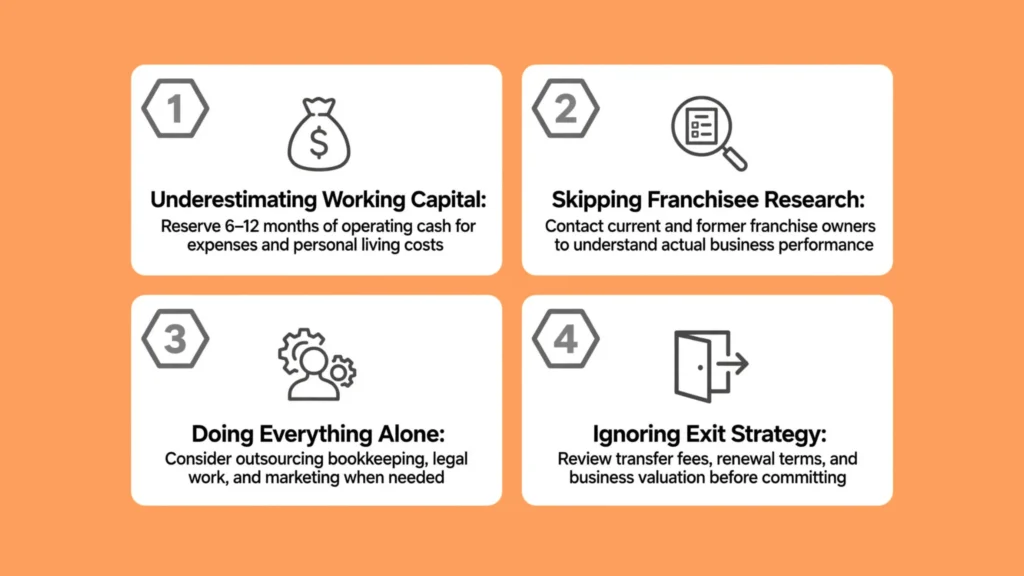
Regardless of which path you choose, new business owners frequently stumble over avoidable blind spots during the planning phase:
Underestimating Working Capital: Many founders budget carefully for launch day but forget to set aside six to twelve months of operating cash to cover payroll, rent, and personal living expenses while the business ramps up.
Skipping Due Diligence on Existing Franchisees: Prospective franchise buyers sometimes rely solely on corporate sales presentations instead of calling current and former franchisees listed in the FDD to ask about real-world profitability and support quality.
Assuming Independence Means Doing Everything Alone: Independent founders often try to handle bookkeeping, legal contracts, and marketing themselves to save money, burning out instead of outsourcing critical tasks early.
Ignoring Exit Strategy from Day One: Whether buying a franchise with a 10-year term or building an independent brand, failing to understand transfer fees, renewal terms, or business valuation drivers can limit your options when you are ready to sell.
Frequently Asked Questions
Is buying a franchise less risky than starting an independent business?
Buying a franchise reduces operational and market-validation risk because you are using a tested product, established branding, and proven workflows. However, it does not guarantee profitability. Poor location selection, inadequate working capital, or weak local management can still cause a franchise to fail, often with higher upfront financial exposure.
Can you negotiate the terms of a franchise agreement?
Most established franchisors offer very little flexibility on core terms like royalty rates, brand standards, or contract length to keep their system uniform. However, you may occasionally negotiate minor details such as territory boundaries, opening timelines, or multi-unit development schedules, especially with emerging franchise brands.
How much money do you need to start a franchise vs an independent business?
Franchise investments vary widely, ranging from under $50,000 for certain home-based service franchises to well over $1 million for brick-and-mortar restaurants or hotels. Independent businesses have no fixed floor—service or online businesses can start with minimal capital, while retail or hospitality startups require substantial funding comparable to franchises.
Do franchise owners actually own their business?
Yes, franchisees own their specific business entity, equipment, and local assets, and they manage their own employees. However, they do not own the brand trademarks or proprietary systems; instead, they license the right to use them for a fixed contract term, typically 5 to 20 years.
Which option generates higher profits over time?
An independent business has higher long-term profit potential because you do not pay ongoing royalties and face no territorial caps on expansion. A franchise can reach profitability faster thanks to immediate brand recognition, though recurring fees take a permanent slice of gross revenue.
What is a semi-absentee franchise, and is it good for beginners?
A semi-absentee franchise is structured so the owner keeps a full-time job while hiring a general manager to oversee daily operations, dedicating roughly 10 to 15 hours per week to oversight. While appealing to first-time owners, it requires higher upfront capital to pay a qualified manager from day one and still demands active financial supervision.
Final Thoughts
Deciding between a franchise vs independent business comes down to matching your capital, industry experience, and desire for control with the right operating structure. If you want a well-lit path with built-in brand equity, training, and lender confidence and you are comfortable following established rules a franchise offers a strong launchpad for first-time ownership.
If you have a clear vision, industry know-how, or a leaner budget, and you want complete freedom to shape your brand and keep every dollar of profit, starting an independent business will reward your initiative. Take time to audit your finances, talk candidly with current owners in both camps, and choose the model that aligns with how you want to work every single day.
About The Author