Getting Your Food Product Into Grocery Stores: A Practical Roadmap from Kitchen to Shelf
Breaking into the retail grocery market is a monumental milestone for any food brand. Transitioning from small-batch production, farmers markets, or direct-to-consumer sales onto commercial supermarket shelves requires far more than a delicious recipe. To succeed, founders must navigate complex supply chains, strict food safety regulations, margin structures, and fierce competition for limited shelf space.
Learning how to get your product into grocery stores involves mastering commercial production, perfecting your retail distribution strategy, delivering a compelling buyer pitch, and managing upfront listing costs like slotting fees. This comprehensive guide walks you through every step of the journey, ensuring your product is not only retail-ready but positioned for long-term profitability.
Laying the Foundation: Making Your Food Product Retail-Ready
Before approaching a single store manager or category buyer, your product must transition from an artisanal creation to a scalable commercial food business with consistent production and inventory management.
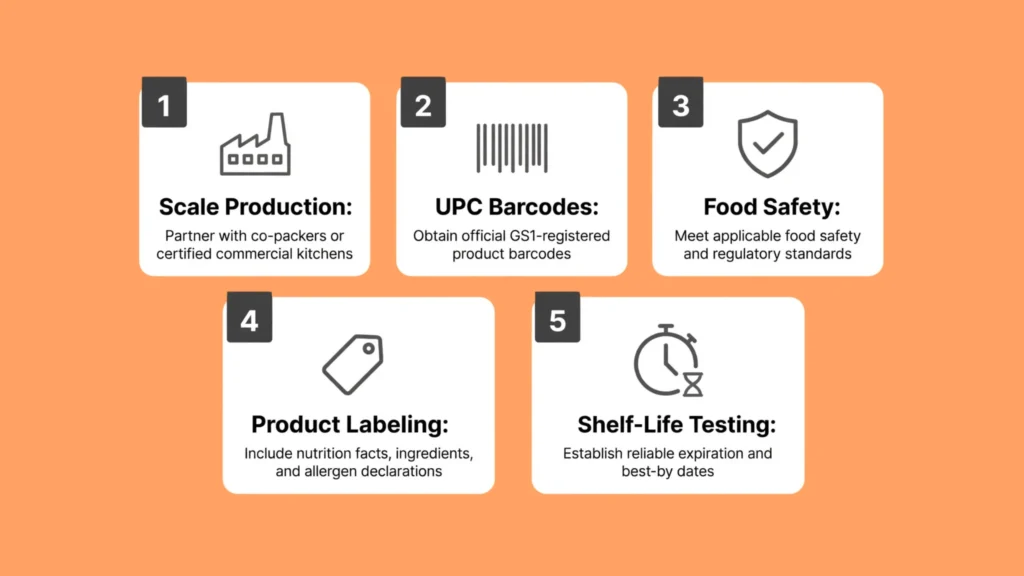
Scale Production Safely
Grocery retailers demand a consistent, reliable supply chain. If a product goes out of stock on store shelves, retailers lose revenue and customer trust. To ensure scalable output:
Partner with a Co-Packer (Contract Manufacturer):
Working with an established contract manufacturer allows you to outsource production without investing millions in industrial machinery. This approach is particularly useful when launching a beverage brand, as specialized co-packers can handle commercial formulation, manufacturing, and packaging.
Lease Space in a Commercial Kitchen: If you prefer keeping production in-house during early stages, operate out of a certified commercial kitchen space that meets local health department standards.
Universal Product Codes (UPC Barcodes)
Every retail item requires a unique UPC barcode for inventory tracking and point-of-sale scanning. Purchase official, globally recognized barcodes directly through GS1. Avoid third-party barcode resellers, as major national chains often reject non-GS1-registered barcodes.
Regulatory Compliance and Packaging Design
Retail packaging serves two primary purposes: regulatory compliance and consumer attraction.
Nutrition Facts Panel & Ingredients: Ensure your label complies with FDA guidelines or your local regulatory authority. This includes proper allergen declarations, net weight placement, and formatted nutritional tables.
Shelf Stability and Lab Testing: Conduct shelf-life testing to establish clear “Best By” or expiration dates.
Visual Appeal: Supermarket aisles are crowded. Your packaging must clearly communicate your brand identity, key differentiators like organic or gluten-free, and value proposition within three seconds of a shopper walking past.
Navigating Retail Distribution Food Channels
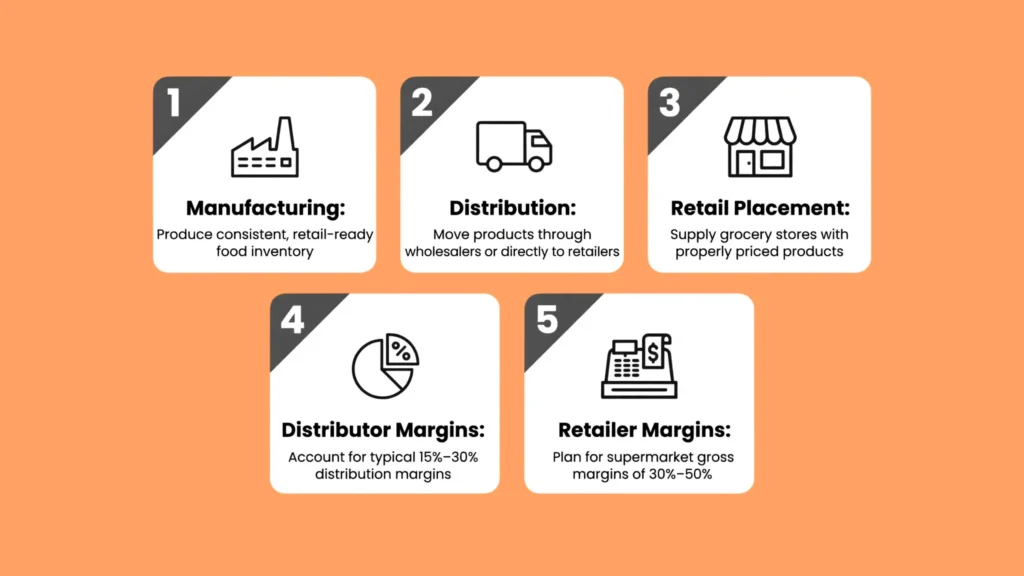
Understanding how inventory moves from your production facility to retail shelves is essential for calculating margins and setting wholesale prices.
In a standard distribution model, the manufacturer produces the goods and supplies them to a distributor like KeHE or UNFI, who then distributes the products directly to grocery stores. Building relationships with reliable wholesale food suppliers also helps businesses maintain consistent inventory and competitive purchasing costs.
Self-Distribution (Direct-to-Store Delivery)
When starting out, self-distribution is often the most practical route. You package, transport, and stock the product on store shelves yourself.
Pros: Complete control over store presentation, direct relationships with store managers, and higher profit margins with no middleman cut.
Cons: Highly labor-intensive, limited geographical reach, and difficult to scale past local regions.
Wholesale Distributors
To expand regionally or nationally, food brands partner with specialty or broadline food distributors such as UNFI or KeHE. Distributors purchase your product in bulk, warehouse it, and distribute it across their established store networks.
Pros: Instant access to thousands of independent stores and national chains, along with handling order fulfillment, logistics, and billing.
Cons: Distributors typically take a 15% to 30% margin, shrinking your overall profitability if your pricing model isn’t built correctly from the start.
Understanding Retail Margins
To survive in retail distribution, your pricing model must accommodate every link in the supply chain:
Cost of Goods Sold: Production, ingredients, packaging, and labor.
Distributor Margin: Typically 15% to 30%.
Retailer Margin: Supermarkets usually demand a 30% to 50% gross margin on food items.
For example, if your product costs $1.50 to make, you might sell it to a distributor for $3.00. The distributor sells it to the grocery store for $4.00, and the grocery store places it on the shelf for $5.99.
Preparing for the Buyer Meeting Pitch
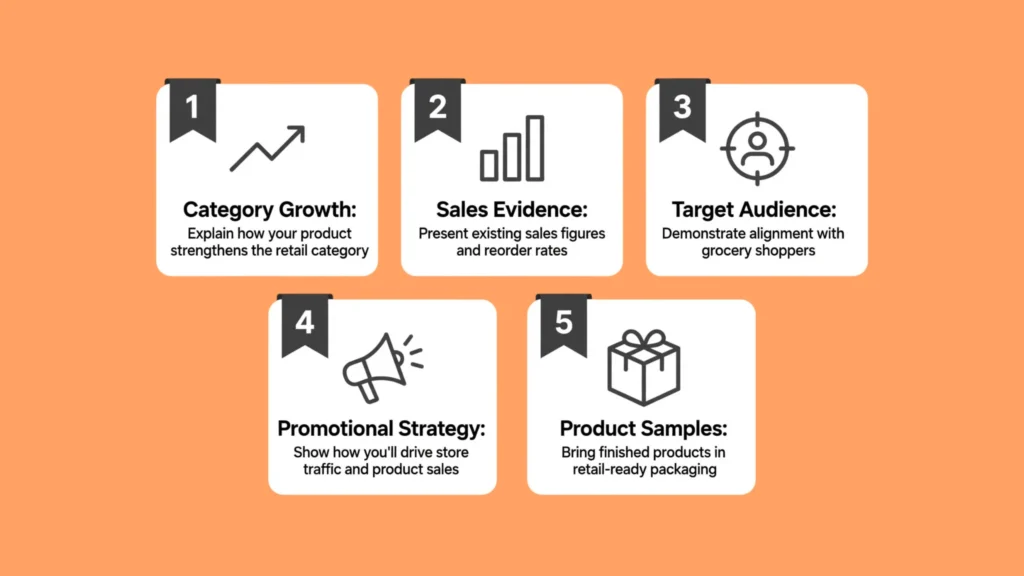
Retail category buyers receive dozens of product pitches every week. To secure a spot on their shelves, your presentation must focus heavily on market data, margin potential, and sales velocity.
What Category Buyers Care About Most
Category Growth: Does your product bring new customers to their store or expand an emerging category?
Proof of Concept: Can you show strong sales velocity from farmers markets, local specialty shops, or online sales?
Marketing & Promotional Support: How are you going to drive shoppers into their stores to buy your product? Stores do not want products sitting idle on shelves.
Key Elements of a Winning Pitch Deck
The Problem & Solution: Clearly define the market gap your product fills.
Product Line Overview: Highlight your top SKUs, flavors, and certifications.
Target Audience & Demographic Fit: Demonstrate why your brand aligns with the grocery store’s shopper base.
Traction & Sales Velocity: Share existing sales figures, reorder rates, and customer reviews.
Trade Promotion Plan: Detail your planned promotional calendar, including temporary price reductions, digital coupons, and store demos.
Margin Architecture: Provide clear breakdowns of wholesale pricing, suggested retail price, and retailer margin.
Always bring physical, finished product samples in retail-ready packaging to your pitch meeting. Allow the buyer to taste, touch, and evaluate the product firsthand.
Understanding Slotting Fees and Retail Expenses
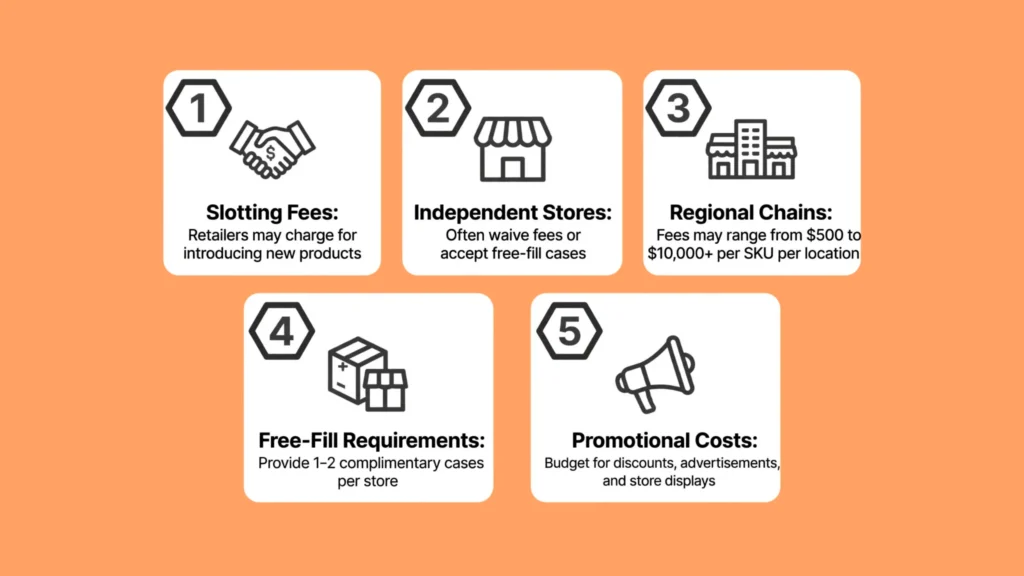
Securing approval from a category buyer is a major win, but you must plan for the financial costs associated with shelf placement.
What Are Slotting Fees?
Slotting fees or slotting allowances are one-time fees charged by grocery retailers to place a new product on their shelves. These fees offset the risk and logistics costs associated with entering a new SKU into their inventory system.
Independent & Specialty Stores: Often waive slotting fees or accept free-fill cases of product instead of cash.
Regional & National Chains: Can charge anywhere from $500 to $10,000 or more per SKU, per store location.
Additional Retail Costs to Factor In
Free-Fill Requirements: Giving 1 to 2 free cases per store location upon initial placement.
Spoil & Waste Guarantees: Agreements where you absorb the cost of unsold, expired inventory.
Promotional Discounts: Funding mandatory sales events, circular ads, or end-cap displays.
Strategic Progression: Independent Stores to National Chains
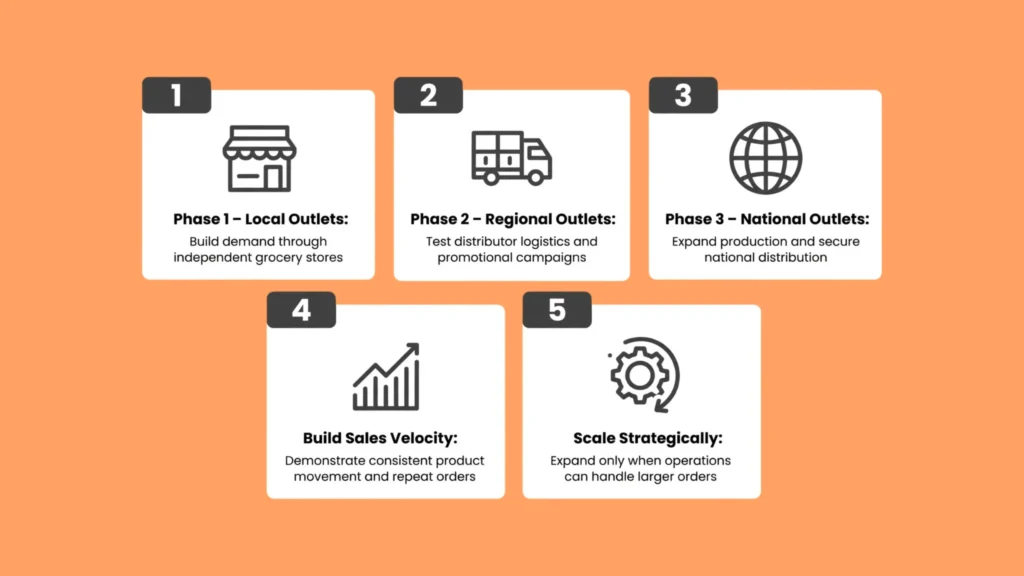
Trying to land on national supermarket shelves on day one often leads to operational failure. A phased expansion strategy builds cash flow and operational stability.
Phase 1: Local Outlets
Target independent grocers, specialty food shops, and boutique markets. Your primary goal is to establish proof of concept and refine your brand messaging. Focus heavily on self-distribution, in-store demos, and local community support.
Phase 2: Regional Outlets
Target regional grocery chains and co-ops. Your primary goal is to test distributor logistics and trade promotions. Focus on onboarding with regional distributors and managing steady cash flow.
Phase 3: National Outlets
Target major supermarket chains and mass retailers. Your primary goal is to maximize brand reach and scale production. Focus on national distribution contracts, optimized co-packing, and broader media campaigns.
Common Mistakes Food Brands Should Avoid
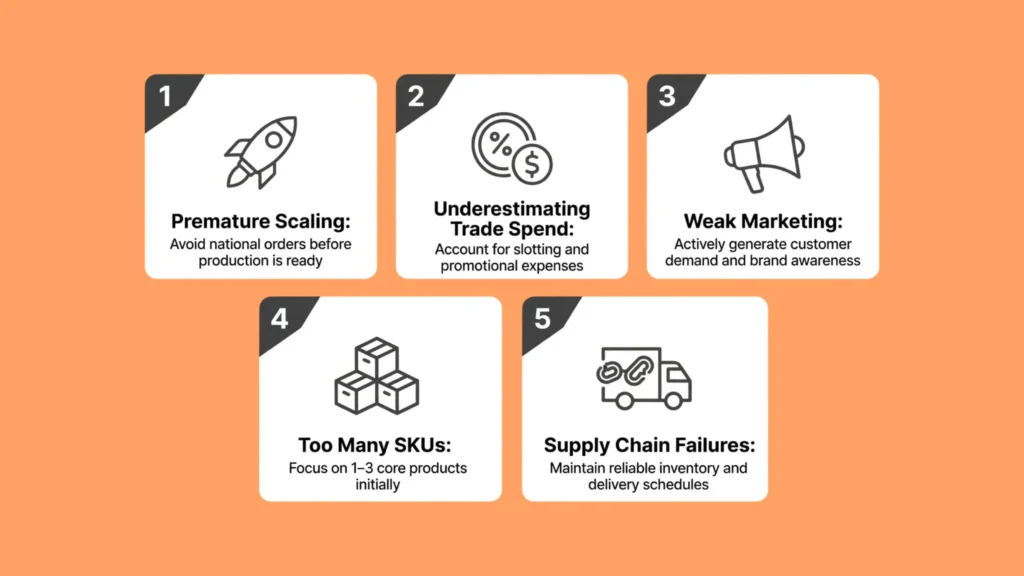
Premature Scaling: Pitching national retailers before your supply chain can handle large purchase orders. Failing to fulfill an order leads to severe financial penalties and blacklisting.
Underestimating Trade Spend: Budgeting only for production costs while ignoring slotting fees, distributor markups, and promotional discounts.
Weak On-Shelf Marketing: Relying entirely on the grocery store to sell your product. You must actively drive brand awareness through digital marketing, influencer partnerships, and local sampling events.
Over-Expanding SKUs: Launching too many flavor variants at once. Focus on 1 to 3 core velocity drivers before introducing line extensions.
Frequently Asked Questions
How long does it take to get a food product into grocery stores?
The timeline typically ranges from 6 to 18 months. Retailers operate on category review calendars, assessing specific product categories like beverages, snacks, or frozen foods only once or twice a year.
Can I pitch grocery buyers without a distributor?
Yes. Independent grocers and smaller regional stores frequently work directly with food founders via direct-to-store delivery. However, larger regional and national chains usually require you to partner with an approved distributor before issuing purchase orders.
What profit margin do grocery stores expect?
Most grocery retailers look for a gross margin between 30% and 50%. Specialty and natural food markets may expect margins on the higher end of that spectrum, often between 40% and 50%.
How do I find the right category buyer for my product?
You can connect with category buyers by attending industry trade shows such as Expo West or Fancy Food Show, utilizing retail networking platforms like RangeMe, or reaching out directly via professional networks like LinkedIn.
Are slotting fees negotiable?
Yes, slotting fees are often negotiable, especially for novel or fast-growing products. Brands can often negotiate lower cash fees by offering free-fill product cases, agreeing to co-op marketing programs, or starting with a smaller store test run.
Final Thoughts
Securing placement on grocery store shelves requires equal parts culinary quality, business acumen, and operational discipline. By building a scalable production model, understanding wholesale margin structures, delivering data-backed pitches to category buyers, and managing placement costs responsibly, your brand can make a seamless transition from local favorite to supermarket staple. Focus on strong sales velocity in early store placements, and use that momentum to expand your retail footprint sustainably.
About The Author