How to Choose a Business Structure for Your Startup (LLC vs C-Corp)
Selecting the right entity type is a critical decision. The legal framework you choose shapes your corporate governance. Additionally, it impacts your personal tax liabilities and your capacity to raise institutional capital. Understanding how to establish an optimal business structure for startup operations ensures long-term growth. Furthermore, it keeps your venture compliant and prevents costly restructuring down the road.
Here at reliablestartup, we help early-stage founders build solid operational foundations. This comprehensive guide provides an in-depth breakdown of your primary business entity options. Specifically, we will compare Limited Liability Companies (LLCs) and C-Corporations (C-Corps). We will also analyze their setup costs, compliance requirements, tax implications, and profit margin impacts.
What Is the Best Business Structure for Startup Founders?
When evaluating the ideal business structure for startup needs, most founders narrow their options down to two choices. You can form a Limited Liability Company (LLC) or a C-Corporation (C-Corp). Both structures create a separate legal entity. Consequently, both options shield your personal assets from commercial liabilities. However, they serve fundamentally different growth strategies, ownership models, and financing paths.
Option A: Limited Liability Company (LLC)
A Limited Liability Company is a flexible hybrid entity. It combines personal asset protection with operational efficiency and tax simplicity.
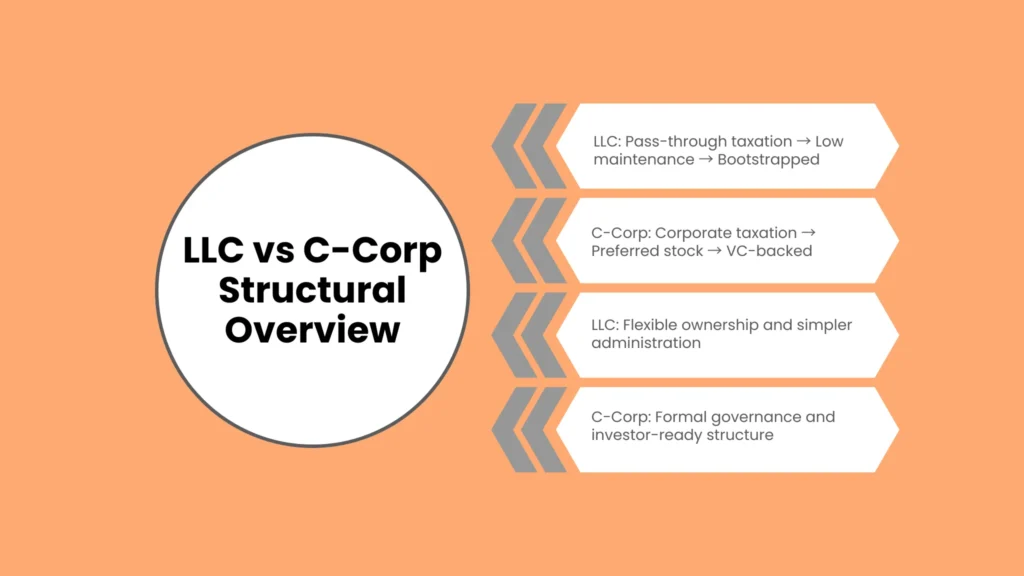
Pass-Through Taxation: Business profits and losses flow directly to your personal tax returns. As a result, business earnings are taxed only once at the individual level. This setup avoids corporate-level double taxation.
Operational Simplicity: LLCs feature low administrative overhead. For example, you do not need a formal board of directors. You can also skip annual shareholder meetings and complex resolution logs.
Flexible Equity Distributions: LLC owners can divide operational responsibilities flexibly. In addition, you can distribute net profits in percentages that differ from direct capital ownership.
Option B: C-Corporation (C-Corp)
A C-Corporation is a distinct corporate entity owned by shareholders. An elected board of directors governs the company. Therefore, it represents the gold standard for venture-backed tech startups.
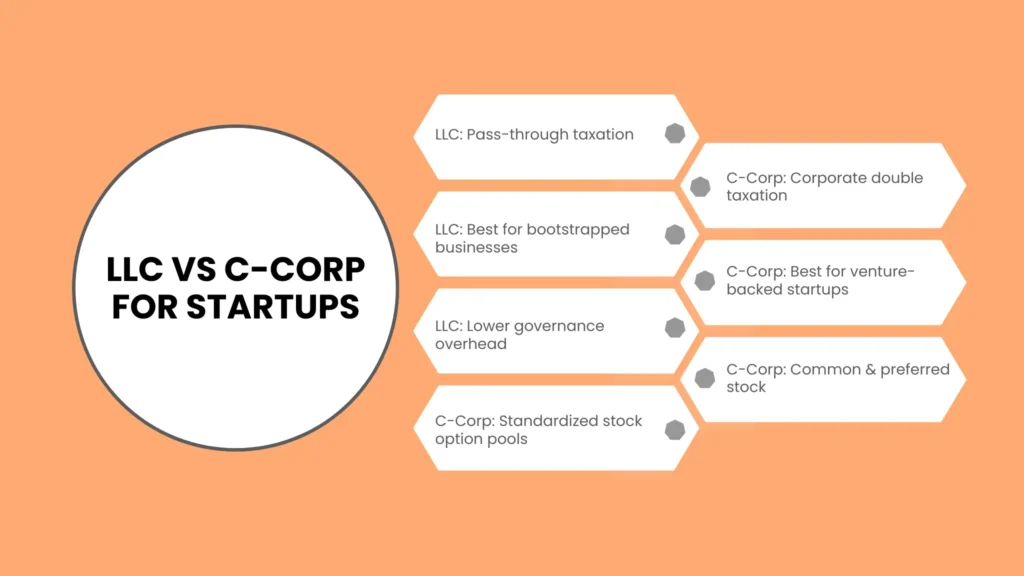
Venture Capital Compatibility: Institutional investors strictly require a C-Corp structure before issuing term sheets. C-Corps can seamlessly issue both common stock and preferred stock.
Standardized Equity Incentive Pools: C-Corps allow founders to reserve dedicated equity option pools. As a result, you can easily attract top executive talent, developers, and strategic advisors.
Corporate Tax Retained Earnings: Profits are taxed at the federal corporate level. While dividends face second-tier personal taxation, founders can reinvest post-tax earnings back into growth initiatives at favorable rates.
Direct Comparison: LLC vs C-Corp for Startups
Evaluating the direct tactical trade-offs in llc vs c-corp for startups helps you make an informed decision. You can align your choice with your immediate execution plans and long-term exit goals.
| Core Feature | Limited Liability Company (LLC) | C-Corporation (C-Corp) |
| Taxation Style | Pass-through taxation (Schedule C / Form 1065) | Corporate double taxation (Form 1120 + Dividend tax) |
| Investor Suitability | Ideal for bootstrapped or self-funded teams | Mandatory for institutional Venture Capital networks |
| Equity Flexibility | Membership units (Requires custom agreements) | Standardized shares (Common and Preferred stock) |
| Governance Overhead | Minimal (Operating Agreement and local filings) | Formal (Bylaws, Board Meetings, Shareholder Minutes) |
| Stock Option Pools | Difficult and tax-inefficient to execute | Standardized Incentive Stock Option (ISO) pools |
| Filing Overhead | Low initial cost and modest annual maintenance | Higher formation costs and ongoing legal support |
Calculating Initial Costs: Business Structure for Startup Cost
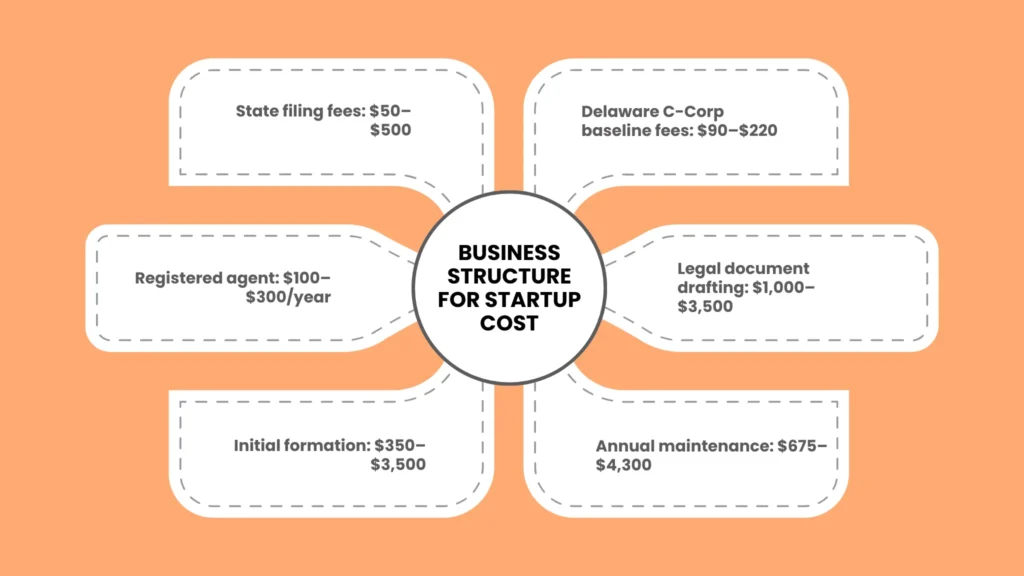
Setting up a formal legal structure requires proper budgeting. You must plan for initial incorporation expenses as well as recurring annual fees. Understanding your complete business structure for startup cost parameters prevents unexpected financial surprises.
1. Upfront Incorporation Expenses
State Filing Fees: Government fees vary significantly across jurisdictions. Forming an entity in your home state typically ranges from $50 to $500. Meanwhile, establishing a Delaware C-Corp generally costs around $90 to $220 in baseline state fees.
Registered Agent Fees: Most states require an official registered agent with a local physical address. Professional registered agent services cost between $100 and $300 annually.
Legal and Document Drafting Fees: Engaging specialized startup attorneys to customize your formation documents usually costs between $1,000 and $3,500. However, using legal technology platforms can reduce initial setup fees to $300 – $800.
2. Ongoing Annual Compliance Costs
State Franchise Taxes: Many state governments levy annual franchise taxes to maintain active status. For instance, California imposes an $800 annual minimum franchise tax. Delaware utilizes a franchise tax scale starting at $175 annually for micro-cap corporations.
Corporate Tax Preparation: Preparing business tax filings requires professional accounting support. Annual tax preparation ranges from $500 to $1,500 for an LLC. Conversely, it ranges from $1,200 to $3,500+ for a corporate C-Corp.
Financial Impact: Business Structure for Startup Profit Margin
Your legal entity choice directly influences cash flow, tax treatment, and administrative expenses. How exactly does your selected business structure for startup profit margin metrics perform over time?
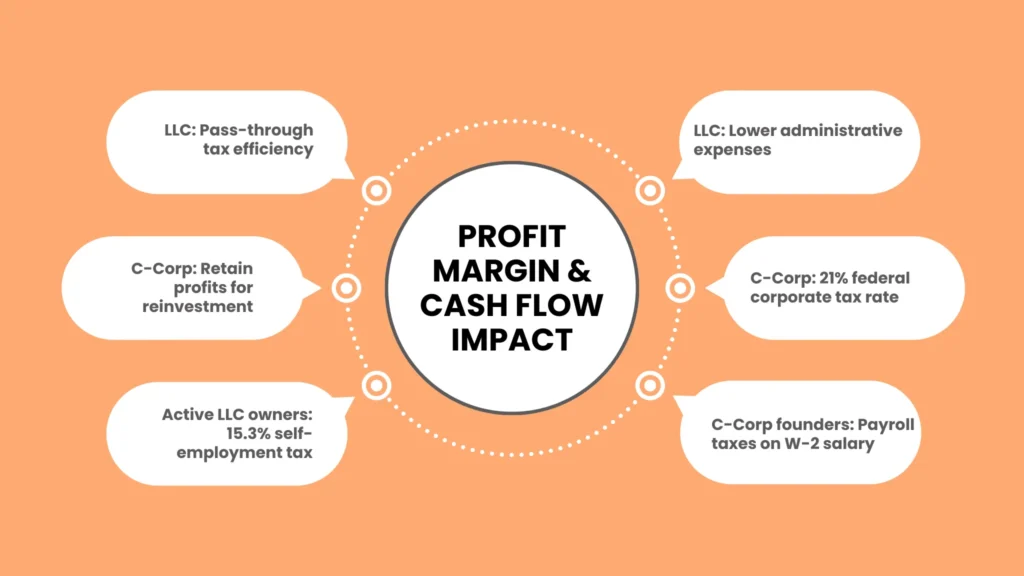
Pass-Through Tax Efficiency for Early Profitability: For bootstrapped startups that generate cash flow early, an LLC lets revenue pass directly to personal returns. Thus, founders can offset startup costs against other income and eliminate business-level tax filings.
Reinvesting Profits at Flat Corporate Rates: C-Corps allow companies to retain earnings inside the business. You can use these funds for software development, inventory acquisition, and hiring. Reinvested profits are taxed at a flat federal corporate rate (currently 21%). As a result, you can protect net operational margins if you fall into higher personal tax brackets.
Optimizing Self-Employment Tax Liabilities: Active LLC owners pay self-employment taxes (15.3% for Social Security and Medicare) on all net earnings. In contrast, C-Corp founders pay payroll taxes only on their W-2 salary. You can then distribute remaining profits as dividends or retain them for growth.
Minimizing Administrative Expense Drag: Complex C-Corp governance routines generate mandatory legal and accounting expenses. For small, lean teams with modest revenue, these costs compress early profit margins. Therefore, starting as a streamlined LLC helps protect early working capital.
Operational Guidelines: Business Structure for Startup Requirements
Fulfilling basic statutory rules protects your personal assets. Furthermore, it keeps your company in good standing with tax authorities. What essential business structure for startup requirements must you manage from day one?
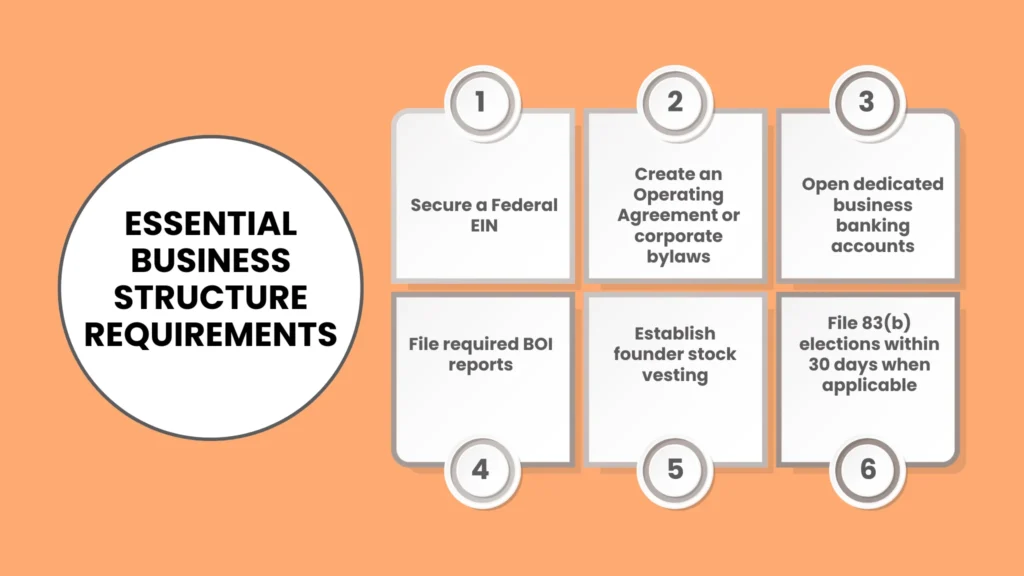
Essential Compliance Checklist
[ ] Secure Federal Employer Identification Number (EIN): Register immediately with the IRS to obtain a free business tax ID number.
[ ] Execute Internal Governance Agreements: Draft an Operating Agreement for an LLC. Alternatively, formalize Corporate Bylaws and Initial Board Resolutions for a C-Corp.
[ ] Open Dedicated Business Banking Accounts: Never mix personal funds with business accounts. Mixing funds breaks your legal shield and exposes personal assets to lawsuits.
[ ] File Beneficial Ownership Information (BOI) Reports: Submit mandatory federal ownership structure disclosures to FinCEN following incorporation.
[ ] Implement Founder Stock Vesting: Secure your equity allocation using restricted stock purchase agreements with a standard four-year vesting schedule and a one-year cliff.
[ ] File IRS Section 83(b) Elections Promptly: Founders receiving restricted stock in a C-Corp should file an 83(b) election with the IRS within 30 days of issuance. This step prevents massive personal tax burdens as your valuation rises.
“Entity setup is just one piece of the puzzle check our full breakdown of legal mistakes startup founders make to avoid costly compliance gaps beyond incorporation.
Commercial Viability: Is Business Structure for Startup Profitable?
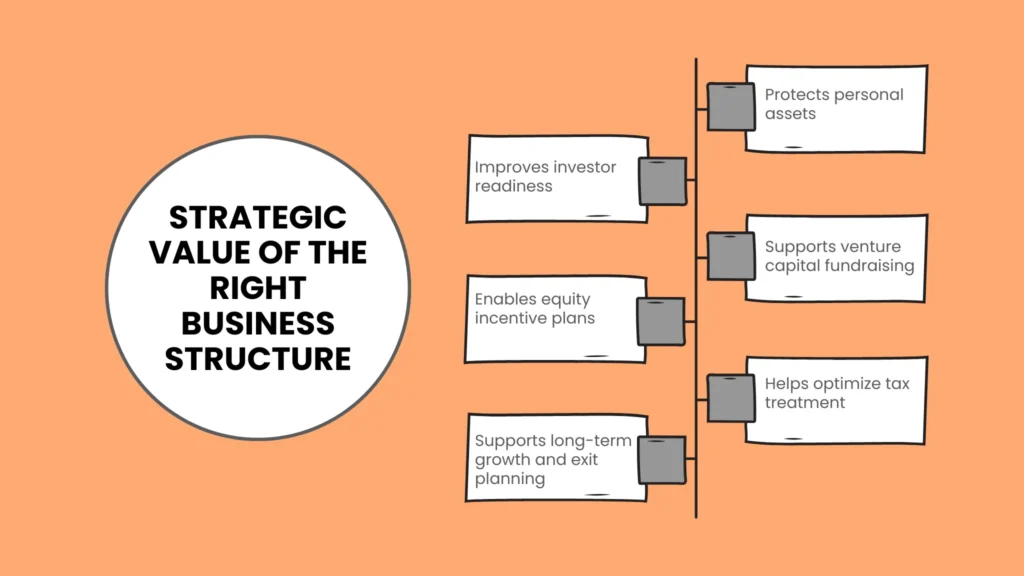
Forming and maintaining an entity costs money upfront. Nevertheless, is business structure for startup profitable as a core strategic decision? Yes, establishing a proper business structure is a high-return investment. It protects asset value and unlocks growth capital:
Personal Liability Risk Mitigation: Operating as a registered entity insulates your personal bank accounts and savings from corporate liabilities. It also protects you from vendor disputes and unexpected lawsuits.
Unlocking Institutional Venture Capital: Raising institutional investment requires a standard Delaware C-Corp structure. Setting up this structure correctly allows you to secure venture funding, issue incentive options, and scale rapidly.
Unlocking Section 1202 QSBS Tax Exemption: Founders holding Qualified Small Business Stock (QSBS) in an eligible C-Corp for at least five years can exclude up to 100% of capital gains taxes upon an exit. This tax incentive provides immense financial upside for successful founders.
Deep-Dive Analysis: Strategic Execution Pathways
To choose the optimal entity structure, founders must evaluate their product roadmap and hiring strategy. Furthermore, you must consider your target exit timeframe.
Path 1: The Bootstrapped and Revenue-First Business
If you are self-funding your business and generating immediate revenue, an LLC is often the most practical choice. This path works best if you plan to retain majority ownership without seeking venture capital.
An LLC minimizes administrative drag and annual legal fees. Consequently, you can focus on product development and profit generation. If your business model changes later, you can execute a conversion to turn your LLC into a C-Corp.
Path 2: The Venture-Backed Technology Startup
Building a high-growth technology company requires significant resources. If you need equity capital, stock pools for engineers, and venture investment, form a Delaware C-Corp from the start.
Incorporating directly as a C-Corp avoids future legal conversion fees. Additionally, it keeps your capital table clean and prepares your legal foundation for due diligence from angel networks and accelerators.
Final Thoughts on Business Structure Strategy
Selecting the right business structure for startup growth gives your venture a stable legal foundation. Furthermore, it protects your personal assets and optimizes your tax posture. Compare llc vs c-corp for startups carefully based on your funding timeline, operational complexity, and exit ambitions. Completing your corporate filings early protects your net profit margins and positions your company for commercial success or more entity calculators, legal checklists, and operational frameworks, explore the guides available on reliablestartup.
Frequently Asked Questions
Can I convert an LLC into a C-Corporation later?
Yes, you can convert an LLC into a C-Corp through a statutory conversion or merger. This process is common when you are ready to raise institutional capital. However, starting directly as a C-Corp eliminates future legal conversion fees and simplifies early stock option recordkeeping.
Why do most venture-backed tech startups incorporate in Delaware?
Delaware offers business-friendly statutes and predictable legal precedents. In addition, its specialized Court of Chancery resolves corporate disputes efficiently without juries. Therefore, venture capital firms worldwide prefer Delaware C-Corps because the legal framework is standardized.
What is the difference between an S-Corp and a C-Corp?
An S-Corporation is not a distinct legal entity type. Rather, it is a special IRS tax election that an eligible LLC or C-Corp can file. S-Corps provide pass-through taxation while allowing active owners to save on self-employment taxes through salaries. However, S-Corps have strict limits. For instance, they cannot have more than 100 shareholders or institutional investors.