How to Dispose of Tires Properly: 10 Safe and Eco-Friendly Options
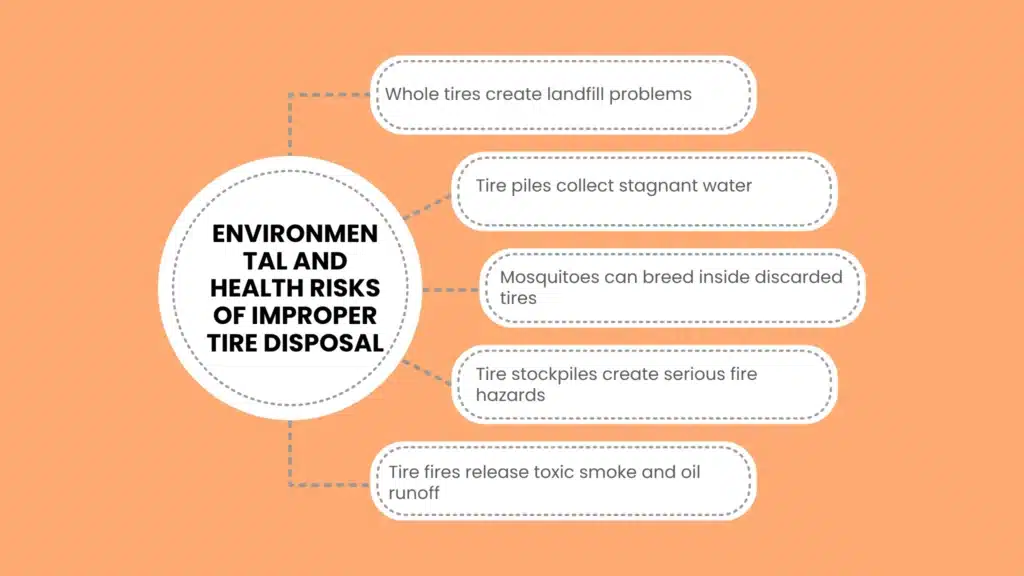
Managing discarded tires poses a significant environmental challenge if handled improperly. Millions of worn tires are removed from vehicles across the globe every year. As a result, this creates a massive stream of solid waste that requires careful handling. Scrap tires trap methane gas and occupy valuable landfill volume. Additionally, they act as ideal breeding grounds for disease-carrying pests when left outdoors in backyards or vacant lots. Furthermore, improper tire storage creates severe fire hazards that are notoriously difficult to extinguish, releasing toxic smoke and hazardous oil runoff into local groundwater systems.
Learning how to dispose of tires correctly prevents illegal dumping and supports sustainable industrial manufacturing. Consequently, when rubber products are routed into proper recycling streams, processors convert them into valuable raw materials for infrastructure, sports facilities, and consumer goods. Below is an exhaustive breakdown of why tire waste requires special care, legal standards for handling scrap rubber, 10 safe pathways for old tire disposal, and creative upcycling alternatives for homeowners and business owners alike.
The Environmental and Health Risks of Improper Tire Disposal
Rubber tires are engineered to be extremely durable, resistant to heat, and capable of enduring thousands of miles of intense road friction. While these properties make tires exceptional for transportation, they also make scrap tire disposal uniquely difficult. Whole tires do not decompose naturally like organic matter. Therefore, if they are left exposed to the elements, synthetic rubber compounds can remain virtually intact for centuries.
Landfill Complications and Gas Trapping
Whole tires are banned from municipal landfills across most states, provinces, and territories. Because tires are hollow and elastic, they trap air and volatile landfill gases such as methane. Over time, as surrounding garbage settles and compacts, this trapped gas generates upward buoyancy. Tires gradually float to the surface of landfill cells in a process called rising. As the tires push upward, their rigid steel belts and sharp edges can puncture expensive landfill liners designed to prevent toxic leachate from leaking into underlying freshwater aquifers.
Disease Vector Risks
Discarded tires stored outdoors are among the most effective artificial breeding sites for mosquitoes. The curved inner structure of a tire catches rainfall. Furthermore, it keeps the water shaded, stagnant, and insulated from temperature swings. Species such as the Asian tiger mosquito favor water-filled tires over natural ponds. A single discarded tire holding stagnant water can incubate thousands of mosquito larvae every week. Therefore, this issue significantly increases the spread of vector-borne illnesses like West Nile virus, Dengue fever, and Zika virus.
Uncontrolled Tire Fires
Tire stockpiles present extreme fire hazards. Although tires are difficult to ignite, a mass tire fire is nearly impossible to put out with traditional water-based firefighting techniques. The interior of a burning tire pile creates a self-sustaining furnace environment. As the synthetic and natural rubber melts, it produces pyrolytic oil that flows like liquid fuel, contaminating surrounding soils and rivers. Additionally, tire fires emit dense, toxic black smoke filled with heavy metals, benzene, butadiene, and polycyclic aromatic hydrocarbons, causing serious respiratory hazards for nearby communities.
10 Safe and Eco-Friendly Ways to Dispose of Old Tires
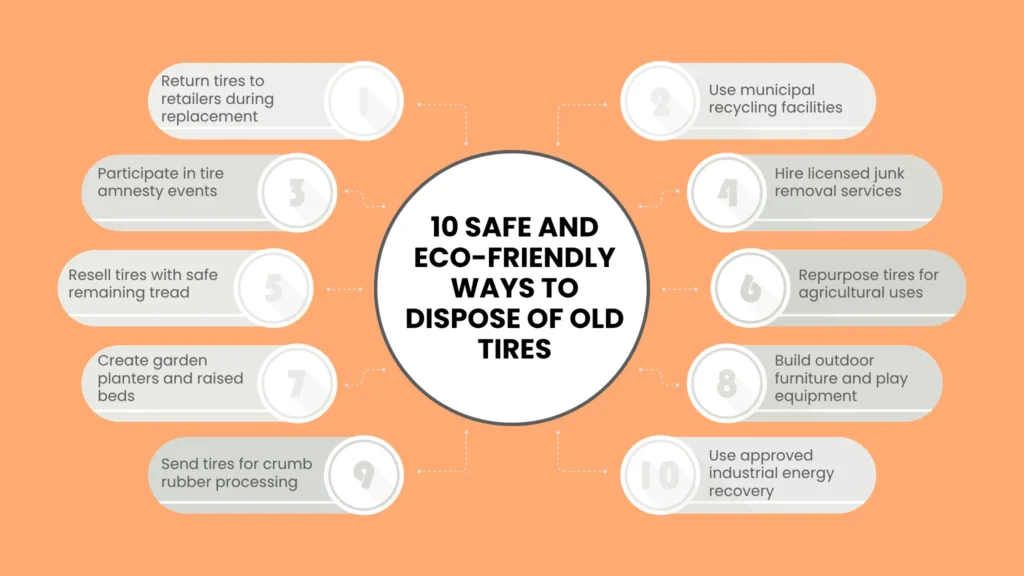
Responsible waste management relies on prioritizing reduction, direct reuse, mechanical recycling, and energy recovery. Depending on the physical condition of your tires and your local service options, the following ten options provide safe, compliant, and environmentally sound avenues for managing scrap rubber.
1. Leave Old Tires with Your Retailer During Replacement
The most straightforward method for managing old tire disposal occurs at the exact moment you buy new tires. When an auto shop or tire center mounts a fresh set of tires onto your vehicle, they routinely offer to take your worn set.
Retailers charge a small fee, often referred to as a tire recycling fee or environmental fee, which typically ranges from $2 to $5 per tire. This fee covers the shop’s logistical costs for storing scrap tires in dedicated bins. Furthermore, it covers hiring certified hauling services to transport them directly to permitted recycling processors. Choosing this option resolves your disposal needs immediately at the point of service. As a result, you eliminate the need to haul dirty tires in your trunk or back seat.
2. Drop Off Tires at Municipal Recycling Facilities and Transfer Stations
If you have scrap tires stored in your garage or shed from past vehicle maintenance, your local government solid waste department usually provides dedicated drop-off sites. Municipal transfer stations, public recycling centers, and regional landfills frequently maintain specialized scrap tire collection zones.
Because municipalities aim to discourage illegal dumping in ditches and public parks, many county facilities allow residents to drop off up to four passenger vehicle tires per year for free or for a minor handling charge. However, when using municipal facilities, ensure that you remove the tires from their metal wheel rims unless the facility explicitly states it accepts mounted units. Metal rims are typically separated and processed through scrap metal recyclers.
3. Participate in Local Community Tire Amnesty Days
City councils, county health departments, and environmental agencies regularly organize free tire amnesty events to combat rural tire dumping and help homeowners clean up long-standing scrap piles. State or regional waste management grants fully fund these public collection drives.
During an amnesty day, residents can load scrap passenger car tires, light truck tires, and even smaller lawnmower or tractor tires into their vehicles. Then, they can drop them off at designated collection points without paying processing fees. Consequently, these events remove thousands of dangerous tires from local neighborhoods each year, preventing mosquito outbreaks and lowering local fire risks.
4. Hire a Licensed Junk Removal Service for Large Quantities
When clearing out an inherited property, cleaning up a commercial garage, or liquidating an old farmstead, you may face dozens or even hundreds of discarded tires. Transporting large quantities yourself can be labor-intensive. Additionally, it may require special commercial transport permits under local environmental laws.
Hiring a licensed, professional junk removal company simplifies bulk clearance. Reputable hauling companies provide the labor, heavy machinery, and transport vehicles necessary to haul away large stockpiles safely. However, before hiring a company, ask for documentation confirming that they transport their collected tires to a state-permitted recycling facility rather than an unapproved storage site.
5. Sell or Donate Used Tires with Safe Remaining Tread
Not every tire removed from a vehicle is ready for the shredder. For instance, if a set of tires was removed early during a vehicle upgrade, or if only two tires were replaced after a puncture, the remaining tires may still have usable life.
Tires that possess at least 4/32 of an inch of tread depth, display uniform wear across the surface, and show no signs of dry rot, cracking, or sidewall damage can be resold or donated. Auto repair shops, used tire retailers, and online marketplace buyers routinely purchase pre-owned tires for budget-conscious drivers. Extending the functional driving lifetime of a tire through direct resale reduces demand for new raw rubber manufacturing. Moreover, it delays the processing energy required for industrial recycling.
6. Repurpose Intact Tires for Agricultural and Farming Uses
Agricultural operations have utilized scrap tires for decades as practical structural tools. Farmers and homesteaders routinely repurpose large truck, tractor, and industrial tires to solve everyday material management challenges.
Silage Pit Tarps: Farmers stack heavy truck tires on top of large plastic sheeting that covers silage and livestock feed bunkers. The weight of the rubber holds the plastic down tight against wind storms while preventing air pockets that spoil animal feed.
Erosion Control: Stacking and interlinking tires along steep hillsides, creek banks, or farm lanes creates strong retaining walls that prevent soil erosion during heavy spring rains.
Livestock Feeders and Waterers: Large tractor tires with their upper sidewalls cut out serve as heavy-duty, indestructible feeding troughs or water basins for cattle and horses.
7. Upcycle Old Tires into Garden Planters and Raised Beds
For homeowners seeking creative landscape features, old tires can be converted into outdoor planters. Synthetic rubber retains heat from sunshine. Therefore, it keeps soil warm and encourages root development for ornamental plants, flowering annuals, and small shrubs.
To build a safe tire planter:
Wash the exterior of the tire thoroughly with eco-friendly soap and water to remove road grime, brake dust, and oil residue.
Apply a coat of non-toxic, exterior-grade outdoor paint to brighten the rubber and reduce heat absorption if planting delicate species.
Drill multiple half-inch drainage holes through the bottom sidewall to prevent waterlogging.
Line the interior bottom with durable landscape fabric to hold the potting soil in place while allowing excess rainwater to drain naturally.
8. Build DIY Outdoor Play Equipment and Garden Furniture
With basic woodworking tools and hardware, homeowners can upcycle scrap tires into long-lasting outdoor furniture and recreational equipment for backyards.
Classic Tire Swings: Inspect a clean passenger tire to confirm no internal steel wires are exposed. Drill drainage holes in the bottom rim to prevent rainwater collection. Next, attach heavy-duty eye bolts through the top tread, and suspend the tire securely from a mature tree branch using rated outdoor rope or coated chain.
Woven Patio Seating: By wrapping a washed tire in natural jute cord or weatherproof nautical rope and attaching wooden legs to the underside, you can create a sturdy, weather-resistant outdoor ottoman or footrest.
Child Play Structures: Half-buried tires set vertically in a line in the ground create balance beams, climbing courses, and sandbox surrounds for backyard play areas.
9. Commercial Crumb Rubber Processing and Manufacturing
When scrap tires reach industrial recycling facilities, workers feed them into mechanical shredders to make crumb rubber. Heavy machinery strips out internal steel cords using powerful magnets. Furthermore, air separators remove synthetic fiber netting, and grinding machines reduce the remaining vulcanized rubber into clean, uniform granules.
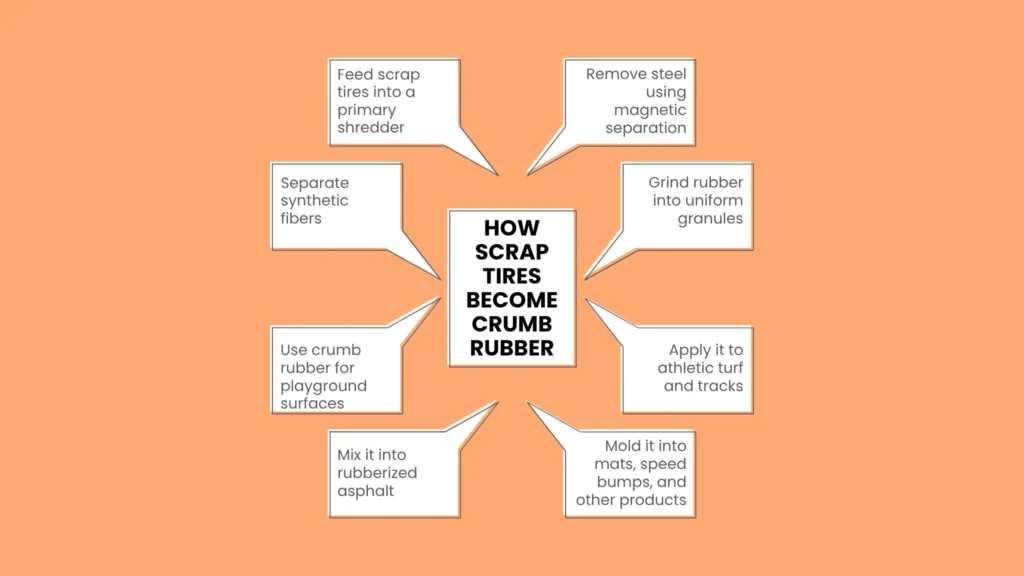
This recycled granulated rubber serves as a core material across multiple industries:
Playground Surfacing: Shredded rubber mulch provides superior shock absorption under swings and climbing sets compared to traditional wood chips or gravel.
Athletic Turf and Tracks: Fine crumb rubber granules are used as infill material for synthetic turf fields, providing cushion and traction for athletes while reducing joint impacts.
Rubberized Asphalt: Mixing finely ground tire rubber into hot asphalt paving compounds creates highways that are quieter, more resistant to thermal cracking, and longer-lasting under heavy highway traffic.
Molded Products: Recycled rubber granules are molded into durable commercial products including commercial floor mats, mud flaps, speed bumps, and acoustic dampening underlayments for building construction.
10. Thermal Conversion and Industrial Energy Recovery
Tires that are too worn, contaminated, or damaged for mechanical recycling can undergo energy recovery processes. Synthetic rubber possesses a high calorific value. In fact, it contains roughly the same energy content per pound as petroleum oil and significantly more energy than coal.
Tire-Derived Fuel (TDF): Processed scrap tires are shredded into uniform chips and used as a supplemental fuel source in energy-intensive industrial operations, such as cement kilns, pulp and paper mills, and electrical utility boilers. When burned in specialized high-temperature industrial settings equipped with advanced scrubbers, TDF burns cleaner and produces lower nitrogen oxide emissions than standard coal.
Pyrolysis and Chemical Recycling: Pyrolysis involves heating shredded tires inside an oxygen-free chamber to temperatures exceeding 1,000°F (538°C). Because no oxygen is present, the rubber does not burn. Instead, the thermal reaction breaks the complex chemical bonds down into usable synthetic fuel oil, combustible gas, carbon black powder, and high-purity scrap steel wire.
Comparative Overview of Tire Handling Options
To help you decide which path fits your current situation, the following matrix compares accessibility, typical costs, and primary use cases across common tire disposal approaches.
| Handling Option | Ideal Use Case | Relative Cost Structure | Primary Output / Result |
| Retailer Trade-In | Replacing tires at an auto shop | Small fee ($2 – $5 per tire) | Industrial Recycling |
| Municipal Drop-Off | Homeowners with 1 to 4 old tires | Free to nominal processing fee | Controlled Shredding |
| Amnesty Clean-Up Days | Clearing residential scrap piles | Free during official events | Bulk Material Recovery |
| Junk Removal Service | Clearing commercial properties | Variable haulage service fee | Verified Facility Delivery |
| Direct Used Tire Resale | Tires with > 4/32″ tread remaining | Generates income for owner | Direct Re-use |
| Agricultural Utilization | Farms, ranches, and homesteads | Free / Recycled scrap supply | Tarps, Feeder & Wall Use |
| DIY Household Upcycling | Gardeners and DIY enthusiasts | Minimal hardware costs | Planters, Furniture, Swings |
| Industrial Crumb Rubber | Worn-out passenger tires | Handled by commercial processors | Turf, Asphalt, Mats |
| Tire-Derived Fuel (TDF) | Non-recyclable industrial rubber | Handled by energy plants | Industrial Power Generation |
Important Safety and Legal Guidelines for Handling Tires
Navigating scrap tire management requires adherence to basic environmental safety protocols and municipal ordinances.
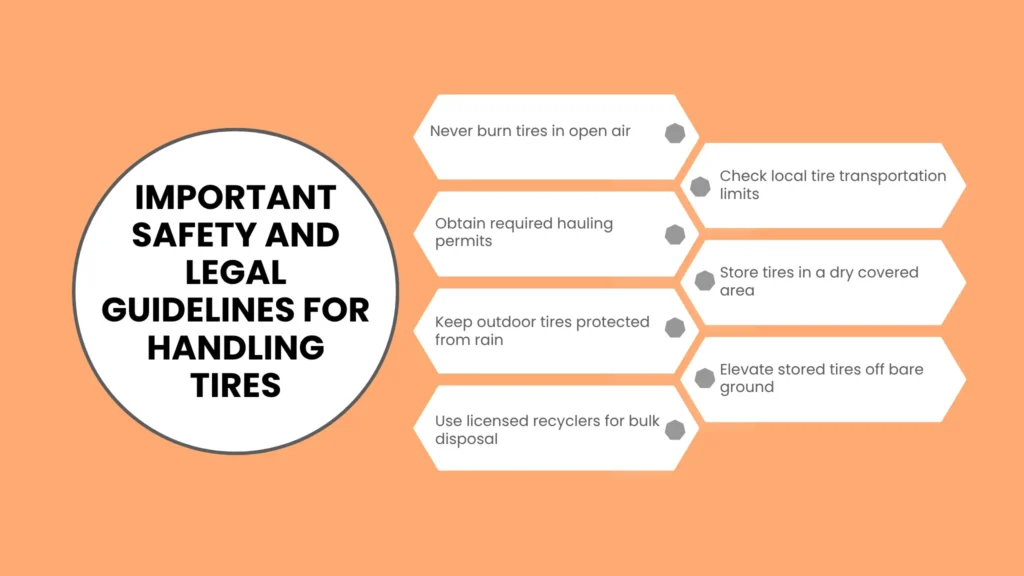
1. Never Burn Tires Openly
Open tire burning is illegal across almost all jurisdictions. Open-air fires lack the high temperatures and advanced filtration systems found in industrial kilns. As a result, they release carcinogenic air pollution, toxic soot, and heavy metals directly into nearby air streams. Landowners caught open-burning tires face significant environmental fines and liability for fire response costs.
2. Check Transportation Limit Laws
Many state and regional environmental protection agencies restrict the number of scrap tires an individual can transport without holding a registered waste hauler permit. In many areas, carrying more than four to nine unregistered tires in a personal pickup truck or trailer can trigger legal penalties intended to prevent commercial dumping. Therefore, if moving large numbers of tires, obtain a temporary transport permit or hire a registered hauler.
3. Maintain Safe Storage Practices
If you must store tires temporarily on your property before taking them to a recycling station:
Store tires indoors inside a dry garage, shed, or covered barn whenever possible.
If stored outdoors, stack tires neatly under a heavy waterproof tarp secured with bungee cords to exclude all rain and debris.
Elevate the bottom layer of tires off the bare ground using wooden pallets to discourage nesting rodents and snake activity.
Summary of Key Takeaways
Knowing how to dispose of tires properly is an essential part of responsible environmental management. Because whole tires create severe landfill hazards, foster pest breeding grounds, and present serious fire risks, choosing safe disposal pathways is critical for community health and natural resource conservation.
Whether you trade in your old set at a local auto retailer, drop them off during municipal amnesty clean-up events, support industrial crumb rubber processing, or upcycle tires into functional farm and garden features, selecting eco-friendly options ensures that scrap rubber gets repurposed safely and effectively.
For more practical step-by-step business guides, emerging startup frameworks, and operational strategies, visit reliablestartup.com.
Frequently Asked Questions
Why do tire shops charge an environmental or disposal fee?
Tire shops charge disposal fees to cover the actual expenses associated with scrap tire handling. These include paying state transport taxes, renting storage bins, labor for manual sorting, and contracting with licensed scrap tire haulers who transport the tires to permitted industrial recycling processors.
Can whole tires be melted down into liquid rubber to make new tires?
No, whole tires cannot be melted back down easily. Vehicle tires are made using vulcanized rubber, which is a chemical process that cross-links polymer chains with sulfur under heat and pressure. Once rubber is vulcanized, it cannot be melted back down into a simple liquid state like plastic or glass. For this reason, recycling relies on mechanical grinding into crumb rubber or chemical breakdown via pyrolysis.
How much tread depth must remain for a tire to be safely reused?
A tire is generally considered legally worn out and unsafe for road use when the tread depth reaches 2/32 of an inch. For a used tire to be resold or reused safely, it should have a minimum of 4/32 of an inch of remaining tread. Furthermore, it must display even surface wear, be less than six years old based on its DOT manufacture date, and show no sidewall cracking or structural cord exposure.
Are tire planters safe for growing edible vegetables?
While tire planters are safe for ornamental flowers and landscape shrubs, you should avoid growing edible root vegetables or leafy greens directly against unlined rubber. Over long periods, exposure to sunlight, water, and soil microbes can cause trace organic compounds and heavy metals to leach from synthetic rubber. However, if you use a tire for edible crops, line the interior completely with heavy food-grade plastic sheeting to form an impermeable barrier between the soil and the rubber walls.