Multi Unit Franchise Ownership: When to Buy Your Second Location

The right time to expand into multi unit franchise ownership is when your first location generates consistent, predictable cash flow, operates smoothly under a trusted general manager without your daily presence, and you have secured sufficient liquid capital to fund a second launch without straining your existing business.
Expanding too early often turns one profitable store into two struggling ones, whereas waiting until your systems are battle-tested creates a repeatable blueprint for sustainable wealth.
Transitioning from a single-unit operator to a multi-unit owner shifts your role entirely. Instead of managing daily shifts, inventory orders, and customer complaints, you become an executive overseeing managers, site selection, and portfolio-level finance. A fractional CFO for startups can help you evaluate financial readiness and plan expansion.
Understanding the exact readiness signals both inside your current store and in your personal balance sheet ensures your expansion is driven by strategy rather than impatience.
What Is Multi Unit Franchise Ownership?
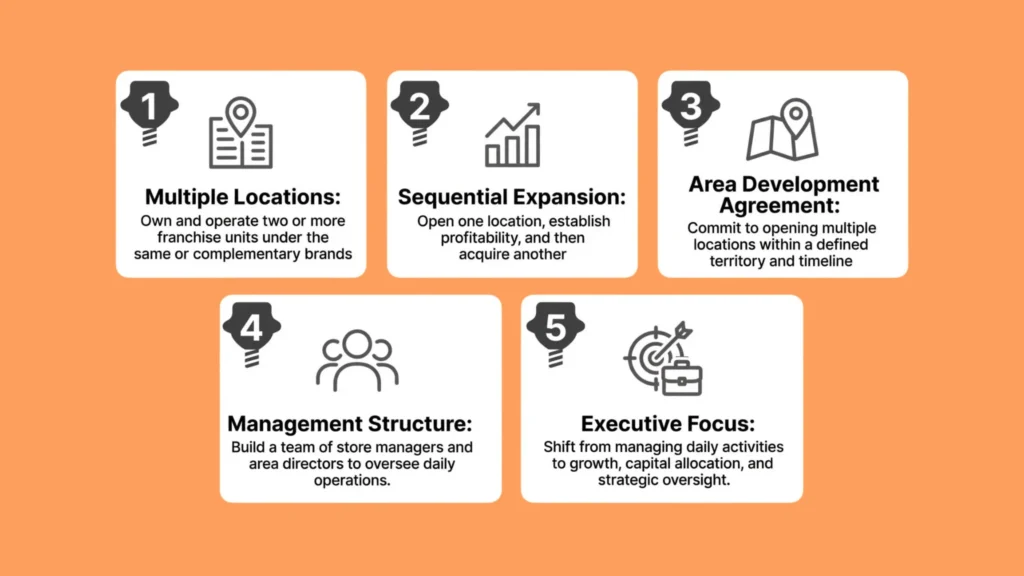
Multi-unit franchise ownership is a business model in which a single franchisee owns and operates two or more franchise locations, either within the same brand or across complementary brands.
Rather than trading personal hours for store-level income, multi-unit operators build an organizational layer of store managers and area directors to oversee daily operations while the owner focuses on growth, business investment, capital allocation, and executive oversight.
Franchisees typically enter multi-unit ownership through two distinct pathways:
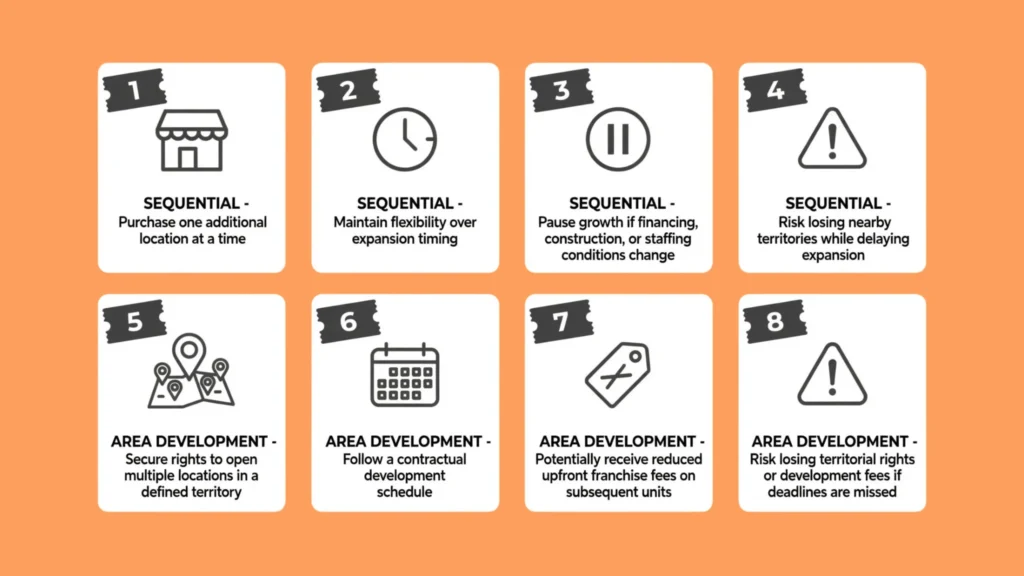
Sequential Expansion: Opening one location, mastering its operations, and purchasing a second franchise unit once the first proves profitable and stable.
Area Development Agreement: Signing a binding contract with the franchisor upfront to open a set number of locations within a defined geographic territory over an agreed timeline.
Both approaches offer distinct advantages, but your readiness to sign an expansion agreement depends heavily on how your first unit performs under real-world pressure.
Key Financial Benchmarks Before Buying a Second Franchise Unit

Before looking at real estate or requesting additional franchise disclosure documents, your first store must prove it can fund growth without compromising its own stability. Strong multi unit economics rely on healthy unit-level margins that can absorb the overhead of above-store management.
1. Consistent Store-Level Profitability
Your first location should demonstrate at least 12 to 18 months of steady, predictable net profit after covering all operating expenses, royalty fees, marketing funds, and debt service.
A single strong quarter especially during a seasonal peak or grand opening surge, is not reliable proof of concept. You need to see how the business performs during slow months and how resilient your margins are against local labor or supply fluctuations.
2. Strong Debt Service Coverage and Cash Reserves
Lenders evaluating multi-unit expansion look closely at your existing cash flow. Generally, your first unit should generate enough free cash flow to cover its own debt obligations comfortably while contributing toward working capital.
In addition to meeting the franchisor’s liquid capital and net worth requirements for the new unit, maintain a dedicated cash reserve equal to three to six months of operating expenses for both the existing store and the new location. Proper financial planning for business owners can help you manage these reserves and prepare for unexpected expenses.
3. Capital Structure Ready for Expansion
Opening a second location requires upfront franchise fees, leasehold improvements, equipment, permitting, and pre-opening payroll. Relying entirely on the cash flow of Store One to pay for Store Two’s construction can starve your original business of needed maintenance or marketing funds.
Ensure you have a clear financing mix whether through retained earnings, SBA loans, conventional commercial credit lines, or equipment financing before committing to a lease.
Operational Readiness: Signs Your First Store Can Run Without You

The most common bottleneck in multi-unit growth is an owner who is still essential to daily operations. If your first store loses efficiency, quality, or morale whenever you take a week off, adding a second location will divide your attention and degrade performance across both sites.
You Have Installed a Capable General Manager
You cannot physically be in two places at once. Before acquiring a second franchise unit, you must recruit, train, and empower a store manager who handles scheduling, local hiring, inventory management, and customer service independently.
Your manager should already be running day-to-day operations for at least three to six months while meeting key performance indicators (KPIs) without constant intervention.
Standard Operating Procedures Are Documented and Followed
In a single unit, you can rely on personal oversight to correct mistakes on the spot. Across multiple units, consistency requires documented systems. Your checklists, opening and closing procedures, training modules, and vendor ordering schedules must be standardized so that a new team in a new location can replicate your first store’s customer experience from day one.
Compliance and Brand Standards Are Effortless
Franchisors closely audit multi-unit candidates before approving expansion. Your first location should consistently pass brand inspections, maintain high customer satisfaction scores, and submit financial reports and royalty payments on time. Franchisors rarely award additional territories to operators who struggle with compliance at their flagship site.
Understanding Multi Unit Economics
Expanding from one location to two or more changes your cost structure in ways that differ significantly from single-unit ownership. Understanding multi unit economics helps you avoid underestimating overhead during your first expansion.
| Economic Factor | Single-Unit Ownership | Multi-Unit Ownership (2+ Units) |
| Owner Role | Hands-on store manager and operator | Executive leader overseeing managers |
| Labor Cost Structure | Owner often fills management gaps | Must fund dedicated store-level managers |
| Purchasing & Vendor Leverage | Standard system pricing | Potential bulk discounts and shared delivery |
| Marketing Efficiency | Covers a single local trade area | Shared regional ad spend and brand halo effect |
| Administrative Overhead | Minimal; handled by owner | Shared bookkeeping, HR, and district oversight |
When moving from one unit to two, your overhead temporarily increases because you must pay for a full-time manager at each location while the combined revenue of just two stores may not yet justify a dedicated district manager.
True economies of scale where shared administrative staff, bulk inventory orders, and regional marketing reduce your per-store operating costs typically become most pronounced once you reach three to five locations. Planning for this transitional dip in net margin prevents financial surprises during your second year of operation.
Sequential Expansion vs. an Area Development Agreement
When deciding how to acquire your next location, you will typically choose between buying one additional unit at a time or committing to an area development agreement.
Buying a Single Additional Unit
Purchasing one unit at a time gives you maximum flexibility. You retain full control over your timeline, allowing you to pause expansion if interest rates rise, construction costs spike, or a key manager leaves.
The trade-off is territory protection: while you focus on stabilizing your first store, another franchisee could acquire the prime real estate or adjacent zip codes you hoped to enter later.
Signing an Area Development Agreement
An area development agreement grants you the exclusive right and the legal obligation to open a specific number of units within a designated territory according to a strict development schedule.
Franchisors often incentivize multi-unit commitments by reducing upfront franchise fees on subsequent units. However, missing your opening deadlines can result in losing your territorial exclusivity, forfeiting development fees, or facing default penalties. This option works best once you have proven your management pipeline and secured reliable access to capital.
Strategic Timing: Market and Territory Factors
Even when your internal finances and operations are ready, external market conditions play a decisive role in timing your second purchase.
Proximity and Travel Time: Your second location should ideally be within a 30-to-60-minute drive of your first store. Close proximity allows you to visit both sites in a single day, share staff during unexpected absences, transfer excess inventory, and build localized brand recognition.
Real Estate Availability: Commercial real estate cycles rarely align perfectly with your internal calendar. If a premier, high-visibility site in an adjacent trade area becomes available slightly ahead of your target timeline and your finances are secure acting early can lock in a long-term competitive advantage. Conversely, never rush into a weak location simply to meet a self-imposed expansion goal.
Cannibalization Risk: Work with your franchisor to analyze demographic data and customer origin reports so your second store captures new customers rather than pulling existing traffic away from your first location.
Common Mistakes to Avoid When Expanding to a Second Location
Avoiding preventable missteps protects both your original investment and your long-term growth trajectory.
Expanding to Fix a Struggling First Store: Buying a second unit will not solve low margins, high turnover, or weak local demand at your first location. Fix foundational operational issues before duplicating your business model.
Underestimating Pre-Opening Cash Burn: Delays in permitting, build-out, and equipment delivery are common. Failing to budget for extended rent payments and pre-opening training payroll can strain your cash reserves before the doors even open.
Promoting Your Best Technician Instead of a True Leader: Your top-performing frontline employee is not automatically ready to be a general manager. Look for candidates with strong communication, accountability, and team-building skills, and train them well ahead of your second store’s launch.
Neglecting Your First Location During Launch: It is natural to pour energy into a new grand opening, but ignoring your flagship store during that window often leads to declining service standards and unexpected revenue drops at your primary cash engine.
Frequently Asked Questions
How long should I wait before buying a second franchise unit?
Most successful franchisees wait between 12 and 24 months after opening their first location before acquiring a second unit. This timeframe allows you to navigate a full annual business cycle, stabilize cash flow, and train a reliable store manager.
How much capital do I need for multi unit franchise ownership?
Beyond the liquid capital and net worth minimums set by your franchisor, you should have enough accessible financing to cover the second franchise fee, build-out, equipment, and at least three to six months of working capital reserves for both locations.
Is it better to open a second unit of the same brand or diversify?
Opening a second unit within the same brand is usually simpler and faster because you already know the operating systems, vendor relationships, and franchisor expectations. Diversifying into a second brand makes more sense once your initial brand territory is saturated or you have established an executive management team.
What happens if I fall behind schedule on an area development agreement?
If you fail to open locations by the deadlines outlined in your area development agreement, the franchisor may revoke your exclusive territory rights, keep your upfront development fees, or terminate the development agreement. Always negotiate realistic timelines before signing.
Can I use profits from my first franchise to fund my second location?
Yes, many operators use retained earnings from their first unit to help fund down payments or working capital for a second store. However, you should pair retained earnings with dedicated commercial financing rather than draining your first store’s cash reserves.
How close should my second franchise location be to my first?
Keeping your second location within a 30-to-60-minute drive of your first store simplifies oversight, enables staff and inventory sharing, and maximizes local marketing efficiency without stretching your travel time.
Final Thoughts
Timing your entry into multi unit franchise ownership comes down to readiness rather than speed. When your first store delivers consistent profitability across all seasons, runs smoothly under a capable general manager, and leaves you with healthy capital reserves, you have earned the operational foundation needed to scale.
By evaluating your unit-level economics honestly, choosing the right development structure for your risk tolerance, and selecting a strategic territory nearby, you can turn your second location into the cornerstone of a thriving multi-unit portfolio.
About The Author