Janitorial Bidding: The Square Foot Formula Explained
To calculate a commercial cleaning quote using the janitorial bidding square foot method, divide the building’s total cleanable square footage by your team’s hourly production rate to find the required labor hours, multiply those hours by your fully burdened hourly labor cost, and add supplies, overhead, and your desired profit margin.
Many new cleaning business owners rely on guesswork or simply multiply the total square footage by an arbitrary flat rate, such as ten cents per square foot. While flat-rate guessing is fast, it often leads to underbidding complex facilities or overbidding simple ones. Understanding the math behind square foot pricing allows you to build competitive, profitable proposals backed by real operational numbers.
Why Flat-Rate Square Foot Pricing Often Fails?
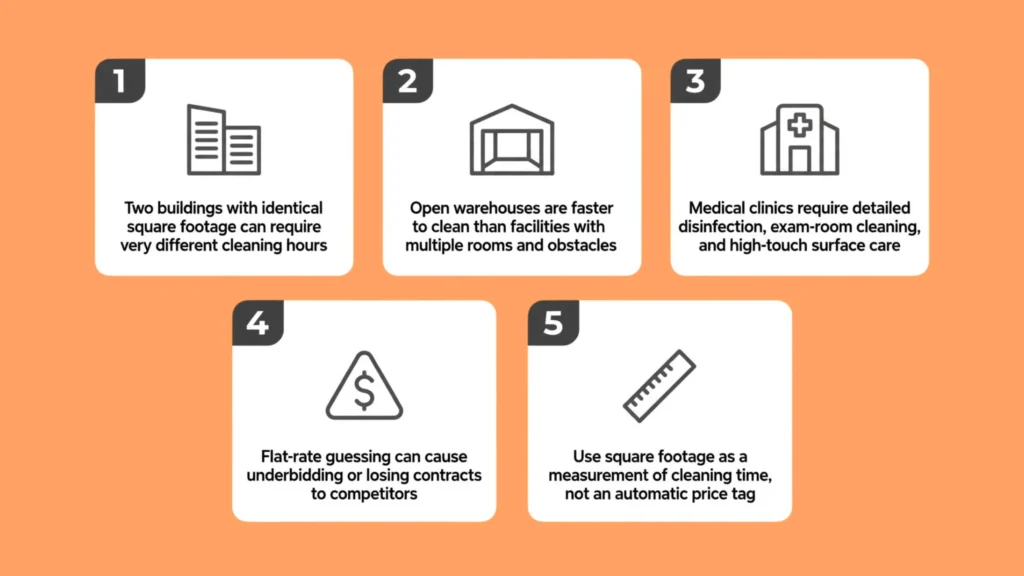
Charging a flat rate per square foot without calculating underlying labor hours is one of the fastest ways to lose money in commercial cleaning. Two buildings can both measure exactly 20,000 square feet yet require vastly different amounts of time and effort to maintain.
Consider the difference between a 20,000-square-foot open warehouse and a 20,000-square-foot outpatient medical clinic:
Open Warehouse: Mostly wide, unobstructed concrete floors that can be cleaned rapidly with an auto-scrubber, along with a small breakroom and two restrooms.
Medical Clinic: Dozens of small exam rooms, strict disinfection protocols, sinks in every room, waiting areas, and high-touch surfaces that require meticulous handwork.
If you apply the same flat square foot rate to both buildings, you will either price yourself out of the warehouse contract or lose money on every single visit to the medical clinic.
Medical facilities may also require specialized services, such as biohazard cleaning, which involve additional safety protocols and labor. A true cleaning bid calculation uses square footage as a starting measurement to determine time, not as an automatic price tag.
The Core Janitorial Bidding Square Foot Formula
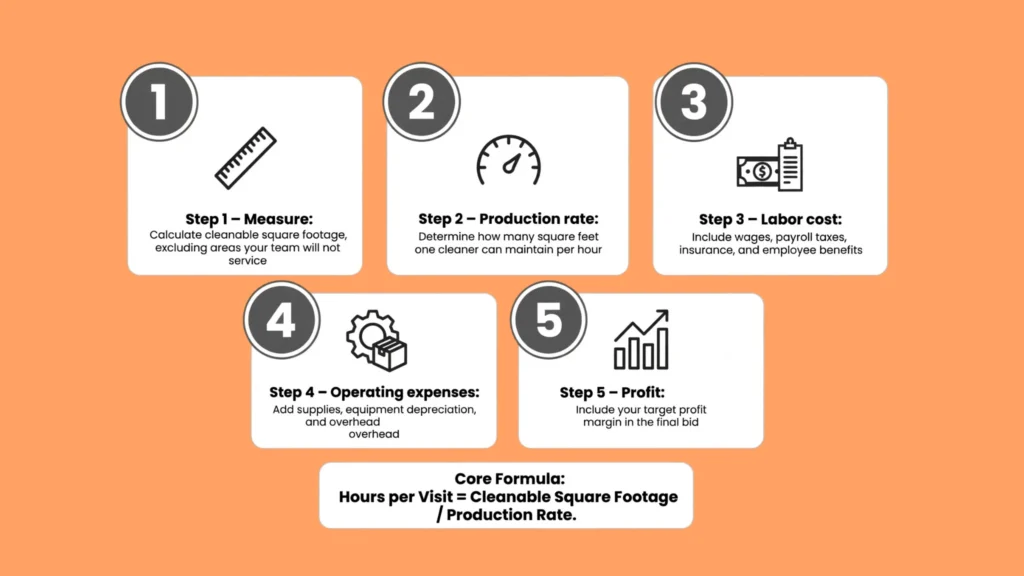
Before quoting a price, you need to translate physical space into labor hours. Labor is the single largest expense in any janitorial business, typically accounting for 50% to 65% of the total bid price.
Step 1: Measure Cleanable Square Footage
Start by determining the exact cleanable square footage of the facility during your walkthrough. Do not rely solely on gross building measurements provided on property tax records or leasing brochures. Gross square footage often includes mechanical rooms, elevator shafts, wall thicknesses, and storage closets that your team will never touch.
Focus on cleanable square footage, which includes lobbies, hallways, private offices, cubicles, conference rooms, restrooms, breakrooms, and stairwells. Separate the measurements by floor type (such as carpet, vinyl composite tile, ceramic tile, or hardwood) because different surfaces require different equipment and cleaning speeds.
Step 2: Determine Your Production Rate
A production rate in cleaning is the number of square feet one trained custodian can clean per hour under normal conditions. Industry standards, such as those published by ISSA (the worldwide cleaning industry association), provide baseline benchmarks, though you should always adjust them based on your equipment and staff efficiency.
Typical hourly production rates vary significantly by facility type and layout:
| Facility Type | Typical Production Rate (Sq. Ft. per Hour) | Key Factors Affecting Speed |
| Open Office / Cubicles | 3,500 – 4,500 | Wide aisles, backpack vacuums, low trash volume |
| Dense Office / Partitioned | 2,500 – 3,500 | Many locked doors, tight spaces, heavy furniture |
| Schools & Classrooms | 2,500 – 3,200 | Desks, chairs, whiteboards, frequent floor care |
| Medical & Dental Clinics | 1,500 – 2,200 | Strict sanitization, exam tables, high restroom count |
| Retail Stores | 3,000 – 4,500 | Display racks, glass entryways, open floor plans |
| Restrooms (Heavy Detail) | 800 – 1,200 | Fixture scrubbing, restocking, floor mopping |
Once you have the cleanable square footage and the appropriate production rate, calculate the hours per visit:
Step 3: Calculate Burdened Labor Costs
Multiplying your required hours by the employee’s base hourly wage is a common accounting mistake. You must calculate your fully burdened labor rate, which includes every cost associated with keeping that worker on your payroll.
Your burdened labor rate should include:
Base hourly wage
Employer payroll taxes (Social Security, Medicare, federal and state unemployment)
Workers’ compensation insurance
General liability insurance allocations
Paid time off, holidays, or benefits (if offered)
As a general rule of thumb, payroll taxes and insurance add roughly 18% to 28% on top of a worker’s base hourly pay, depending on your state and workers’ compensation classification. For example, if you pay a cleaner $16.00 per hour and your labor burden is 22%, your true hourly labor cost is $19.52 per hour.
Step 4: Add Supplies, Equipment, Overhead, and Profit
Once you know your exact labor cost per visit, add the remaining business expenses to reach your final monthly price:
Consumables and Supplies: Estimate the monthly cost of trash liners, chemicals, microfiber cloths, and vacuum bags. Typically, cleaning chemicals and supplies add 3% to 6% to your labor cost. (Note: Paper towels, toilet paper, and hand soap are usually billed separately or reimbursed by the client).
Equipment Depreciation: Factor in wear and tear on commercial vacuums, auto-scrubbers, and floor machines, usually around 2% to 4%.
Overhead: Include administrative salaries, office rent, software, vehicle fuel, and marketing expenses, commonly calculated at 10% to 15%.
Net Profit Margin: Add your target profit margin. Commercial janitorial profit margins generally range from 10% to 25%, depending on contract size and local competition.
Step-by-Step Cleaning Bid Calculation Example
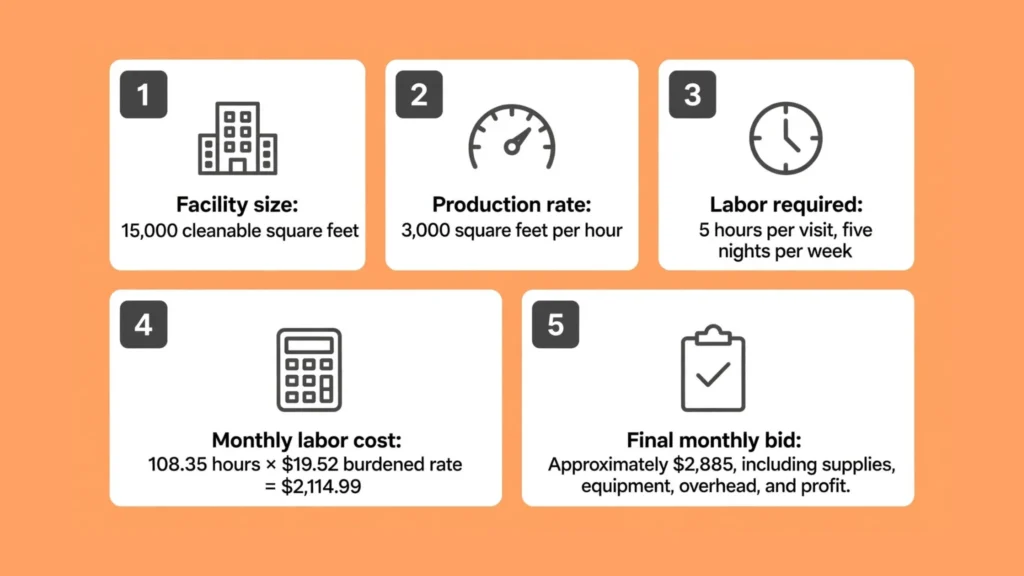
To see how the janitorial bidding square foot formula works in practice, walk through a realistic scenario for a standard 15,000-square-foot commercial office building serviced five nights per week.
1. Gather the Facility Details
Cleanable Area: 15,000 square feet (mix of commercial carpet and tile restrooms/breakroom)
Cleaning Frequency: 5 days per week (21.67 visits per month on average)
Estimated Production Rate: 3,000 square feet per hour
2. Calculate Monthly Labor Hours
Hours per Visit: $15,000 \div 3,000 = 5 \text{ hours per night}$
Monthly Hours: $5 \text{ hours} \times 21.67 \text{ visits} = 108.35 \text{ hours per month}$
3. Calculate Monthly Labor Cost
Base Wage: $16.00 per hour
Burdened Rate (at 22%): $19.52 per hour
Total Monthly Labor Cost: $108.35 \text{ hours} \times \$19.52 = \$2,114.99$
4. Add Supplies, Overhead, and Profit
Supplies & Equipment (5% of labor): $\$105.75$
Subtotal Direct Costs: $\$2,220.74$
Overhead & Profit Markup (30% combined): $\$666.22$
Total Monthly Bid Price: $\$2,886.96$ (or roughly $\$2,885$ per month)
If you divide that final monthly price by the building’s square footage ($\$2,886.96 \div 15,000$), your effective square foot pricing comes out to $0.19 per square foot per month. Notice how the square foot price is the result of the formula rather than an arbitrary starting guess.
Factors That Adjust Your Production Rate
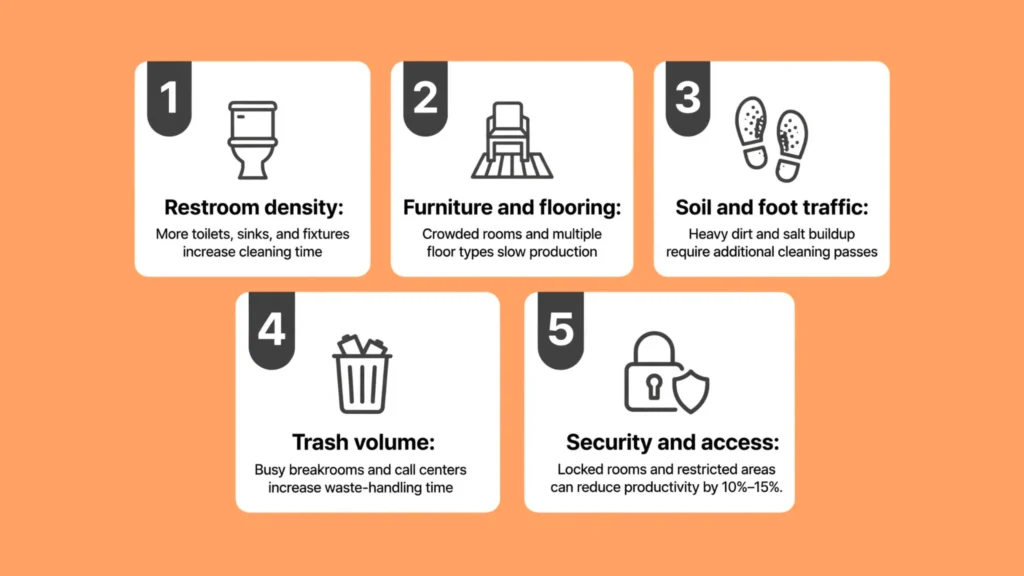
Even with a solid formula, real-world building conditions will speed up or slow down your crew. During your initial walkthrough, look closely for variables that require adjusting your baseline production rate:
Restroom Density: A 10,000-square-foot office with two restrooms takes far less time than a 10,000-square-foot call center with 16 restroom stalls. Restrooms require heavy scrubbing and sanitizing regardless of how much carpet surrounds them.
Flooring Transitions and Furniture: Open spaces allow cleaners to use commercial backpack vacuums efficiently. Rooms packed with rolling chairs, cords, and low desks force staff to move slower and bend frequently.
Soil Load and Foot Traffic: Buildings near construction zones, gravel parking lots, or harsh winter climates track in significantly more dirt and salt, requiring extra vacuuming and mopping passes.
Trash Volume: Call centers, breakrooms, and dining facilities generate heavy, wet trash that requires frequent liner changes and long walks to exterior dumpsters.
Security and Access: High-security facilities where cleaners must unlock and relock every office door individually can reduce hourly production rates by 10% to 15%.
Common Mistakes in Square Foot Pricing
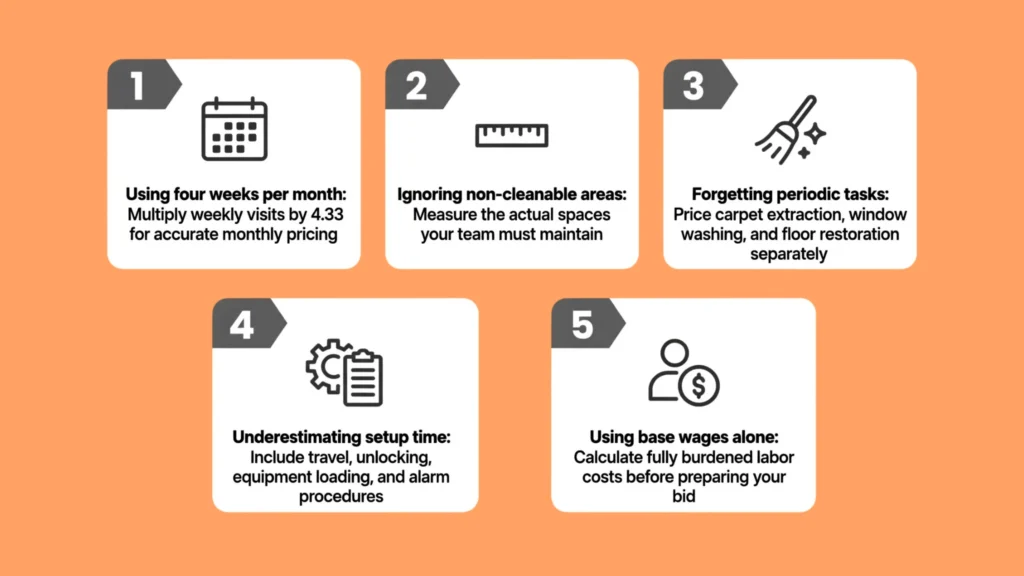
Even experienced estimators occasionally miscalculate bids when rushing through proposals. Watch out for these frequent pitfalls:
Forgetting the 4.33 Weeks Multiplier: There are not exactly four weeks in a month. Multiply weekly cleaning visits by 4.33 (52 weeks divided by 12 months) to calculate accurate monthly averages. Using 4.0 weeks means you work nearly four full weeks a year for free.
Ignoring Non-Cleanable vs. Cleanable Space: Quoting based on exterior building dimensions without verifying interior layouts can lead to overpricing an account with large storage areas and losing the bid to a competitor who measured carefully.
Omitting Periodic Tasks: Standard nightly rates cover routine tasks like trash removal, vacuuming, and restroom sanitation. If the client expects quarterly carpet extraction, semi-annual window washing, or VCT floor stripping and waxing, price those specialty services separately or build their amortized monthly cost into the contract.
Underestimating Travel and Setup Time: On smaller accounts (under 5,000 square feet), the time spent unlocking the building, loading supplies, and setting the alarm can account for a noticeable percentage of the shift. Ensure minimum visit charges cover this operational friction.
Frequently Asked Questions
What is the average price per square foot for janitorial services?
Commercial janitorial pricing typically ranges from $0.07 to $0.25 per square foot per month, depending on cleaning frequency, facility type, and geographic labor rates. Lightly trafficked offices cleaned once or twice a week sit at the lower end, while medical clinics and high-traffic facilities cleaned five to seven nights a week fall at the higher end.
How do I calculate production rates for my cleaning crew?
Time your team cleaning a measured section of a building over several shifts, then divide the square footage cleaned by the exact hours worked. Tracking your own crew’s real-world speed gives you a much more accurate production rate than relying solely on national industry averages.
Should I include paper products and soap in my square foot bid?
Most commercial cleaning companies exclude consumable paper goods (toilet paper, paper towels) and hand soap from the base monthly janitorial rate. Because usage fluctuates based on building occupancy and seasonal illness, it is safer to bill consumables separately at cost-plus or have the client purchase them directly.
How many weeks are in a month for janitorial bidding?
Always use 4.33 weeks per month when converting weekly cleaning hours into a monthly contract price. This accounts for the 52 weeks in a calendar year divided equally across 12 months, ensuring you are paid for months that contain five weeks.
What is a good profit margin for a commercial cleaning contract?
A healthy net profit margin for a standard commercial cleaning contract typically falls between 10% and 20%, after covering all direct labor, payroll taxes, insurance, supplies, and company overhead. Specialty floor care and one-time deep cleans often command higher margins of 25% to 35%.
How do I price a small office under 3,000 square feet?
For small offices, the standard square foot formula often produces a figure too low to attract reliable staff. Instead of relying strictly on square footage, use a minimum visit fee (for example, $65 to $95 per visit) to ensure the account remains profitable after accounting for drive time and setup.
Final Thoughts
Mastering the janitorial bidding square foot formula transforms pricing from a stressful guessing game into a repeatable business system. By separating cleanable square footage by floor type, applying realistic production rates, and accounting for your true burdened labor costs, you protect your profit margins on every contract you sign. Take thorough notes during every walkthrough, track your crew’s actual cleaning times once a contract starts, and refine your production numbers over time to keep your bids both competitive and sustainable.
About The Author