Tyre Derived Fuel Business: How to Start and Earn Profit in 2026
A tyre derived fuel business picks up scrap tyres, shreds them into chips called TDF, and sells those chips to cement kilns, paper mills, and power plants. The US TDF market hit $371M in 2024 and looks set to reach $674M by 2030. You need $150K to $500K to get rolling. TDF moves at $30 to $60 per ton in 2026 and margins land somewhere around 20% to 30%.
Americans dump more than 300 million tyres a year. Sit with that number for a second. Most folks drive past the pile behind their local tyre shop and think nothing of it. A few people look at the same pile and see a fuel depot. That is the tyre derived fuel business in one sentence. Take what nobody wants, shred it, sell it to cement plants and paper mills who genuinely need it. The US market crossed $371 million in 2024 and is not slowing down.
Over at reliablestartup, we keep pointing new founders toward industries everyone else ignores, and this is one of them. I will skip the fluff. You will get real prices, real buyers, the actual five steps, and what a tyre derived fuel business really costs in 2026.
What Is a Tyre Derived Fuel Business?
It is the business of turning dead tyres into industrial fuel. Nothing fancy. The fuel itself is called TDF. Two flavours. Whole tyres get fed into the biggest cement kilns, and chips between 2 and 12 inches go everywhere else.
Why does anyone bother?
- TDF burns hotter than coal, somewhere between 25% and 50% more BTU
- The EPA has been backing it as a real alternative fuel for decades
- Cement plants and paper mills already burn it every single day
- Scrap tyres pile up faster than any landfill can swallow them
That last bit changes everything. Tyre shops will pay you to take the headache off their hands.
Why a Tyre Derived Fuel Business Is Profitable in 2026
You get paid coming and going. Tyre shops slip you a tipping fee, $1 to $3 per tyre, just to drop their scrap. Then a cement kiln pays you again for the finished fuel. Same input, two cheques. Not many business ideas work like that.
TDF Market USA: Size, Demand and Growth Forecast
The TDF market USA runs deeper than most people guess. Cement kilns alone burn through roughly a third of the country’s TDF. Paper mills, steel plants, and utilities split most of the rest. Coal keeps getting pricier, landfill rules keep getting stricter, and that combo is pushing buyers straight to TDF.
Numbers to memorise before you sign a lease on anything:
| Metric | Value | Source |
|---|---|---|
| US TDF market size (2024) | $371.5 Million | Grand View Research |
| Projected market size (2030) | $674.39 Million | Virtue Market Research |
| US scrap tyres generated yearly | 300+ Million | US Tire Manufacturers Association |
| Scrap tyres diverted to TDF | 43% to 52% | EPA |
| Average CAGR (2025 to 2030) | 3.1% to 6.6% | Industry Average |
| Top buyer industry | Cement (~33% share) | Acumen Research |
Texas, California, Pennsylvania, Tennessee. Those four states are basically the playground. Cement output drives the bulk of demand in each one.
How to Start a Tyre Derived Fuel Business: 5 Steps
Most blog posts wave their hands at this part. Here’s how it actually goes, in order.
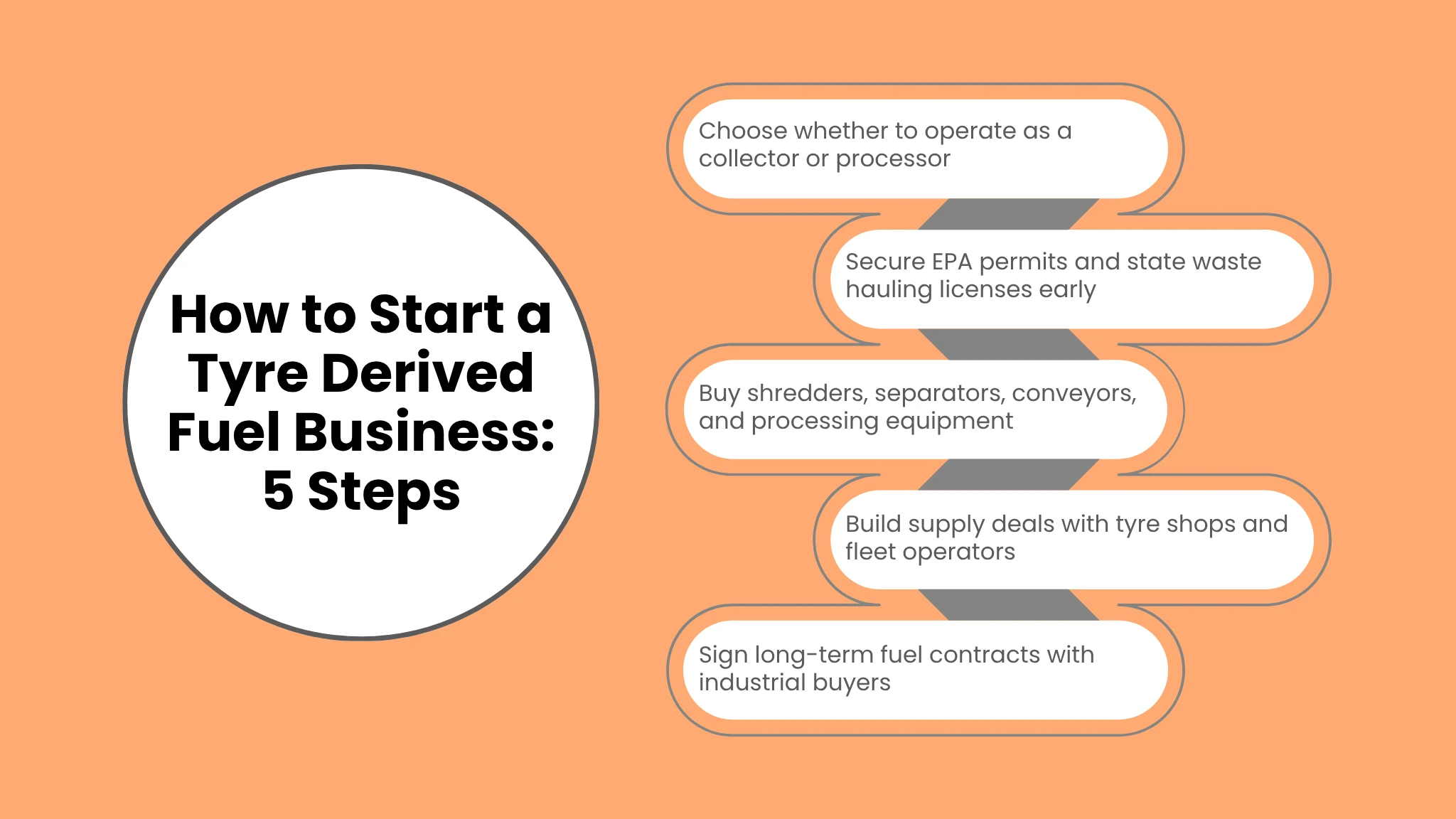
1: Plan Your Tyre Derived Fuel Business Model
Pick what kind of player you want to be. A collector hauls tyres and sells them to bigger processors. A processor shreds and sells fuel. A pyrolysis operator goes a layer deeper and pulls out oil and carbon black too. New founders almost always start as collectors or basic processors because the cash gap is huge. You can level up later.
2: Get EPA Permits & State Licenses
Do not even store a hundred scrap tyres without paperwork. You will want an EPA scrap tyre permit, a state waste hauler licence, and air-quality clearance if you plan to shred on the same lot. The paperwork takes anywhere from 60 to 120 days. Annoying, yes. But the fines for skipping it will end your business in one inspection.
3: Buy Shredding and Processing Equipment
This eats most of your capital. The basic kit: primary shredder, wire separator, screening unit, conveyor belts, and a baler. Used gear costs $100K to $250K. Buy new and you are staring at $300K to $500K. Go used at first. There’s no prize for shiny machines that are not earning yet.
4: Build Your Tyre Supply Chain
No tyres means no business. Pick up the phone. Auto repair shops, tyre retailers, fleet operators, and city recycling centres inside a 50-mile circle are your first calls. Offer free pickup. Charge a tipping fee of $1 to $3 per tyre. One medium auto shop dumps about 200 tyres a month. Sign ten of those and overhead is already covered.
5: Sign Contracts With Tire Derived Fuel Buyers
Buyers would not come knocking. You knock first. Throw together a one-page spec sheet (BTU, sulfur, wire content, chip size). Email the fuel manager or sustainability lead at every cement plant, paper mill, and utility you can truck to. Push hard for 6-month or 12-month contracts. Long deals mean predictable cash flow, and predictable cash flow keeps the lights on.
TDF Price Per Ton 2026 & Profit Margins
The TDF price per ton 2026 sits between $30 and $60 across the US. Crumb rubber clears way more, around $200 to $400 per ton, but you need cleaner equipment and more processing to make it. Whole baled tyres go for less than chipped TDF because the buyer ends up doing extra work.
Run the math with me. Say you process 50 tons of TDF a day at $45 per ton. That’s $2,250 a day, or roughly $585,000 a year just on fuel sales. Tack on tipping fees coming in (about $150,000 a year) and steel wire scrap on the side ($30K-ish). Strip out wages, electricity, diesel, and maintenance, and you’re looking at 20% to 30% net margin on a tight operation.
Carbon credits are the cherry on top. A handful of states now pay TDF producers for diverted CO2, which is basically free money once the paperwork is in.
How to Sell Tyres to Cement Plants
If you want to sell tyres to cement plants, you have to think the way they think. Cement kilns run at brutal temperatures, so they obsess over three numbers: BTU, sulfur content, and chip size. Most want chips under 2 inches with under 1% wire.
What actually works:
- Map every cement plant within 300 miles using the USTMA producer directory
- Find the alternative fuels or sustainability manager on LinkedIn
- Send a short, plain email with your spec sheet attached
- Offer a free trial load of 25 tons (this opens almost every door)
- Push for a 12-month contract the moment they approve your specs
The big names ordering TDF in the US right now are Holcim, CEMEX, Heidelberg Materials, and Lehigh Hanson. They already run TDF programmes. You’re not pitching them on a new idea, you are pitching yourself as a better supplier.
Other Tire Derived Fuel Buyers in the USA
Cement gets the spotlight but it’s not the whole story. These tire derived fuel buyers deserve room on your customer list too:
- Pulp and paper mills: They blend TDF with wood waste in their boilers
- Steel mills: Blast furnaces use it as a coal substitute
- Electric utilities: Coal-fired plants mix TDF in for lower emissions
- Pyrolysis plants: They use whole tyres as feedstock for oil and recovered carbon black
- Industrial boilers: Textile mills, chemical plants, food processors
Spread your bets early. If one cement plant cuts your order in half next quarter, you don’t want to be staring at the ceiling wondering how to make payroll.
Conclusion
A tyre derived fuel business is one of those rare ideas where waste literally pays you twice. The market keeps growing, buyers keep buying, and the rules are quietly pushing demand straight at your front door. Start small, get the permits right, lock down a few solid supply contracts, then scale. At reliablestartup, we walk founders through every stage of launches just like this.
Frequently Asked Questions
Is a tyre derived fuel business profitable in 2026?
Yes. A well-run TDF shop clears 20% to 30% net margin. You’re earning from both sides, tipping fees coming in and fuel sales going out. A 50-ton-per-day operation can pull in over $500K a year in gross revenue.
How much does it cost to start a TDF business in the USA?
Anywhere from $150,000 to $500,000. Most of that money goes to shredding equipment ($100K to $300K). Permits, trucks, land lease, and working capital take care of the rest. Buying used gear cuts your entry cost roughly in half.
What is the current TDF price per ton in 2026?
TDF sells between $30 and $60 per ton across the US in 2026. Crumb rubber goes for a lot more ($200 to $400 per ton) but takes more work to produce. Prices shift by region, chip size, and wire content.
Do I need an EPA permit to sell tyres to cement plants?
Yes. You need an EPA scrap tyre permit plus a state waste hauler licence. Cement plants won’t even take a call without proof of compliance. Filing takes 60 to 120 days, so do not leave it for the last minute.
Who are the biggest tire derived fuel buyers in the USA?
The biggest are cement majors like Holcim, CEMEX, Heidelberg Materials, and Lehigh Hanson. Paper giants like International Paper and WestRock buy heavy too, along with steel mills and coal utility plants. Cement alone soaks up about 33% of US TDF demand.