Winning School and Government Cleaning Contracts
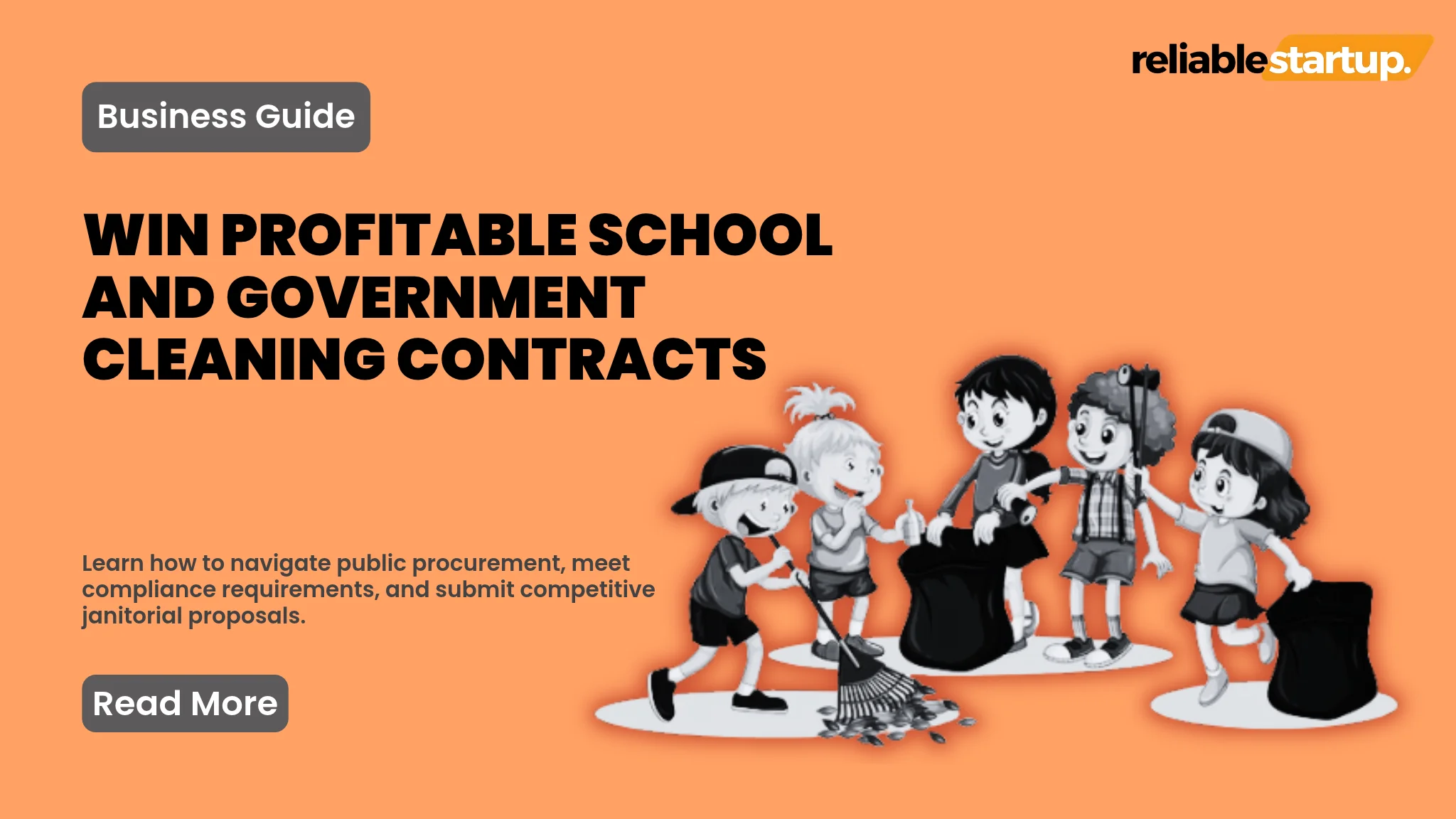
Securing school and government cleaning contracts requires proving legal compliance, operational reliability, and competitive pricing through a formal procurement process.
Unlike commercial office cleaning, where a handshake and a walk-through often seal the deal, public sector janitorial work is awarded through strict competitive bidding, such as Requests for Proposals (RFPs) and Invitations to Bid (ITBs).
For janitorial business owners, breaking into the public sector offers unmatched stability. Schools, municipal buildings, libraries, and federal facilities operate on predictable fiscal budgets, pay reliably, and frequently renew multi-year contracts for vendors who perform well.
However, navigating government bureaucracy, strict background check mandates, and complex pricing sheets intimidates many capable contractors. Understanding how public agencies evaluate bids gives your company a clear advantage over competitors who treat government work like standard commercial accounts.
Understanding Public Sector Janitorial Procurement
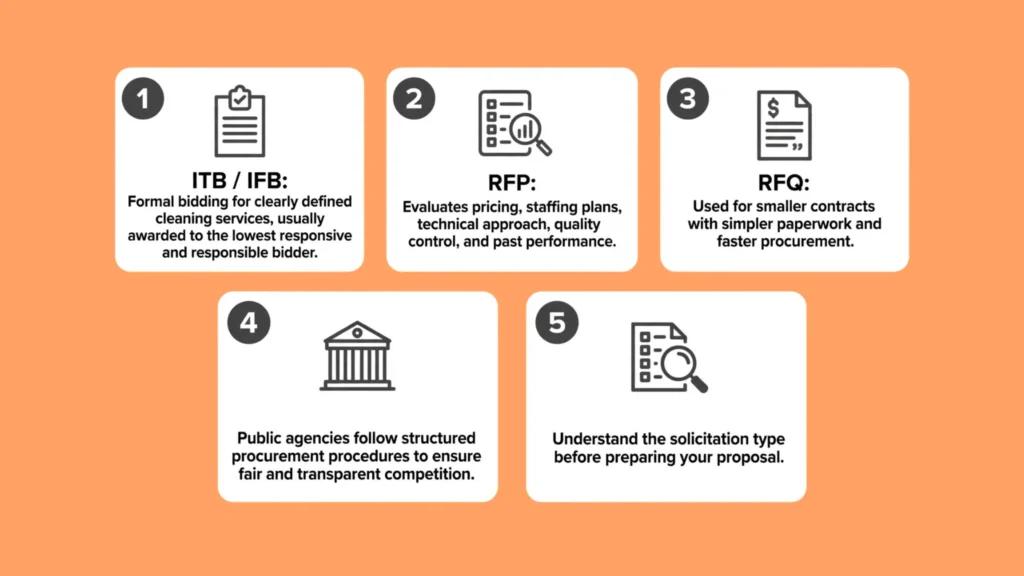
Public agencies are legally obligated to spend taxpayer money transparently and fairly. Because of this, they rarely hire vendors off the street. Instead, they use structured solicitation methods to compare contractors objectively.
If you want to expand beyond public facilities, learning how to secure commercial cleaning contracts can help you develop additional revenue opportunities.
Common Solicitation Types
Invitation to Bid (ITB) or Invitation for Bid (IFB): Used when the scope of work is straightforward and standardized. The agency specifies exact cleaning frequencies and standards, and the contract is typically awarded to the lowest responsive and responsible bidder.
Request for Proposals (RFP): Used when the agency wants to evaluate more than just price. An RFP for cleaning services scores vendors on technical approach, staffing plans, quality control, past performance, and cost.
Request for Quotes (RFQ): Typically used for smaller, micro-purchase contracts below a certain dollar threshold (often under $10,000 to $50,000, depending on the municipality or school district). These require less paperwork and move faster than formal RFPs.
Why Schools and Government Buildings Differ from Commercial Accounts
Cleaning a public high school or a county courthouse involves distinct operational realities compared to cleaning a private corporate suite. High foot traffic, strict security protocols, and public health regulations mean your standard operating procedures must be airtight.
Furthermore, public facilities often require green cleaning certifications, strict adherence to prevailing wage laws, and zero-tolerance policies regarding staff vetting.
Essential Prerequisites Before You Bid
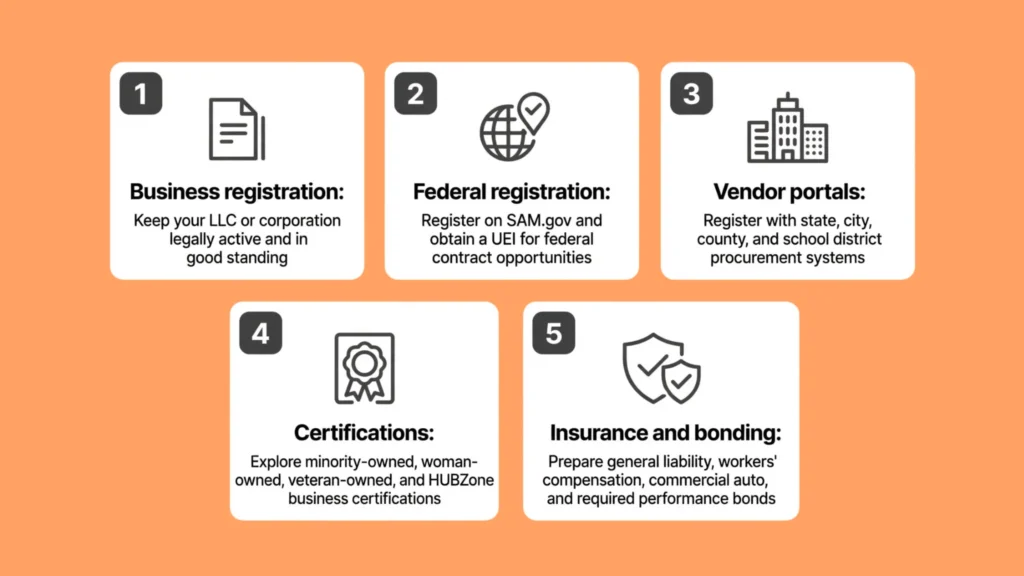
Before downloading your first RFP, your business must meet baseline administrative and legal requirements. Missing even a single registration can get your bid disqualified before a human ever reads your proposal.
Business Registrations and Certifications
Entity Registration: Ensure your LLC or corporation is in good standing with your state.
SAM.gov and UEI: If you plan to bid on federal government cleaning contracts, you must register in the System for Award Management (SAM.gov) and obtain a Unique Entity Identifier (UEI).
State and Local Vendor Portals: Most school districts, cities, and counties maintain their own procurement portals. Register early and select the appropriate NAICS codes—primarily 561720 (Janitorial Services).
Socioeconomic Certifications: If your business is minority-owned, woman-owned, veteran-owned, or located in a Historically Underutilized Business Zone (HUBZone), get officially certified. Many public sector agencies set aside a percentage of contracts or award bonus evaluation points to certified small and diverse businesses.
Insurance and Bonding Requirements
Public entities carry high liability standards. Standard commercial general liability insurance is rarely enough on its own. Be prepared to provide certificates of insurance showing:
Higher general liability limits (often $1 million per occurrence and $2 million aggregate).
Workers’ compensation coverage for all employees (independent contractors/1099 workers are frequently prohibited on public contracts).
Commercial auto insurance for company vehicles entering school or government grounds.
Janitorial Surety Bonds or Performance Bonds: Performance bonds guarantee that if your company fails to complete the contract, the bonding company will cover the cost of hiring a replacement.
Understanding the right coverage options is essential, so review this guide to cleaning business insurance before submitting your first public sector bid.
Where to Find School and Government Cleaning Contracts
Finding opportunities early gives you time to attend mandatory site visits and prepare accurate numbers.
Federal Opportunities: Use SAM.gov to search active federal solicitations from agencies like the General Services Administration (GSA), the Department of Veterans Affairs, and military bases.
State Procurement Portals: Every state operates a centralized procurement website where state agencies, public universities, and state-run facilities post bids.
Local School Districts and Municipalities: Check the “Business Services,” “Facilities,” or “Procurement” pages on local school board, city, and county websites. Many school districts publish annual bidding calendars so vendors know when custodial contracts come up for renewal.
Cooperative Purchasing Networks: Organizations like OMNIA Partners, Sourcewell, and NASPO ValuePoint allow public agencies to buy services through pre-vetted master contracts, bypassing lengthy local bidding processes.
Step-by-Step Guide to Winning a School Cleaning Contract Bid
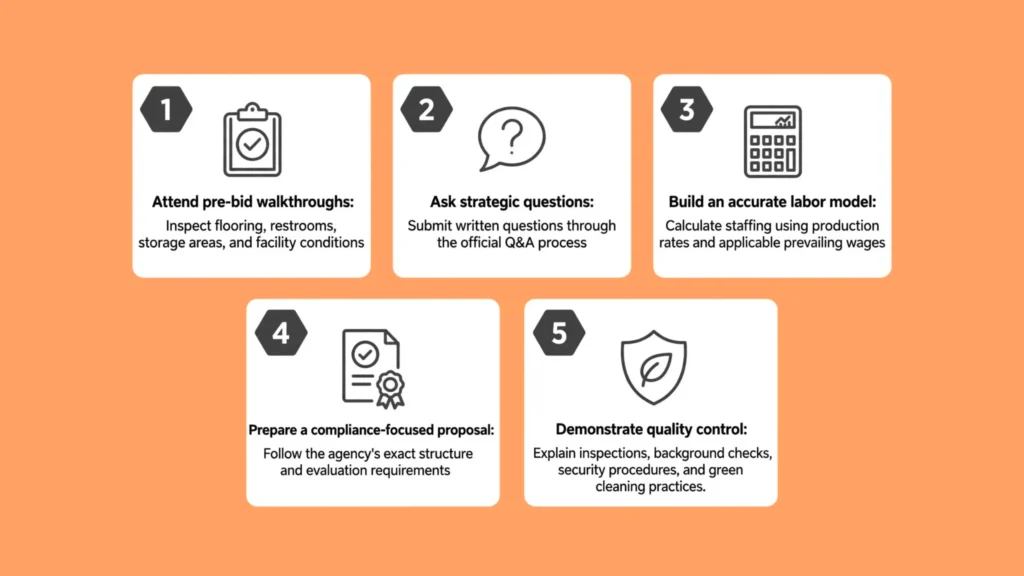
A school cleaning contract bid requires meticulous attention to square footage, student schedules, and seasonal deep-cleaning cycles. Follow these steps to build a competitive submission.
1. Attend the Mandatory Pre-Bid Walk-Through
Almost every school district and government facility hosts a pre-bid conference and walk-through. If a walk-through is marked “mandatory,” failing to sign the attendance sheet automatically disqualifies you.
Even when optional, attending is essential. Use this time to inspect flooring types (VCT tile, terrazzo, carpet), count restrooms, check storage closets, and note the current condition of the building.
2. Ask Strategic Questions During the Q&A Window
Public procurement rules strictly forbid contacting school principals or facility managers directly once a bid is live. Instead, submit written questions during the official Q&A period.
Ask clarifying questions about ambiguous scope items such as who supplies trash liners and paper products, whether daytime porter services are required, or how snow days affect billing. The agency will publish all answers in an official addendum visible to all bidders.
3. Build an Accurate Staffing and Labor Model
Labor typically accounts for 70% to 85% of the cost in public sector janitorial contracts. Never guess your hours. Calculate production rates based on facility type.
Accurate cost calculations are essential when preparing competitive bids, and understanding janitorial bidding helps contractors estimate labor, supplies, overhead, and profit more effectively.
Classrooms with desks and chairs take longer to vacuum and sanitize than open administrative hallways.
Restrooms, locker rooms, and cafeterias require heavy disinfection and higher labor allocation.
Factor in prevailing wage laws (such as the Davis-Bacon Act or Service Contract Act at the federal level, or state-specific prevailing wage mandates) which dictate minimum hourly pay and fringe benefits for custodial workers.
4. Draft a Clear, Compliance-Focused Proposal
When responding to an RFP, mirror the exact structure and numbering requested by the agency. Evaluators use a grading rubric; make it effortless for them to find every required detail. Highlight your:
Quality Assurance Plan: Explain how supervisors inspect buildings, log deficiencies, and resolve issues before the client notices.
Background Check and Security Protocol: Detail your criminal background screening, fingerprinting (often required by state education departments), and badge/key control procedures.
Green Cleaning and Safety Standards: Outline your use of EPA-approved disinfectants, Green Seal-certified chemicals, and OSHA hazard communication training.
Key Differences: School Cleaning vs. Municipal Government Cleaning
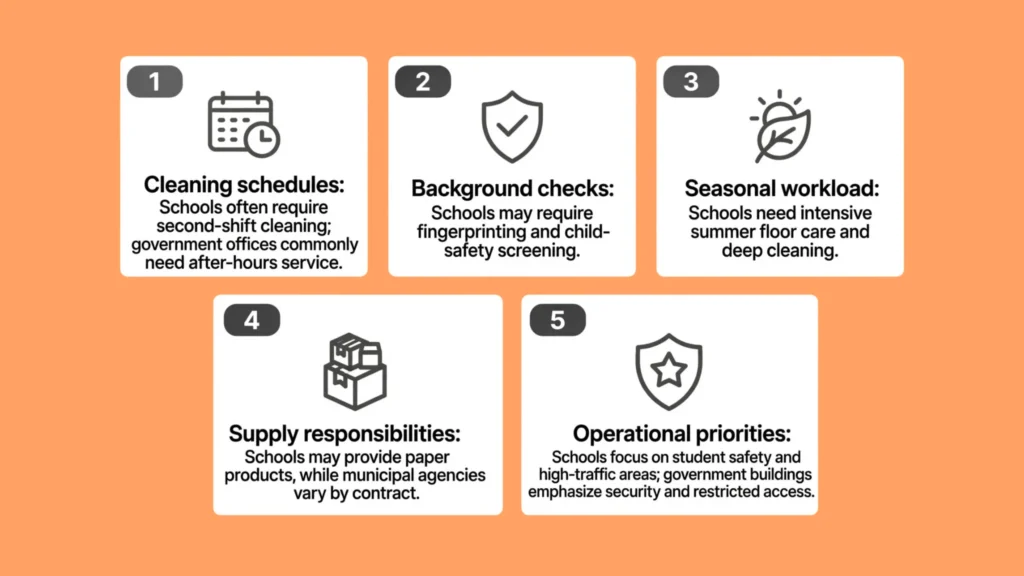
While both fall under public sector procurement, schools and general government facilities have distinct operational demands.
| Feature | K–12 School Districts | Municipal & Government Buildings |
| Primary Cleaning Hours | Second shift (after 3:00 PM) plus daytime day-porters for cafeterias and restrooms. | After-hours (after 5:00 PM) or strictly supervised daytime cleaning for high-security offices. |
| Vetting Requirements | Strict state fingerprinting and child-safety background checks. | Criminal background checks; federal or courthouse roles may require security clearances. |
| Seasonal Workload | Heavy summer deep-cleaning (stripping/waxing floors, carpet extraction) during breaks. | Consistent year-round schedule with occasional event or council meeting support. |
| Supply Responsibility | Districts frequently bulk-buy paper goods and trash liners; contractor provides chemicals. | Varies widely; agencies often require the vendor to supply all consumables. |
| Key Pain Points | Flu/norovirus outbreaks, high restroom traffic, gymnasium floors, and cafeteria spills. | Sensitive documents on desks, restricted access zones, and public lobby appearance. |
Common Mistakes That Disqualify Public Sector Bids
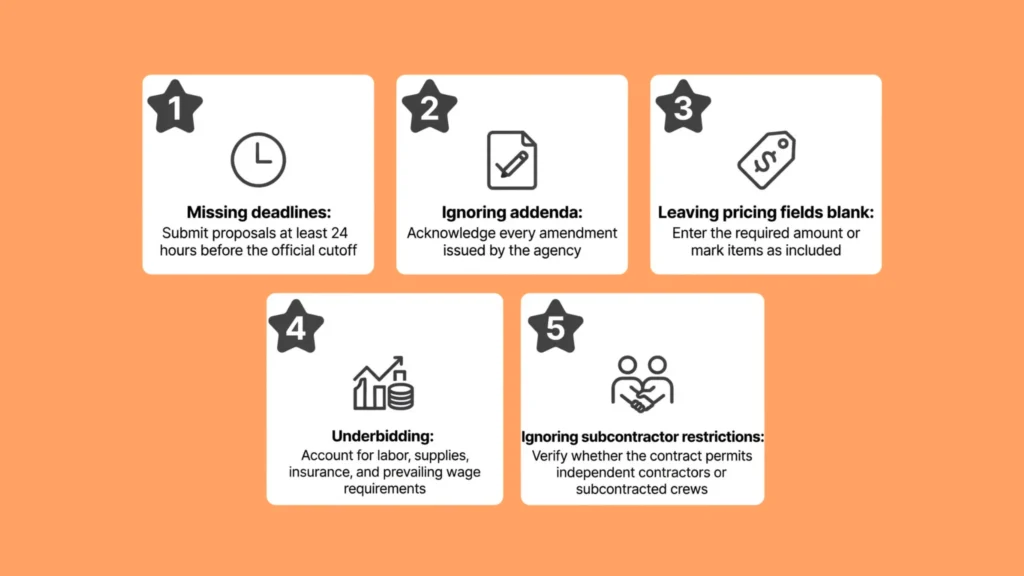
Many strong cleaning companies lose out on lucrative contracts not because of their price, but because of avoidable administrative errors.
Missing the Submission Deadline by Minutes: Public procurement systems automatically lock at the exact deadline (e.g., 2:00:00 PM). Submitting at 2:00:01 PM results in automatic rejection. Always upload your proposal at least 24 hours early.
Failing to Acknowledge Addenda: If the agency issues three addenda modifying the RFP, you must sign and include acknowledgment forms for all three. Omitting one renders your bid “non-responsive.“
Leaving Blank Spaces on Pricing Sheets: Never leave a line item blank on a bid form. If a service is included in your base price, write “$0.00” or “Included” as instructed by the bid guidelines.
Underbidding to Win: Pricing a contract below your true labor and supply costs leads to high employee turnover, missed cleanings, contract termination, and forfeiture of your performance bond which can permanently damage your reputation with local agencies.
Ignoring Subcontractor Restrictions: Many school and government contracts prohibit subcontracting out the work without prior written approval. If you rely on 1099 crews rather than W-2 employees, verify whether the solicitation allows it before bidding.
Frequently Asked Questions
Do I need to be a large company to win government cleaning contracts?
No. While large national firms compete for massive multi-building contracts, local school districts, town halls, police stations, and public libraries routinely award contracts to small and mid-sized local janitorial companies. Small businesses often win because they offer faster management response times and lower administrative overhead.
How long does it take to get awarded a school or government cleaning contract?
The timeline typically ranges from 30 to 90 days from the date the RFP is posted to the final contract award. School boards and city councils usually must vote to approve contracts above a certain dollar amount during scheduled public meetings, which adds time to the review process.
What are prevailing wages in janitorial contracts?
Prevailing wages are legally mandated minimum hourly wages and fringe benefits set by federal, state, or local governments for workers on public contracts. When a solicitation includes a wage determination sheet, every bidder must pay at least those exact rates, leveling the playing field so competitors cannot undercut you by paying minimum wage.
How do payment terms work for public sector janitorial contracts?
Government agencies and school districts are reliable payers, though they rarely pay immediately. Standard payment terms are typically Net 30 to Net 45 after submitting a compliant monthly invoice. Ensure your business has enough working capital to cover payroll and supplies for the first 60 days of a new contract.
What if I don’t have previous government cleaning experience?
If you lack direct public sector references, highlight comparable commercial experience—such as medical facilities, private schools, churches, daycare centers, or multi-tenant office buildings. Emphasize your employee retention rates, supervision structure, safety record, and ability to follow strict cleaning checklists.
Are green cleaning products required for school contracts?
In many states and school districts, yes. Numerous states legally mandate that public schools use environmentally preferable cleaning products certified by organizations like Green Seal or UL ECOLOGO to protect student and staff respiratory health. Always check the RFP specifications for approved chemical lists.
Final Thoughts
Winning school and government cleaning contracts comes down to preparation, compliance, and disciplined estimating. By getting your registrations, insurance, and bonding in place early, attending every walk-through, and submitting thorough, error-free proposals, you position your business as a low-risk partner for public facility managers.
Start by targeting local municipal buildings or single-school contracts to build a strong public sector track record once you prove your reliability on one contract, expanding across entire school districts and government agencies becomes significantly easier.
About The Author