Air Duct Cleaning Business: Equipment Cost and Claims to Avoid
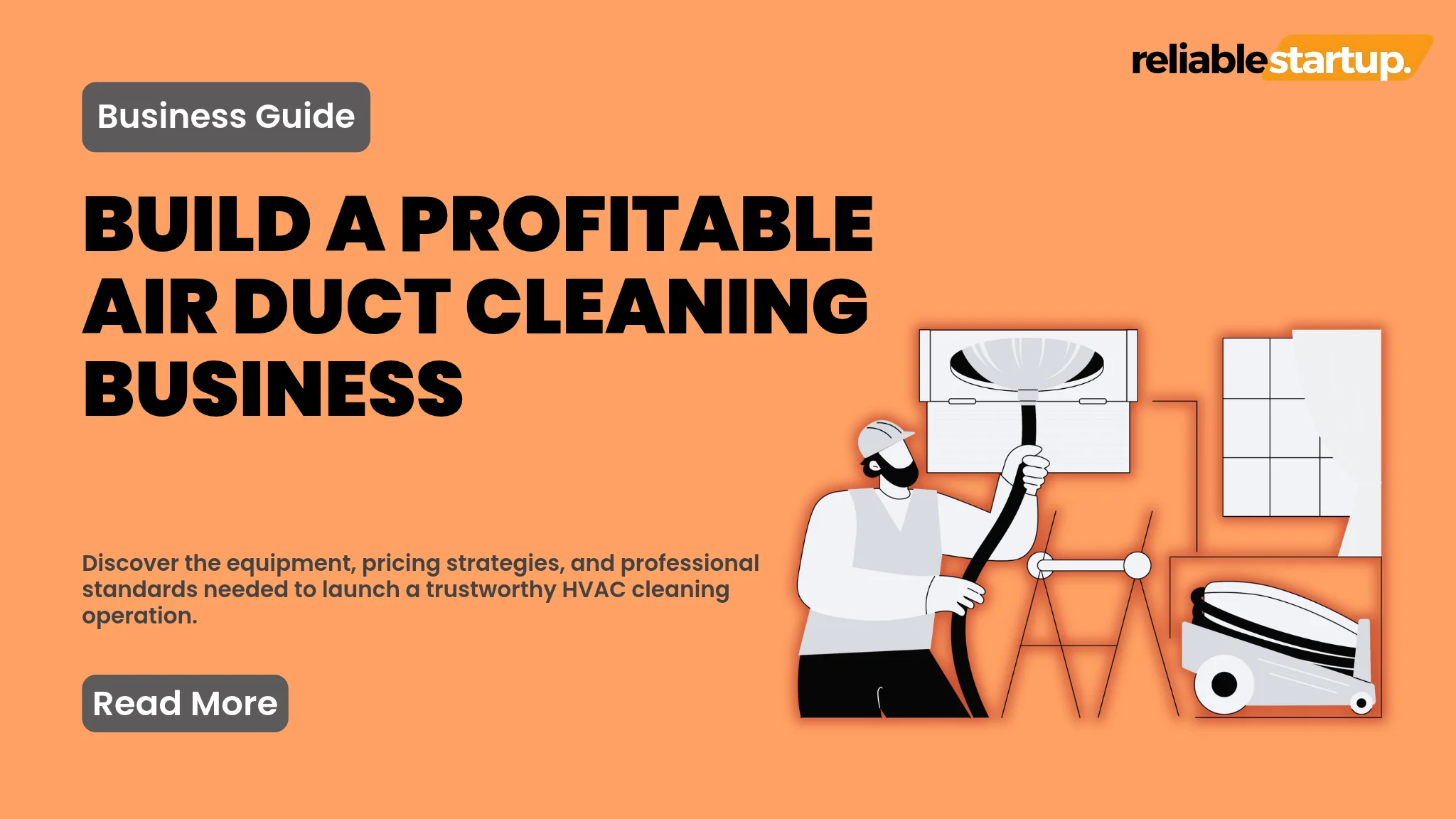
Starting an air duct cleaning business requires a realistic upfront capital investment of $15,000 to $100,000 depending on whether you choose portable or truck-mounted systems, alongside strict adherence to ethical marketing practices. While demand for indoor air quality services continues to grow, the industry faces heavy scrutiny from federal regulators and homeowners due to widespread “blow-and-go” scams and unverified health promises.
Building a profitable, long-term company in this space means balancing two core priorities: buying commercial-grade source removal equipment that meets industry guidelines and positioning your services around documented mechanical benefits rather than exaggerated medical claims.
Understanding the Modern Air Duct Cleaning Business Model
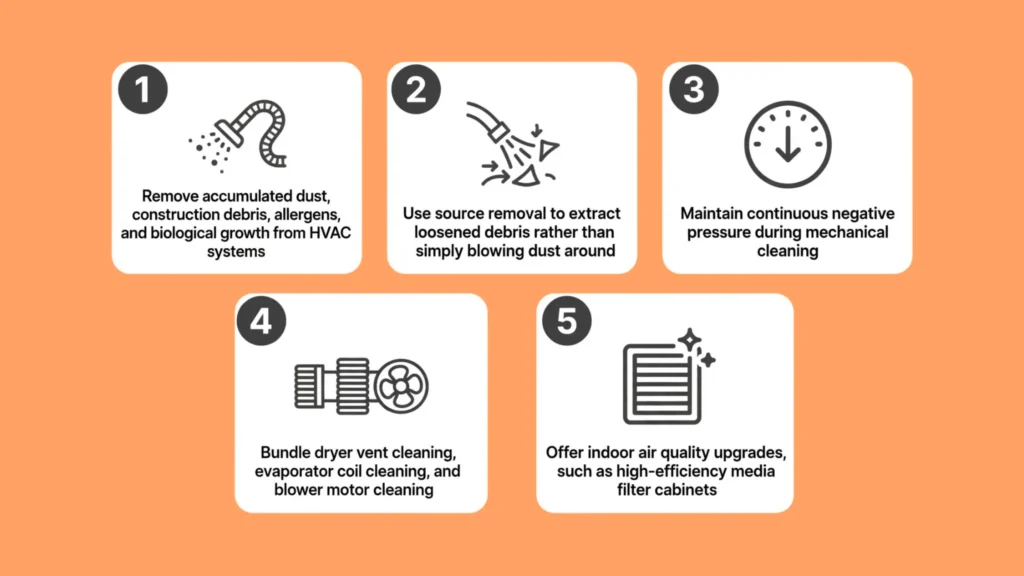
An air duct cleaning business specializes in removing accumulated dust, construction debris, allergens, and biological growth from residential and commercial heating, ventilation, and air conditioning (HVAC) networks.
Modern duct cleaning relies on a process called source removal. Rather than simply blowing dust around or running a shop vacuum near a register, technicians place the entire ductwork system under continuous negative pressure using a high-powered collection unit. Simultaneously, they insert mechanical agitation tools such as rotary brushes, air whips, and compressed air nozzles into the ducts to dislodge stubborn debris so the vacuum can extract it safely outside the building or into a HEPA-filtered containment unit.
Because residential systems typically only need cleaning after renovations, water damage, pest infestations, or heavy debris buildup, successful operators rarely rely on duct cleaning alone.
Most profitable businesses bundle related services to stabilize cash flow, including dryer vent cleaning, evaporator coil maintenance, and indoor air quality upgrades. Expanding into complementary services, such as a gutter cleaning business or a biohazard cleaning business, can also create additional revenue opportunities and help diversify the company’s service offerings.
Dryer vent cleaning and airflow optimization
Evaporator coil and blower motor cleaning
Commercial exhaust and rooftop unit maintenance
Indoor air quality (IAQ) upgrades, such as high-efficiency media filter cabinets
Duct Cleaning Equipment Cost Breakdown
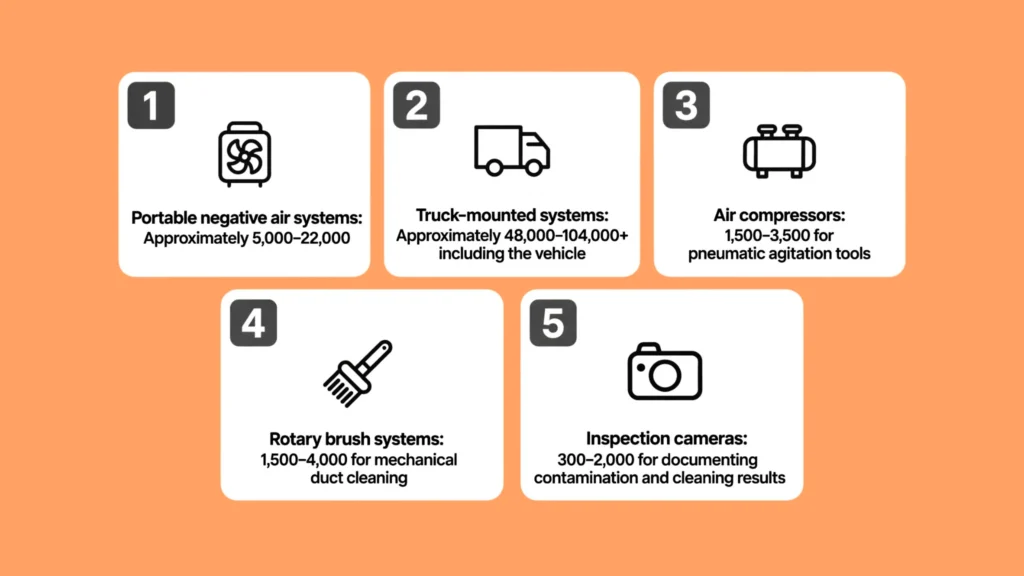
Your initial duct cleaning equipment cost represents the largest capital expense when launching your company. The machinery you choose dictates which residential and commercial jobs you can accept, how fast your crews can finish a house, and how much maintenance you will manage over time.
Portable vs. Truck-Mounted Systems
Contractors generally choose between two primary equipment architectures: high-CFM portable systems or dedicated truck-mounted vacuum rigs.
Portable Negative Air Systems ($5,000 to $22,000): Commercial portable units use multi-motor electric vacuums paired with multi-stage HEPA filtration. A basic starter package with a negative air machine, rotary brush system, and standard hoses costs between $5,000 and $10,000. Complete professional portable setups with advanced agitation tools and air compressors run $15,000 to $22,000. Portable units fit inside standard cargo vans, navigate high-rise elevators, and eliminate long hose runs that reduce suction power.
Truck-Mounted Vacuum Systems ($48,000 to $104,000+): Truck-mounted rigs integrate an industrial gas or PTO-driven vacuum blower directly into a 1-ton cargo van or box truck. The vacuum unit, installation, and 150 to 200 feet of 8-inch collection hose typically cost $23,000 to $39,000, while the commercial vehicle itself adds $25,000 to $65,000 depending on whether you buy used or new. Truck mounts deliver massive raw airflow and impress residential homeowners visually, though they require specialized engine maintenance and cannot easily service multi-story condos or tight urban properties.
Essential Agitation, Inspection, and Safety Tools
Beyond the main vacuum collector, every technician van requires supporting tools to perform thorough source removal:
Air Compressor ($1,500 to $3,500): A high-PSI, continuous-duty compressor is necessary to power air whips, skipper balls, and pneumatic agitation tools inside sheet-metal trunk lines.
Rotary Brush Systems ($1,500 to $4,000): Electric or pneumatic rotating brushes scrub flex duct and lined ductwork without tearing delicate insulation.
Inspection Cameras ($300 to $2,000): Fiber-optic borescopes and robotic duct cameras allow technicians to document pre-cleaning contamination and prove post-cleaning results to customers.
Duct Access and Sealing Supplies ($500 to $1,000): Sheet-metal hole saws, zoning bags, magnetic register covers, access panels, and UL-listed foil tape are required to create and properly reseal service openings.
Summary of Startup Capital Requirements
| Expense Category | Estimated Cost Range | Key Considerations |
| Portable Vacuum & Agitation Package | $5,000 – $22,000 | Lower upfront cost; works in condos, apartments, and single-family homes. |
| Truck-Mounted Vacuum & Vehicle | $48,000 – $104,000 | High visual appeal and raw suction; higher fuel, insurance, and repair overhead. |
| Commercial Cargo Van (For Portable) | $15,000 – $40,000 | Standard fleet maintenance; easier parking and lower fuel consumption. |
| Business Insurance & Licensing | $1,500 – $4,000 / yr | General liability, commercial auto, and workers’ compensation coverage. |
| Initial Marketing & Branding | $2,000 – $5,000 | Website setup, local SEO, vehicle wraps, and digital lead generation. |
How to Structure HVAC Cleaning Pricing
Setting sustainable HVAC cleaning pricing is critical to avoiding the low-margin trap that destroys new service businesses. Bait-and-switch operators often advertise “$49 whole-house specials” and rely on aggressive high-pressure upsells once inside the home. Reputable companies reject that model in favor of transparent, scope-based pricing.
This approach is equally important for specialized cleaning services, such as a medical office cleaning business, where clear service agreements and honest pricing help build long-term client trust.
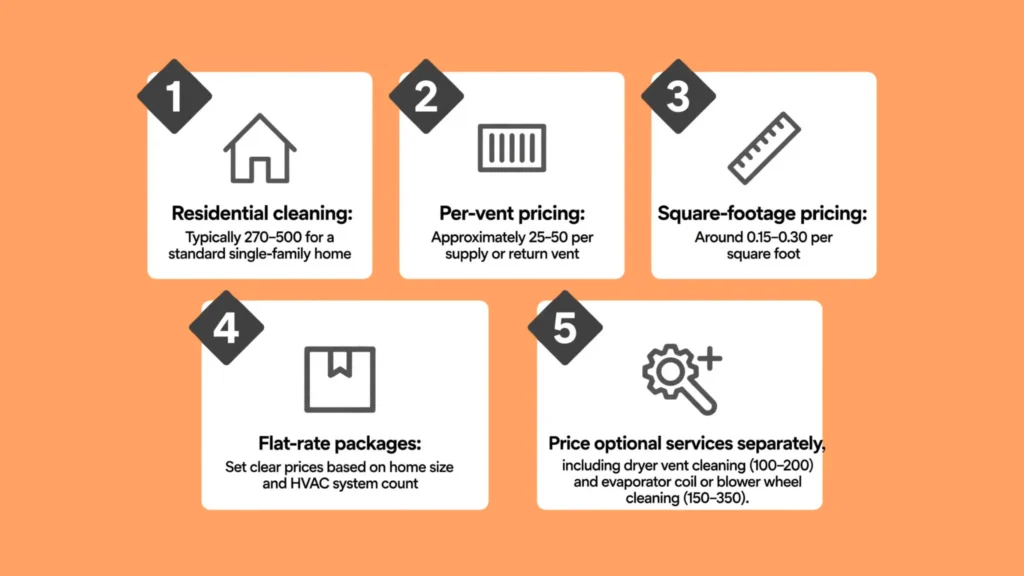
Across the United States, legitimate residential air duct cleaning averages between $270 and $500 for a standard single-family home, with larger properties or multi-zone systems reaching $600 to $1,000. Most established contractors use one of three pricing structures:
Per-Vent (Supply and Return) Pricing: Contractors charge a base service fee plus a flat rate per register, typically ranging from $25 to $50 per vent. This model scales naturally with home size and is easy to explain over the phone.
Square-Footage Pricing: Some companies price residential jobs at $0.15 to $0.30 per square foot of conditioned living space, adjusting upward for multiple furnaces or difficult attic and crawlspace access.
Flat-Rate Tiered Packages: Offering clear tiers based on system count (for example, single-system homes under 2,000 square feet versus two-system homes over 2,500 square feet) streamlines quoting and protects your profit margins when a job takes four to six hours to complete properly.
Optional add-ons should always be priced transparently as separate line items. Dryer vent cleaning typically adds $100 to $200, while deep cleaning an evaporator coil or blower wheel adds $150 to $350 depending on accessibility.
Following the NADCA Standard for Credibility and Quality
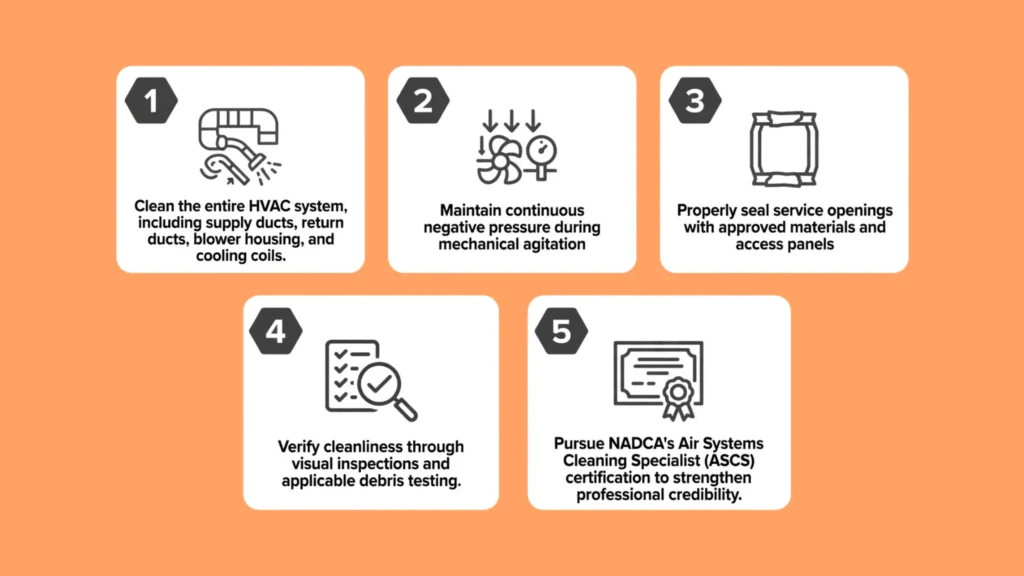
Because few states enforce strict licensing exclusively for duct cleaners, adhering to the NADCA standard is the most reliable way to differentiate your company from unverified competitors. The National Air Duct Cleaners Association publishes ACR, The NADCA Standard, which establishes the industry benchmark for assessing, cleaning, and restoring HVAC systems.
Following NADCA protocols requires specific operational practices on every job site:
Full-System Cleaning: Technicians must clean the entire HVAC air conveyance system, not just the supply ducts. Leaving the return side, blower housing, or cooling coils dirty immediately recontaminates newly cleaned ductwork.
Verified Negative Pressure: The duct system must be placed under continuous negative pressure differential throughout mechanical agitation so dislodged dust cannot escape into the customer’s living space.
Proper Service Access and Closure: Any access holes cut into trunk lines must be sealed afterward using sheet-metal patches, mechanical fasteners, or approved closure panels that preserve airtightness and comply with mechanical codes.
Post-Cleaning Verification: Surfaces must pass visual cleanliness inspections and, on commercial projects, meet quantitative debris limits verified through standardized vacuum testing.
Earning NADCA certification which requires passing the Air Systems Cleaning Specialist (ASCS) exam and maintaining proper insurance—instantly builds trust with homeowners, property managers, and commercial facility directors.
Marketing and Operational Claims to Avoid
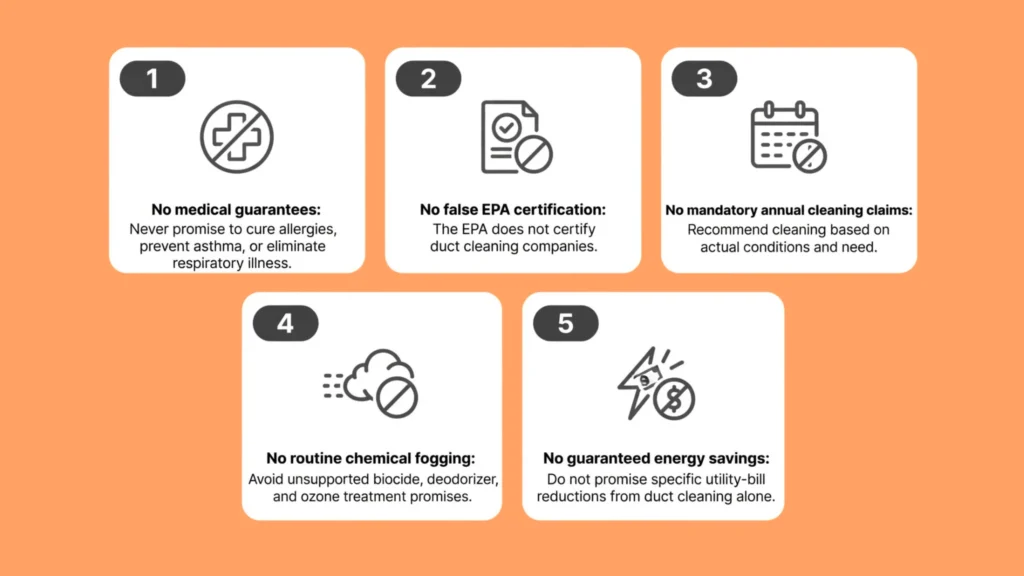
The U.S. Environmental Protection Agency (EPA) and the Federal Trade Commission (FTC) closely monitor deceptive advertising in the HVAC cleaning sector. Making false or unsubstantiated promises can trigger regulatory fines, chargebacks, and permanent reputation damage. Keep your sales scripts, website copy, and technician pitches completely free of the following claims.
1. Sweeping Health and Medical Guarantees
Never claim that air duct cleaning prevents asthma, cures allergies, eliminates respiratory illness, or improves overall human health. According to the EPA, scientific studies have not conclusively proven that routine duct cleaning prevents health problems or measurably lowers airborne dust levels in typical homes. Position your service around removing visible debris, post-construction dust, pet dander buildup, and airflow restrictions—never medical outcomes.
2. Claiming to Be “EPA Certified”
The EPA does not certify, endorse, approve, or license air duct cleaning companies, technicians, or equipment. Advertising your business as “EPA certified” is a direct misrepresentation. If you use antimicrobial treatments, state accurately that you apply only EPA-registered sanitizers in strict accordance with product labels.
3. Routine Annual Cleaning Schedules
Avoid telling residential customers that their air ducts must be cleaned every single year as mandatory maintenance. The EPA advises cleaning ducts on an as-needed basis, such as after home remodeling, visible mold growth, vermin infestations, or excessive particulate buildup. Honest recommendations build far stronger repeat referrals than manufactured urgency.
4. Routine Chemical Fogging or Biocide Spraying
Do not push chemical biocides, deodorizers, or ozone treatments as standard add-ons for every residential job. The EPA warns that little research supports the effectiveness of routine biocide fogging inside ductwork, and no chemical biocides are registered for use on porous fiberglass duct liner or fiberglass duct board. Furthermore, ozone generators release lung irritants into occupied homes. Chemical treatments should only be considered after thorough mechanical cleaning and only when verified biological contamination warrants targeted intervention.
5. Exaggerated Energy-Savings Promises
While cleaning a heavily fouled evaporator coil or clogged blower fan can restore lost HVAC efficiency, cleaning sheet-metal ducts alone rarely produces dramatic reductions in monthly utility bills. Avoid promising guaranteed percentage drops in energy costs unless you are performing comprehensive mechanical component restoration.
Practical Tips for Launching a Sustainable Business
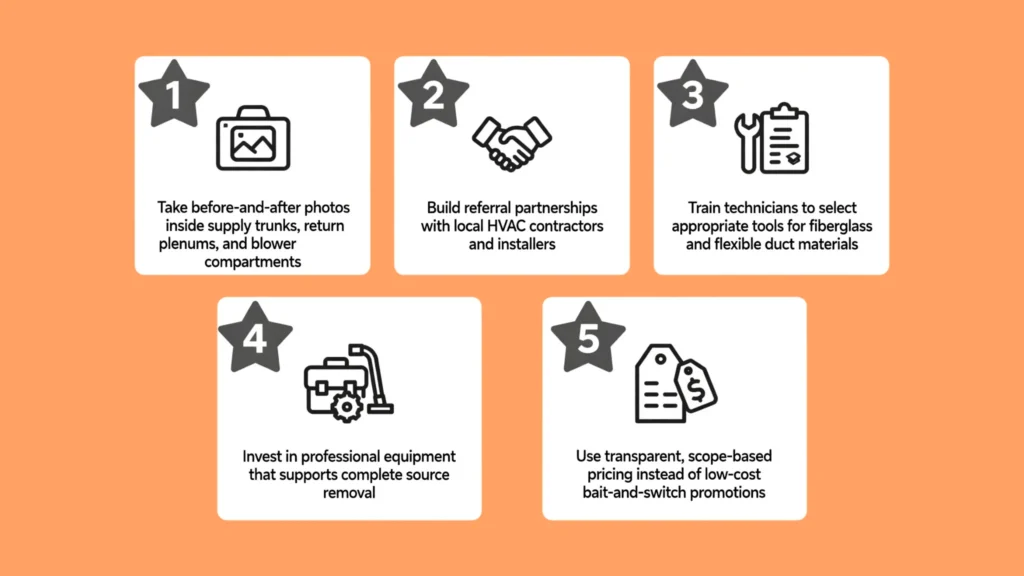
Invest in Camera Documentation: Take clear before-and-after photos inside the supply trunk, return plenum, and blower compartment on every job. Visual proof justifies professional pricing and turns satisfied homeowners into five-star reviewers.
Build Partnerships with Local HVAC Contractors: Many traditional heating and cooling companies dislike performing full-duct cleanings because the work is labor-intensive. Partnering with local HVAC installers gives you a steady stream of referrals whenever they replace furnaces or renovate ductwork.
Train Technicians on Fiberglass and Flex Duct Care: Aggressive rotary brushes or excessive air pressure can shred flexible ducts and fiberglass duct board. Train crews to match agitation heads to the exact duct material before starting work.
Frequently Asked Questions
How much does it cost to start an air duct cleaning business?
Starting an air duct cleaning business typically costs between $25,000 and $65,000 using a commercial cargo van and a high-CFM portable negative air system. Launching with a dedicated truck-mounted vacuum rig generally requires $60,000 to $110,000+ once vehicle purchase, vacuum installation, hoses, and insurance are included.
How much should I charge for residential air duct cleaning?
Most legitimate residential companies charge between $270 and $500 for a standard single-system home, or roughly $25 to $50 per supply and return vent. Larger homes, multi-zone HVAC systems, and add-ons like dryer vent or evaporator coil cleaning increase the total invoice to $600 or more.
Is portable or truck-mounted duct cleaning equipment better for a new business?
Portable negative air machines are usually better for startups because they cost $15,000 to $30,000 less upfront, fit in standard cargo vans, and can be carried into high-rise apartments, condos, and commercial buildings where long truck hoses cannot reach. Truck-mounted systems offer strong suction for single-family residential neighborhoods but come with higher fuel and maintenance expenses.
Do I need NADCA certification to open an air duct cleaning business?
NADCA certification is not legally required in most jurisdictions to start operating, but it is the gold standard for professional credibility. Obtaining the Air Systems Cleaning Specialist (ASCS) credential proves to residential and commercial clients that your technicians follow recognized source-removal and containment procedures.
What should you never say when marketing an air duct cleaning service?
Never claim that your company is “EPA certified,” never guarantee that duct cleaning will cure allergies or prevent illness, and never push unverified chemical fogging or ozone treatments as routine services. Stick to verifiable mechanical outcomes, such as removing construction dust, pet hair, and debris restricting system components.
How long does a proper residential air duct cleaning take?
A thorough, NADCA-compliant cleaning of a standard single-family home takes 3 to 5 hours for a two-person crew. Jobs finished in under an hour usually indicate superficial vacuuming at the register covers rather than true full-system source removal.
Final Thoughts
Launching a successful air duct cleaning business comes down to matching the right equipment to your target market and earning customer trust through transparent work.
Choosing a commercial portable or truck-mounted source removal system gives your crew the power to clean entire HVAC networks safely, while fair, scope-based pricing ensures your business stays profitable without relying on deceptive coupons.
By following the NADCA standard and steering clear of unsubstantiated health or EPA claims, you can build a respected service company with strong referrals and steady year-round demand.
About The Author