Peer-to-Peer Rental Business Ideas That Are Booming in the USA

A peer-to-peer rental business connects asset owners with renters, taking 10-30% commission. Top ideas include P2P car rentals (Turo: $958M), equipment rentals (easiest to start at $100-500/month), event spaces, luxury goods, and RV rentals. Success requires choosing the right vertical, sustainable unit economics, and trust-building. The sharing economy business is projected to reach $1.4 trillion by 2030.
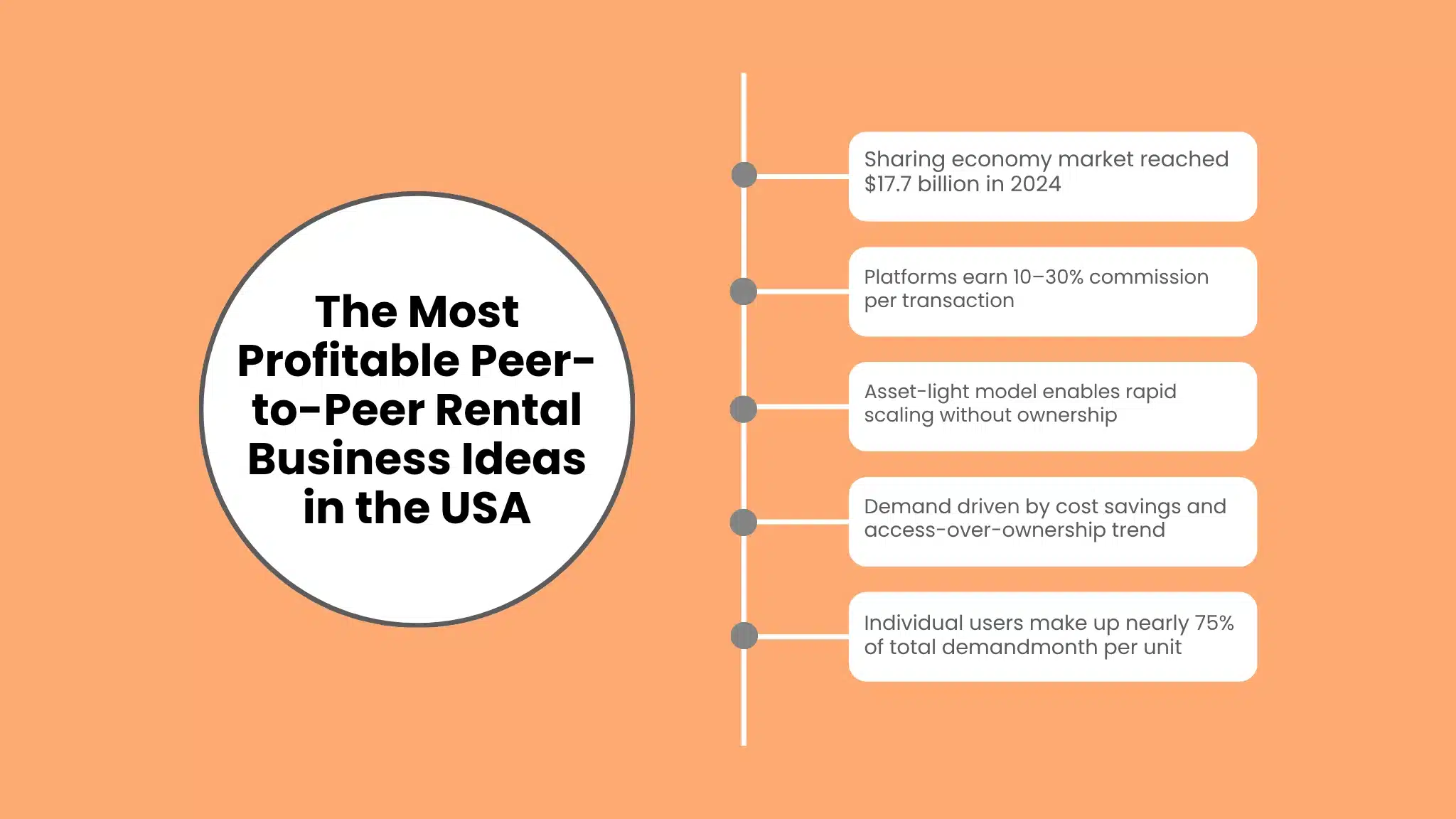
The peer-to-peer rental business has exploded into a $17.7 billion market in 2024 and here’s the mind-blowing part: companies like Turo own zero cars yet facilitate $2.5 billion in bookings, while Airbnb owns zero properties yet generates $9 billion in annual revenue, proving that the most profitable businesses today don’t own anything at all.
If you’re considering launching a sharing economy business or exploring which rental marketplace ideas actually thrive, this guide breaks down the exact verticals booming in the USA right now and which niche could be your next opportunity.
The Market Reality Behind Peer-to-Peer Rental Businesses
The rental business landscape has shifted dramatically in 2025. According to GM Insights, the P2P rental apps market valued at $17.7 billion in 2024 is projected to grow at 10.9% annually through 2034. Similarly, individual consumers represent 75% of all P2P rental users, driven by cost savings and the cultural shift from ownership to access.
However, not all rental marketplace ideas succeed equally. Consider this: Getaround raised $750 million and shut down its entire US operations in February 2025 because its focus on hourly car rentals couldn’t achieve profitable unit economics. In contrast, Turo which emphasizes daily rentals continues generating nearly $1 billion in annual revenue.
This critical lesson reveals that in the asset rental business space, the details separate winners from failures.
The Most Profitable Peer-to-Peer Rental Business Ideas in the USA
Here are profitable business ideas:
1. P2P Car Rental Marketplace (Highest Revenue Potential)
Turo remains the gold standard in the rental business for vehicles. Founded in 2009, Turo generated approximately $958 million in revenue in 2024 with 9% year-over-year growth. The platform connects:
- 140,000 active hosts
- 3.5 million active guests
- Over 340,000 vehicles across five countries
The economics tell a compelling story. A car owner with a vehicle worth $25,000 can generate $5,000-$15,000 in annual passive income. For renters, avoiding rental car counters saves an average of 8 minutes per transaction (J.D. Power 2025).
Why car rentals work as a rental marketplace idea:
Additionally, specialty vehicles create competitive advantage:
- Teslas and electric vehicles
- Classic and vintage cars
- Luxury SUVs and sports cars
- Unique experiences traditional companies don’t offer
Nevertheless, insurance and liability are complex. Turo solved this through tiered coverage up to $750,000, requiring substantial capital.
2. Equipment and Tool Rental Marketplace (Lower Barrier to Entry)
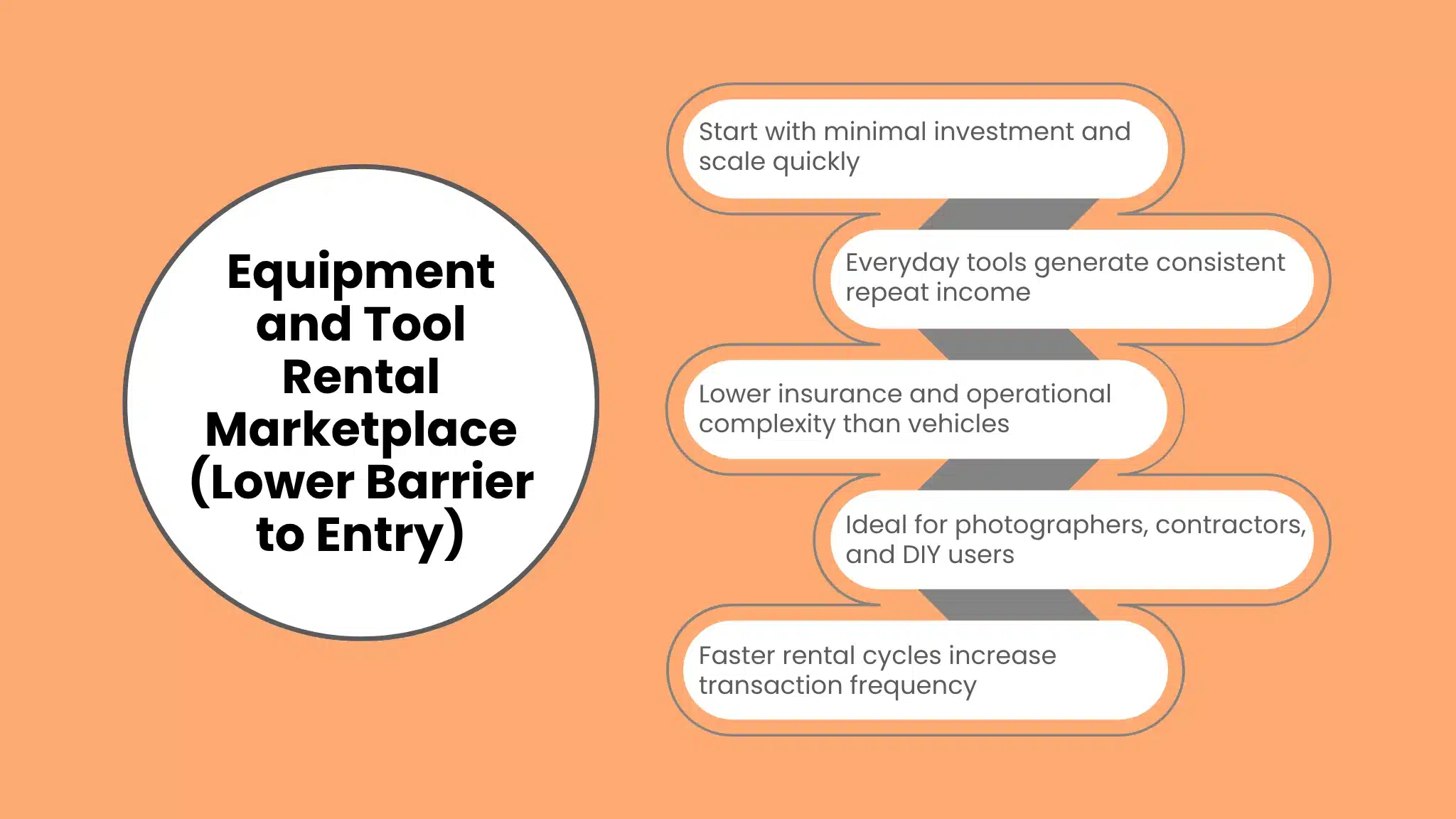
Fat Llama has built a thriving rental business around consumer goods. Importantly, the barrier to entry is dramatically lower than car rentals.
How equipment rentals work:
For owners:
- Professional camera ($2,000 value) generates $400-$800 annually
- Power drill at $15/day generates $4,500 annually (300 days/year)
- Homeowners monetize unused items in garages and storage units
For renters:
- Renting professional equipment costs $50-$100 vs. $2,000+ for ownership
- Access to tools without purchase commitment
Advantages of this asset rental business:
- Lower insurance costs than cars or homes
- Faster transaction cycles (days, not weeks)
- Larger pool of potential asset owners
- Repeat customers (photographers, contractors, event planners)
The primary challenge involves logistics and damage handling.
3. Event Space Rental (Peerspace Model)
Peerspace, founded in 2014, revolutionized rental marketplace ideas by connecting property owners with event planners. Instead of expensive event halls, users book unique spaces:
- Rooftop terraces
- Art studios and galleries
- Warehouses and lofts
- Private homes and gardens
Why event space rentals are booming:
Event spaces are catastrophically underutilized. A loft in Brooklyn hosts events twice yearly. Traditional venues charge $2,000-$10,000+ per day, while Peerspace listings range from $200-$3,000, creating substantial pricing advantages.
Revenue model:
- Peerspace takes 20% commission on bookings
- Average booking: $500-$1,500
- Per-transaction platform revenue: $100-$300
4. Luxury Goods Rental (Fashion, Designer Items)
A smaller but growing subcategory of sharing economy business is luxury goods rental focusing on high-end handbags, designer dresses, jewelry, and accessories.
Why luxury goods rental is emerging:
- A luxury handbag costs $2,000-$5,000
- Renting the same bag costs $50-$150 per event
- Owners earn $200-$400+ monthly in passive income
- Taps into sustainability, financial pragmatism, and access-over-ownership trends
The key challenge: Building trust with high-value items requires rigorous photography, condition documentation, and damage waivers.
5. RV and Motorhome Rental (Outdoorsy Model)
Outdoorsy operates a successful rental business for RVs. Notably, this vertical exploded during COVID-19 when outdoor experiences surged.
Why RV rentals work:
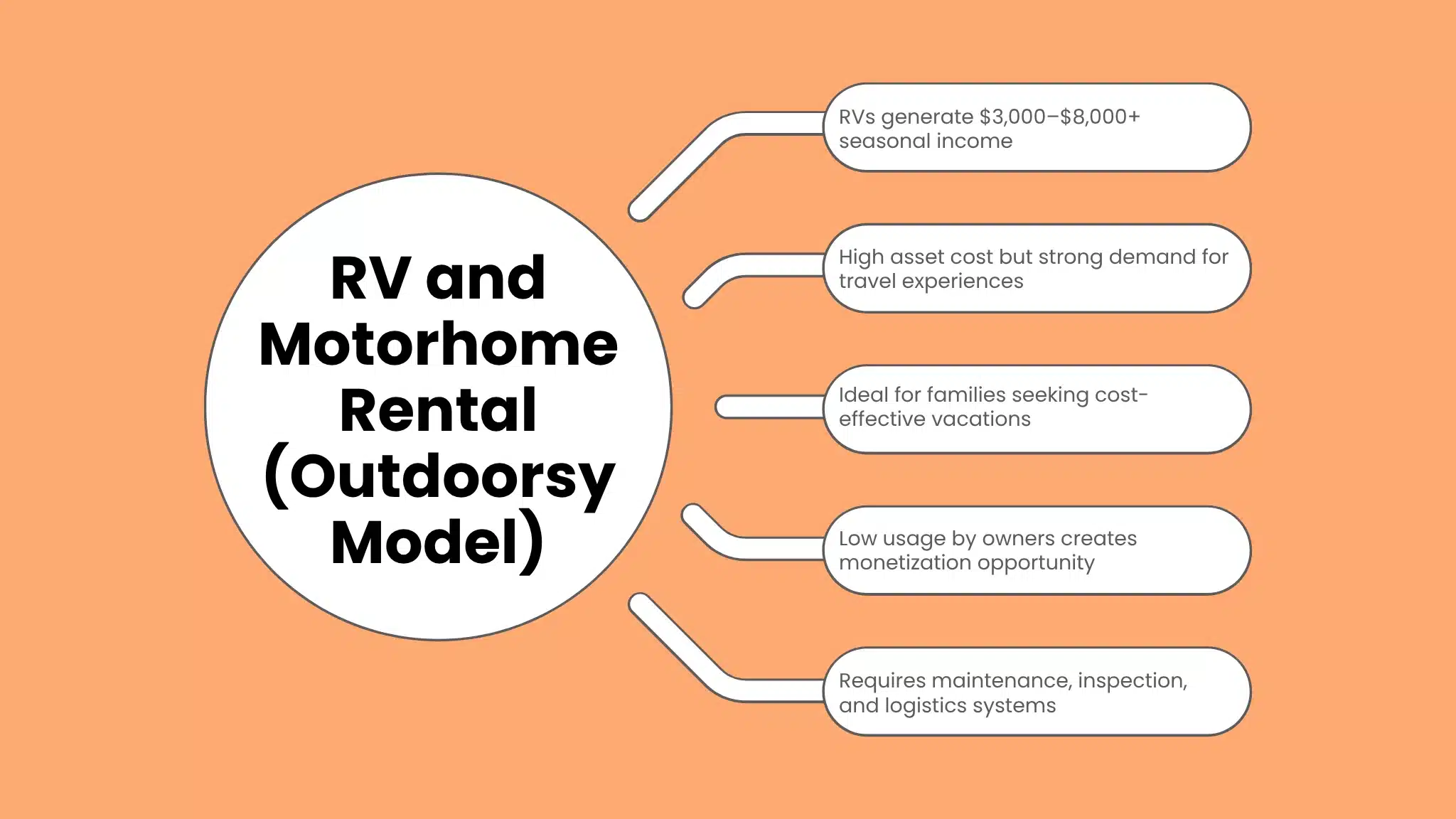
- RVs cost $50,000-$200,000+
- Owners use them only 2-4 weeks annually
- They generate $3,000-$8,000+ in seasonal income
- Families save money vs. hotels plus rental cars
However, vehicle inspection and maintenance costs are substantial, requiring significant operational infrastructure.
Comparison: Success Factors Across Rental Business Verticals
| Vertical | Commission | Entry Barrier | Trust Complexity | Scalability |
|---|---|---|---|---|
| Car Rentals (Turo) | 20-35% | Very High | Very High | Very High |
| Equipment Rentals | 28% | Low-Medium | Medium | High |
| Event Spaces | 20% | Medium | Medium | Medium-High |
| Luxury Goods | 20-30% | Medium | High | Medium |
| RV Rentals | 20-30% | High | High | High |
Why Some Peer-to-Peer Rental Business Ideas Fail
Getaround’s US exit in February 2025 illustrates a critical truth:rental business models fail despite massive funding. Getaround focused on hourly car rentals with instant booking. Unfortunately, transaction costs (insurance processing, vehicle inspection, cleaning) consumed excessive margins. Turo’s daily model proved more sustainable.
Other notable failures:
- Lyft Rentals (2019-2022): Poor unit economics
- Audi on Demand (ended 2024): Couldn’t compete with Turo
- Kyte (shut down August 2025): Struggled to scale
The pattern: rental marketplace ideas that work have crystalline value propositions, cost-effective trust solutions, and sustainable unit economics.
Choosing Your Peer-to-Peer Rental Business Idea
Before launching your sharing economy business, answer these questions:
- Is demand real? Can you find 50 potential renters actively searching?
- Can you solve the trust problem cost-effectively? Insurance and verification aren’t optional
- Is unit economics viable? Calculate transaction value, platform fees, and acquisition costs
- What’s your regulatory landscape? Restrictions vary dramatically by city and state
- Can you reach critical mass? The chicken-and-egg problem requires capital or clever marketing
Modern tools make launching easier. Platforms like Sharetribe and Dittofi offer no-code marketplace builders at $100-500/month. You can validate your asset rental business idea in weeks with minimal investment.
Conclusion: The Peer-to-Peer Rental Business Opportunity Awaits
The peer-to-peer rental business opportunity is real and growing rapidly. From Turo’s $958 million in car rental revenue to Peerspace’s thriving event marketplace, the sharing economy business is reshaping how Americans access assets. Additionally, market conditions are ideal for new entrants because technology barriers have collapsed and customer adoption is mainstream.
Therefore, choosing the right rental marketplace ideas vertical where demand is genuine and unit economics work is crucial. Whether you focus on equipment rentals, event spaces, luxury goods, or unconventional niches, the key is solving genuine problems and building trust relentlessly.
ReliableStartup.com offers comprehensive resources and expert guidance to help you validate, launch, and scale your asset rental business idea successfully.
Frequently Asked Questions
What is a peer-to-peer rental business and how does it make money?
A peer-to-peer rental business is a digital marketplace connecting asset owners with renters, taking a commission (10-30%) on each transaction. For example, Turo generates $958 million by taking 20-35% commission on car rentals. Essentially, this sharing economy business model owns nothing but the technology enabling rapid scaling without capital investment.
What are the best peer-to-peer rental business ideas to start in 2024-2026?
A: The most profitable rental marketplace ideas currently booming include:
- P2P car rentals (Turo model)
- Equipment rentals (Fat Llama model)
- Event space rentals (Peerspace model)
- Luxury goods rental (fashion, handbags)
- RV and motorhome rentals (Outdoorsy model)
Also, each asset rental business vertical has different profitability levels. Equipment rentals, however, offer the lowest entry barrier for beginners.
How much does it cost to start a peer-to-peer rental business?
Using no-code platforms like Sharetribe or Dittofi, you can launch a peer-to-peer rental business MVP for $100-500/month. Additionally, full validation typically requires $5,000-10,000/month for 6-12 months. Nevertheless, custom development costs $50,000-$500,000+. Therefore, most successful founders start lean with no-code solutions, then invest in custom development later.
Why did Getaround fail if peer-to-peer rental business is profitable?
Getaround shut down US operations in February 2025 despite raising $750 million because its hourly car rental model couldn’t achieve profitable unit economics. In contrast, Turo’s daily rental P2P rental model succeeded. Similarly, other sharing economy business failures like Lyft Rentals (2019-2022) and Audi on Demand (2024) show that not all rental marketplace ideas survive. Consequently, choosing the right vertical and ensuring sustainable unit economics is critical.
What is the easiest peer-to-peer rental business to start with low capital?
Equipment and tool rentals represent the easiest peer-to-peer rental business to launch. This asset rental business vertical requires lower insurance costs, faster transaction cycles, and larger asset owner pools. For instance, a professional camera generates $400-$800 annually, while a power drill renting at $15/day generates $4,500 annually. Importantly, you can launch this P2P rental marketplace using no-code platforms for under $500/month, making it the most accessible entry point into rental marketplace ideas for bootstrapped entrepreneurs.