Best Pontoon Boats for Families 2025 Top Family Picks

A pontoon gives families room to cruise, swim, fish and relax together without splitting into separate outings. Its wide deck and open layout make it easy to share time on the water, whether your crew wants a quiet ride or a fun afternoon at anchor.
The best pontoon boats for families 2025 depend on your crew, activities, comfort needs and budget. A roomy, stable layout can support casual fishing, swimming breaks and relaxed cruising, but the right boat also needs suitable safety features and space for gear. Start with the number of people you regularly bring aboard, not the biggest crowd you might host once a year.
Key Takeaways
- Choose space for your regular crew, plus room for gear and occasional guests.
- Match the boat and outboard to your usual water and activities.
- Compare seating, shade, storage and safe access before choosing a layout.
- Check towing needs and ongoing costs alongside the listed price.
- Take a hands-on look at your top choices before you decide.
How much space does your family need aboard?
A family should size a pontoon for its regular crew and leave a little breathing room for guests and gear. Pontoon boats typically range from 16 to 27 feet or longer, but the length alone does not show how usable the deck feels.
For a comfortable crew estimate, subtract two people from the maker’s maximum passenger rating. That leaves room for bags, coolers and easier movement, rather than treating every available seat as everyday space.

Compare the maximum passenger rating with your likely comfortable headcount before treating a capacity number as a seating plan.
Match seating to your regular crew
Average crew ranges give you a useful first screen. Typical pontoon length classes pair 16-to-19-foot boats with four to six passengers, and 20-to-22-foot boats with six to nine.
Boats from 23 to 25 feet are listed for eight to 12 passengers. Models from 26 to 27 feet or longer are listed for 12 or more, though actual layouts differ.
| Length class | Average crew | Family fit |
|---|---|---|
| 16-19 feet | 4-6 passengers | Smaller crews |
| 20-22 feet | 6-9 passengers | Midsize families |
| 23-25 feet | 8-12 passengers | Frequent guests |
| 26-27+ feet | 12+ passengers | Larger groups |
Use length as a starting point, not a guarantee
Families who regularly entertain eight to ten guests should consider a pontoon at least 22 feet long. That size offers a starting point for comparing boats with room for a full group.
Layout, gear and seating configuration change how much space you can use. A large lounge may cut into the walking area, while a table or fishing station needs room around it.
Walk the deck if you can, and picture where people will sit, stand and pass each other. Compare the maximum passenger rating with your likely comfortable headcount before treating a capacity number as a seating plan.
Which pontoon setup suits your lake and activities?
A quiet river with narrow coves calls for a different setup than a big reservoir that builds afternoon chop. A tritoon is a pontoon boat with three flotation tubes instead of two, and it can offer more stability and storage.
Choose the tube setup for the roughest conditions you plan to boat in. Twin-tube pontoons suit many calm-water outings, while a tritoon can better fit heavier loads, larger waters and some watersports.
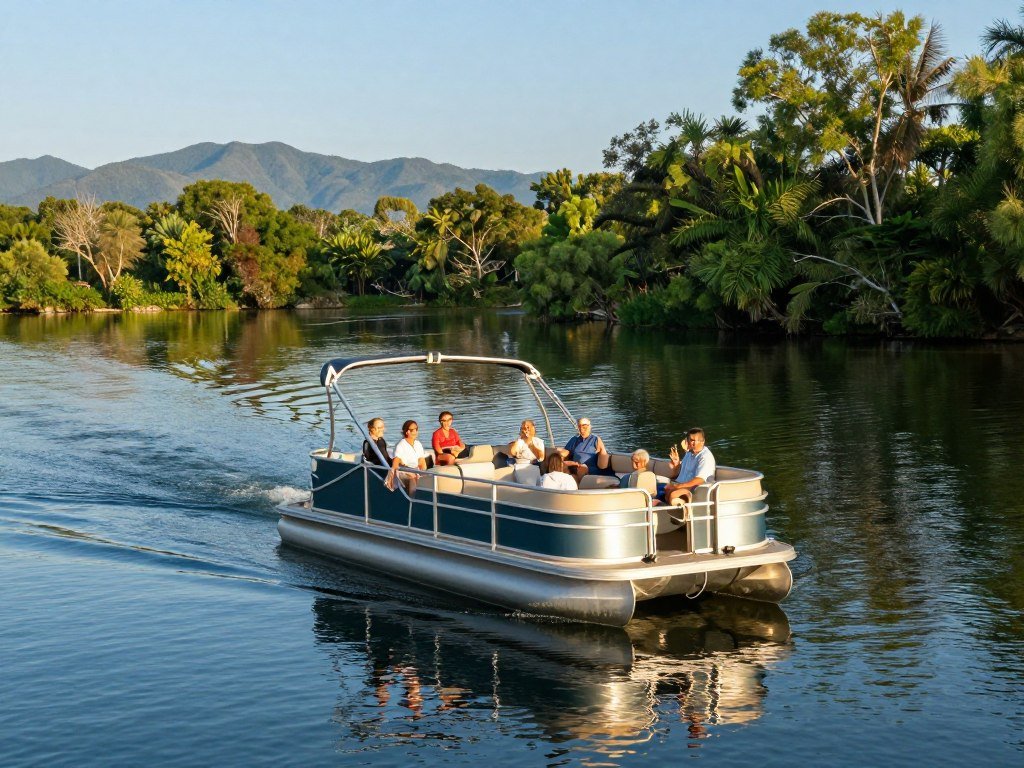
Twin tubes for calm, confined water
On small lakes and quiet rivers under 1,000 acres, 16-to-20-foot twin-tube pontoons suit narrow channels and shallow coves. Their size can make it easier to explore tight spots and pause for swimming.
For calm cruising, swimming and casual fishing, a twin-tube layout may meet your boating needs without adding a third tube. Still, compare the outboard and the boat’s intended use before choosing a setup.
When a tritoon makes sense
Large lakes and reservoirs of 1,000 acres or more can develop rough chop. On those waters, 22-to-27-foot pontoons, especially tritoons, offer more displacement and buoyancy.
A third tube can also support larger crews and watersports, depending on the model and power. It does not make a pontoon suitable for offshore use or every rough-water condition.
- Twin tubes: calm inland cruising and compact waters.
- Performance package: towing activities such as watersports.
- Tritoon: larger waters, heavier loads and added stability.
Consider how the boat will handle the conditions your family actually encounters, not just the most sheltered morning. Choose the tube setup around the roughest conditions you actually plan to boat in, not the most powerful setup on the showroom floor.
Which family features matter on a full day out?
A practical family layout makes it easy to sit together, move around and find the gear you need without turning the deck into a pile of bags. Look for useful space first, then judge which extras will earn their place on board.
Good seating, clear walkways, shade and easy-to-clean flooring support longer days more than a long list of gadgets. Two- and three-tube pontoons have high carrying capacity and rectangular layouts that make room for couches, lounges and movement.

Seating and room to move
Conversation seating lets family members face one another instead of sitting in separate rows. Check whether the seats leave a clear path between the bow, stern and swim ladder.
Children need space to move without cutting through a crowded seating area. A broad lounge may feel inviting at the dock, but it can limit room to walk once bags and coolers come aboard.
Try each seat and note where people will put their feet. A [guide to comfort, stability and accessories](https://reliablestartup.com/rental/right-kayaks-for-rentals/) can also help if your family is weighing kayaks for smaller outings.
Shade, storage and easy cleanup
Under-seat storage keeps towels and gear off the deck. A table helps with snacks and lunch, while cup holders prevent drinks from rolling around during a ride.
USB ports are handy for charging devices, but they matter less than a good place to sit and shade during a long outing. Shade can make a hot day easier, especially when the boat stays out for hours.
Non-slip flooring helps with wet feet, and a surface that cleans easily saves time after swimming or fishing. Prioritize the features your family will use on nearly every outing, rather than a long accessory list.
Best Pontoon Boats for Families 2025: Top Picks
For a compact, lower-cost family option, start with the Bass Buggy 16 XL Select; for more room, compare the SS210 and Party Barge 22 DLX. These models serve different needs, so compare space and layout as carefully as price.
The best pontoon boats for families 2025 for sale are the ones whose capacity and layout fit your household, not simply the lowest-priced model. The listed prices give you a first way to sort the options.

| Model | Stated price | Stated seating |
|---|---|---|
| Sun Tracker Bass Buggy 16 XL Select | $15,495 starting price | Up to 7 |
| Lowe SS210 | $32,995 starting price | Up to 11 |
| Sun Tracker Party Barge 22 DLX | $39,595 base price | 11 |
The 2025 Bass Buggy 16 XL Select starts at $15,495 and seats up to seven. Its standard 20 HP motor suits shoppers comparing a compact setup with a lower starting price.
The 2025 Lowe SS210 starts at $32,995 and seats up to 11 passengers. Its stated capacity gives larger families more room to compare, though seating arrangement still matters.
The Sun Tracker Party Barge 22 DLX has a $39,595 base price and seats 11. Its 24-foot-2-inch length can suit family cruising when you want more deck room for a shared day aboard.
The 2025 model starting prices are useful for an early comparison, not a promise that every boat has the same equipment. Compare what each configuration includes before deciding which one offers better value.
Starting prices can change with the selected equipment and setup. Treat listed starting prices as a first comparison point, then confirm the exact configuration and final price with a dealer.
What do affordable 2025 pontoon models cost?
A shopper comparing Bennington pontoon boats can use the 2025 20 SL as a starting point, then check what its chosen configuration includes. The model starts at around $22,500, giving you one point in the mid-$20,000 range.
The 2025 Lowe SF214 starts at about $26,500, while the Bennington 20 SL starts near $22,500. Those figures help you compare two different boats before reviewing the details of each build.
A starting price does not tell you the full value of a boat. The engine, included equipment, seating layout, warranty and delivery or setup terms can change what you receive.
Compare the same engine and equipment level across quotes. If one model includes more gear or a different outboard, its price is not a direct match to a less-equipped boat.
Ask how the seats are arranged and what storage comes with the selected version. A family may value a clear walkway or an extra lounge more than a small price gap.
Warranty terms also matter when you compare models. Check what the warranty covers and how long it lasts, then review delivery and setup charges as part of the offer.
The Bennington 20 SL is the priced 2025 model to use in this comparison. Compare the same engine and equipment level across quotes so a lower starting price does not disguise a different build.
Is the Sun Tracker Party Barge 22 DLX a good family value?
The Party Barge 22 DLX can be a good family value if its build and engine fit your usual outings. Families who want a larger cruising platform can look beyond the seating plan and check how the build and engine suit their typical outings.
Its performance figures depend on the optional Mercury 150 outboard, not every configuration. With that engine, the boat can reach 32 mph and reach 30 mph in under nine seconds.
Those speeds may suit families who want quicker runs between coves or plan to tow activities. Compare them with your real use, since calm cruising and frequent towing place different demands on an outboard.
At a cruising speed around 16 mph, the boat can exceed 130 miles of range from a 32.1-gallon tank. That range is a test result, not a promise for every load, route or throttle setting.
The logs are 24 inches in diameter, and the deck uses 3/4-inch treated plywood with marine-grade flooring. These construction details help you assess the platform beyond its seating plan.
The stated warranty runs 10 years bow-to-stern and lifetime on the hull and deck. Read the exact terms, since coverage can shape how much value a family gets over time.
Families should compare the performance setup with how they expect to use the boat. Ask the dealer to confirm whether the tested performance setup and warranty terms apply to the exact boat you are considering.
Which pontoon works best for family fishing?
The Forest River Dockside 20DF is the fishing-oriented choice, with dedicated fishing chairs, a livewell and a rod-holder station. If fishing is the main activity, a livewell, rod holders and casting seats can matter more than an extra lounge.
Its standard Suzuki 50 HP outboard and optional 90 HP offer two power choices. The boat starts at $25,999, measures 20 feet 10 inches and carries 10 passengers or 1,405 pounds.
The fishing equipment includes twin chairs, a livewell and a rod-holder station. A console graph is an option, which can help you plan a setup around how your family fishes.
Choose between the standard 50 HP and optional 90 HP based on the boat’s load and intended use. Dry weight is 1,915 pounds, a figure to consider separately from any loaded towing weight.
In reported test conditions, the Dockside cruised just under 15 mph at 6.7 mpg. Its reported 126-mile range came from a 21-gallon tank with a 10 percent reserve.
Those mileage and range figures describe test conditions, not a guarantee for each trip. Passengers, gear, weather and throttle can affect what you see on the water.
The fishing layout gives you dedicated places to cast and store equipment, yet it still needs room for the rest of the family. Check that the fishing stations leave enough clear seating and walking space for everyone who comes aboard.
Are Bayliner Element boats alternatives to pontoons?
Yes, Bayliner Element models are alternatives to pontoons, not pontoon boats. A Bayliner Element can be worth comparing if your family prefers a different hull and a more compact layout than a pontoon provides.
The 2025 Element M17 starts around $22,000 and seats up to six passengers. The 2025 Element E18 starts at $28,995, but its stated starting price alone does not show its passenger capacity.
The Element models have a different hull and layout from pontoons. A compact runabout-style boat can suit families who want a smaller setup, while a pontoon offers an open deck with lounge seating.
For the best family boat for the money, compare usable seating, gear space and included equipment at the same budget. A low starting price may not tell you how well a boat supports your usual day.
For the best family boat for a lake, think about what you plan to do there. A compact runabout-style layout and an open pontoon deck serve different needs, from shorter rides to relaxed group time.
Look at the seats and storage in person, then picture a full day aboard with your usual crew. Decide whether your family values open deck space or a more compact boat layout before comparing equipment.
What safety details should families check before buying?
A family-friendly boat should make safe movement and reboarding straightforward, not just provide more seats. Check the whole route from the dock to the seats, deck and swim ladder.
U.S. Coast Guard guidance calls for a wearable, properly fitting life jacket for each person aboard. Boats 16 feet and longer generally must carry a readily accessible throwable flotation device, subject to applicable exceptions.
Use this four-part check before you choose a layout:
- Life jackets: one wearable jacket that fits each passenger.
- Throwable device: readily accessible where required.
- Gates and railings: secure and easy to check before departure.
- Deck and ladder: non-slip flooring and easy access for swimmers.
A posted passenger rating is not permission to overload the boat. Children and older relatives may need extra help when boarding or moving across a wet deck.
Check whether gates close securely and whether the ladder can be reached without stepping over seats or gear. BoatU.S. Foundation’s capacity guidance also stresses sound boat condition and upkeep.
Before a test ride, locate the safety gear and ask the dealer to demonstrate the boarding ladder and gates.
Can you use a pontoon in salt water?
A pontoon can be used in some saltwater settings, but protected bays and rivers are a different proposition from an offshore trip. Pontoons suit intercoastal waters, bays and rivers, not trips 30 to 40 miles offshore.
Keep shore visible and use a pontoon in waves no larger than 3-4 feet. A triple-tube pontoon can add stability and help cut through chop for a smoother, drier ride.
| Saltwater consideration | Practical check | Limit or reason |
|---|---|---|
| Operating area | Bays, rivers and intercoastal waters | Not trips 30-40 miles offshore |
| Conditions | Keep shore visible | Waves no larger than 3-4 feet |
| Corrosion protection | Inspect zinc anodes and saltwater-suitable materials | Limit galvanic corrosion |
| After-use care | Rinse with fresh water and flush the outboard | Remove salt deposits |
Salt can harm metal parts through galvanic corrosion, so check the anodes and materials used on the boat. BoatUS corrosion care advice explains how anodes help shield other components.
Some pontoons use a solid keel and sealed lifting strakes to limit saltwater and marine-life buildup. Saltwater-ready seating may use aluminum bases and armrests or high-grade stainless steel.
Fresh-water rinsing helps limit galvanic corrosion, and the outboard needs a regular flush after saltwater use. Saltwater pontoon boats for sale should be judged by their corrosion protection and upkeep needs.
The best saltwater pontoon boats suit protected waters, not offshore travel. If your route requires leaving shore out of sight or entering waves above the stated limit, choose another plan for the day.
Can your vehicle tow the pontoon you want?
A boat that fits your family on the water still has to fit your vehicle’s tow rating and your storage space. Check both before choosing a model, since the boat’s listed weight may not include everything on the trailer.
A 16-to-20-foot pontoon typically has a dry weight of 1,500-2,500 pounds. Dry weight is not the same as total towing weight, which includes the boat, outboard, trailer and fuel.
A 22-to-27-foot tritoon’s total towing weight, including boat, motor, trailer and fuel, often exceeds 4,500-6,500 pounds. That loaded figure cannot be compared directly with a smaller boat’s dry weight.
Use the total loaded trailer weight when checking a tow vehicle’s limits. Include the motor, fuel and gear rather than relying on the boat’s dry weight alone.
Storage needs more room than the advertised deck length. Allow 2-3 feet beyond that length for a trimmed-up outboard and bow-light extensions.
Measure the garage or storage space with those extensions in mind. A boat that clears the door may still need extra length once its outboard is raised.
Verify the loaded trailer weight against the tow vehicle’s limits before buying or towing.
How should you compare the total cost of ownership?
A lower purchase price is only good value if the boat’s equipment, upkeep and storage fit your family’s budget. Compare the recurring costs as well as the amount due at the start.
Separate purchase price from recurring expenses
Size, brand, engine, materials and amenities all affect a pontoon’s price. Fuel, insurance, docking, storage and maintenance add costs throughout ownership.
Use a simple budget checklist before you compare boats:
- Purchase and setup.
- Fuel.
- Insurance and docking.
- Storage and maintenance.
Families weighing a boat against renting can review boat rental costs and upkeep as another way to think about use and expense.
The best saltwater pontoon boats for the money need more than an appealing price. Protected-water suitability, corrosion protection and regular upkeep all affect the value you get.
Check a used boat for saltwater wear
When comparing used saltwater pontoon boats for sale, inspect tubes, fittings, anodes and outboard condition. Ask to see maintenance records, which can help explain how the boat was cared for.
Look for wear or corrosion around metal parts and fittings, not just marks on the deck. A clean appearance does not replace a close inspection of areas exposed to salt.
Before committing to a used saltwater boat, have its corrosion-prone areas and outboard inspected by a qualified marine technician.
A marine technician can assess wear that is hard to judge during a quick walk-through. Make that inspection part of your decision before you commit to a used boat.
Conclusion
A good family choice balances comfortable space, the activities you enjoy most and the practical demands of owning the boat. The best fit supports your regular crew without exceeding your towing or upkeep limits.
Make a short must-have list, then arrange a hands-on comparison or test ride. Walk the deck, try the seats and picture the gear your family brings on a typical day.
Write down your usual crew size, top two activities and towing limit, then take that list to a dealer before choosing a model.
Conclusion
A good family choice balances comfortable space, the activities you enjoy most and the practical demands of owning the boat. The best fit supports your regular crew without exceeding your towing or upkeep limits.
A short list can keep a tempting layout or extra feature from steering you away from what your family needs. Test the space in person and see how the boat feels under way.
Write down your usual crew size, top two activities and towing limit, then take that list to a dealer before choosing a model.
FAQ
How much horsepower should a family pontoon have?
Match horsepower to the boat’s rated capacity, loaded weight and intended use. Calm cruising needs less power than towing watersports, which calls for an outboard suited to the added pull. A full crew and heavy gear also affect performance. Check the boat maker’s guidance and capacity plate before choosing an engine or towing activity.
Can a pontoon pull a tube?
Yes, a pontoon can pull a tube if the boat, engine and tow point are rated for that activity. Check the capacity plate and the maker’s guidance before towing. The setup must suit the people and gear aboard, as well as the tow load. Follow the boat’s operating directions and keep a spotter aboard to watch the rider.
Is a pontoon safe for young children?
Yes, a pontoon can be safe for young children when adults supervise them closely and use properly fitting life jackets. Check the gates, railings and ladder before leaving the dock. Set clear rules about where children may move, and keep them away from the swim area unless an adult is helping. Stay alert whenever the boat is moving.
How often should you rinse a pontoon after saltwater use?
Rinse the pontoon with fresh water after each saltwater outing, and flush the outboard regularly. Salt left on metal parts can contribute to corrosion, so pay attention to fittings and exposed components. Follow the engine maker’s flushing directions. Regular care also gives you a chance to spot damage or worn parts before the next trip.
Is a Bayliner Element a pontoon boat?
No, the Bayliner Element M17 and E18 are alternatives to pontoons, not pontoon boats. They use a different hull and layout. The M17 starts around $22,000 and seats up to six passengers, while the E18 starts at $28,995. Compare their compact layout with the open deck and lounge seating common on pontoons.
What costs should I budget for besides a pontoon’s purchase price?
Budget for fuel, insurance, docking, storage and maintenance, along with the engine and equipment configuration. Setup costs can also affect what you pay at the start. Larger boats and more powerful outboards can change fuel and storage needs. Compare these costs with how often your family expects to go boating before choosing a model.
About The Author